


Gold Turquoise Pendant
When you search for a gold turquoise pendant, you enter a world of sentimental Victorian hearts, delicate Edwardian lavaliers and fluid Art Nouveau motifs.
Gold Turquoise Pendant
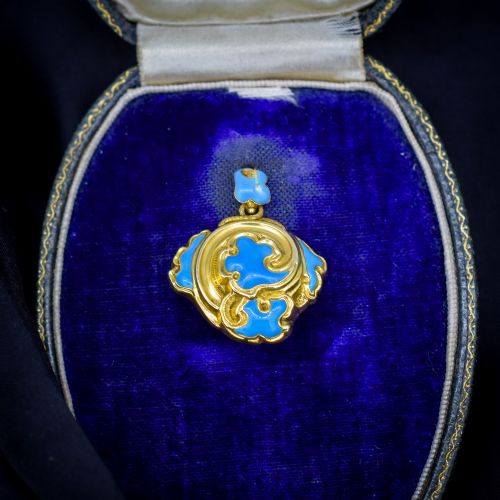
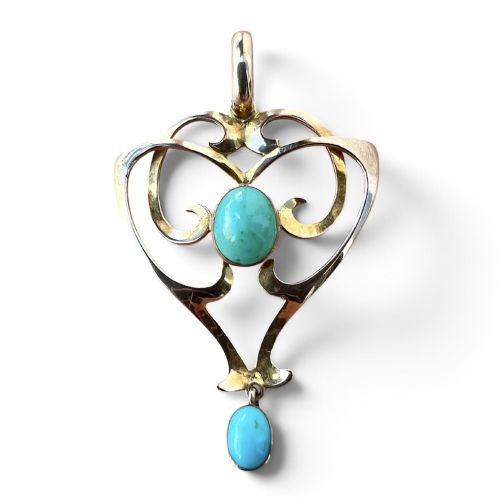
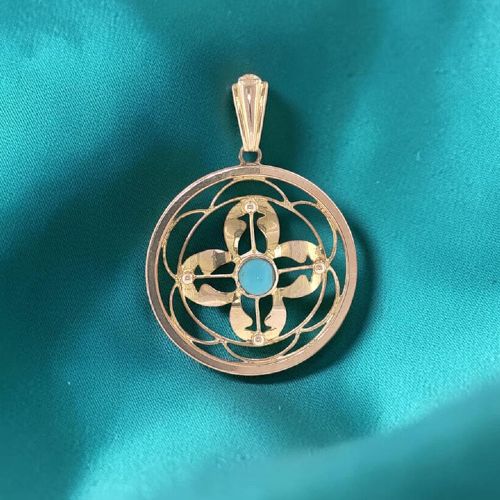
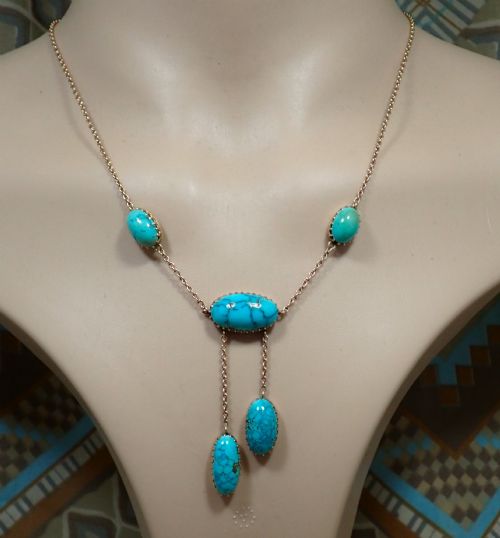
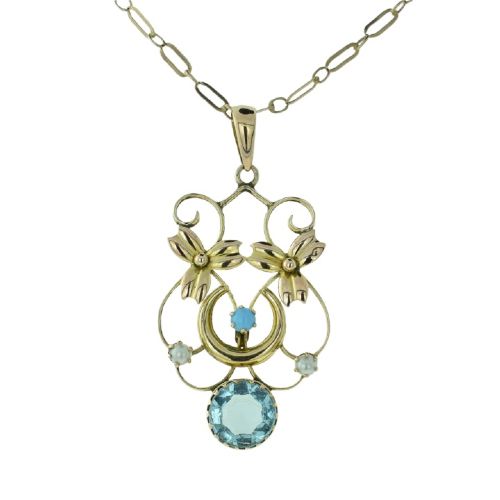
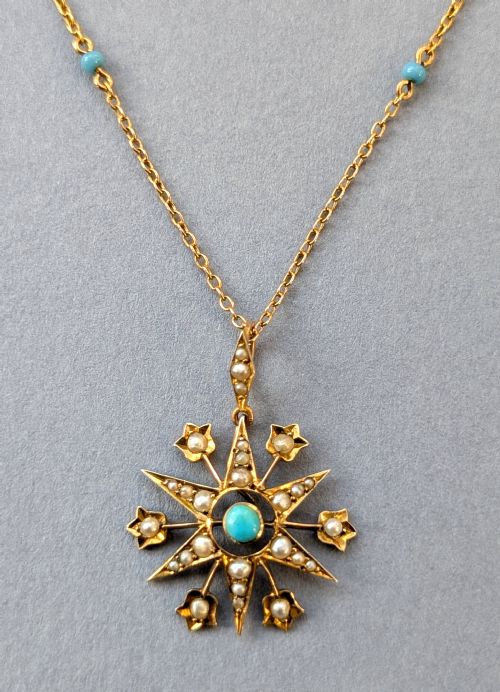
A gold turquoise pendant brings together vibrant blue cabochons and warm yellow or rose gold, often taking the form of hearts, stars, crosses, or romantic floral clusters. These ornaments frequently double as lockets or brooches, reflecting the versatile jewellery design of the nineteenth and early twentieth centuries.
The pieces on this page are dominated by Victorian and Edwardian examples, alongside pieces from the Art Nouveau and Arts and Crafts movements. Buyers most commonly encounter 9ct and 15ct gold settings paired with seed pearls, diamonds, and natural turquoise stones.
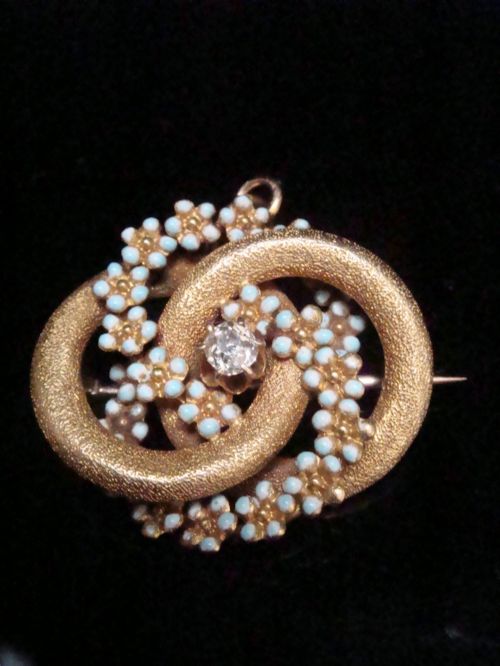
Design vocabulary ranges from Etruscan Revival granulation to flowing linear motifs and symmetrical negligee necklaces. Symbolic elements like forget-me-nots, doves, and lovers' knots appear repeatedly across the selection.
Materials and Technique
Craftsmen built these pendants using varying purities of gold, predominantly 9ct, 15ct, and 18ct, sometimes combining silver settings for diamond work to enhance the brilliance of the stones. Metalworking techniques span hollow puff hearts, delicate wirework, filigree, and cast Etruscan revival details.
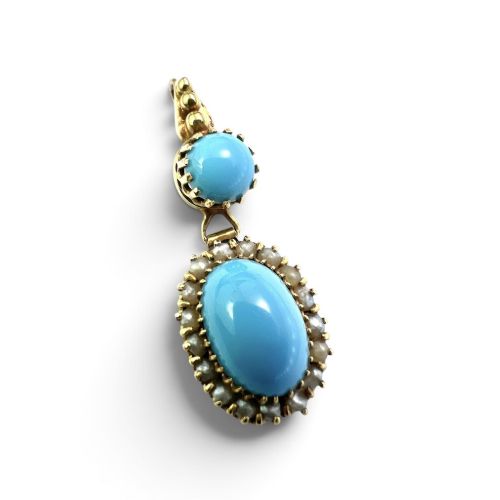
Turquoise stones are typically set en cabochon, ranging from matrix-rich natural turquoise to smooth robin's-egg blue gems. Seed pearls and occasionally diamonds or blue topaz provide accent work, secured in claw or collet settings alongside enamel details.
Gold Turquoise Pendant Retail Price Guide 2026
Typical asking prices for gold turquoise pendant among the pieces listed under this phrase on Sellingantiques today, from the lower quarter to the upper quarter. They describe what is for sale here now, not the wider market.
Some lockets hide tiny woven locks of hair behind glass, holding centuries of personal history close to the chest.
Judging Quality
Quality rests upon the weight and carat of the gold, with higher carat yellow and rose gold settings offering a richer warmth. The intricacy of the metalwork, such as fine wire granulation or hand-engraved foliage, distinguishes superior workshop production.
Deakin & Francis·Murrle Bennett & Co·Dorrie Nossiter
The Gold Turquoise Pendant Glossary
- Cabochon
- A gemstone shaped and polished with a smooth, rounded dome rather than faceted edges. This cut highlights the natural colour and opacity of turquoise.
- Negligee necklace
- A delicate pendant style featuring asymmetric drops suspended on short lengths of chain from a central motif. It became especially popular during the Edwardian period.
- Etruscan Revival
- A Victorian design movement inspired by ancient archaeological discoveries, characterised by applied wirework and granular gold decoration.
- Seed pearl
- A very small, naturally occurring pearl, often drilled and threaded or glued in clusters around central turquoise stones.
- Lavalier
- A dangling pendant suspended from a chain, featuring one or more swinging drops that became fashionable in the early twentieth century.
Gold Turquoise Pendant: Frequently Asked Questions
What periods do these pendants come from?
The available pieces span from the Georgian era through the Victorian and Edwardian periods into the early twentieth century, including Arts and Crafts and Art Nouveau designs.
Victorian and Edwardian examples make up the vast majority of the selection, showcasing sentimental and naturalistic motifs.
Were these always worn as pendants?
Many of these pieces were manufactured with dual purposes in mind, functioning simultaneously as pendants and brooches through the inclusion of a pin and a hidden loop.
Others incorporate locket compartments at the back designed to hold miniature portraits or locks of hair.
What gold purities should I expect?
The gold used in these items varies from 9ct and 15ct up to 18ct yellow and rose gold, alongside occasional silver and gold combinations.
Higher carat 15ct and 18ct gold pieces are frequently encountered alongside standard 9ct offerings from the later Victorian and Edwardian periods.
What stones accompany the turquoise?
Seed pearls are the most frequent companion to turquoise, often arranged in floral halos or starburst patterns around the central blue stone.
Diamonds, blue topaz, and enamel work also appear as accent materials in specific Arts and Crafts and mourning pieces.