
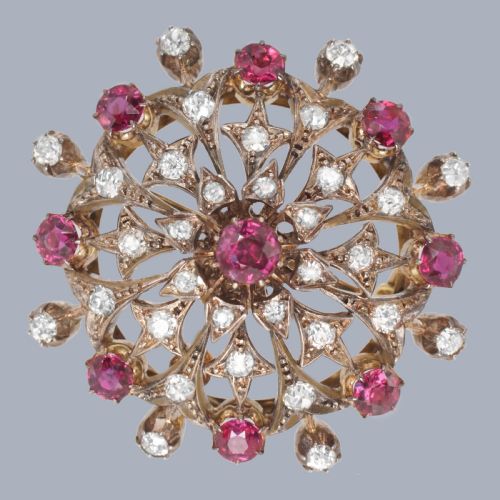


Gold Starburst Pendant
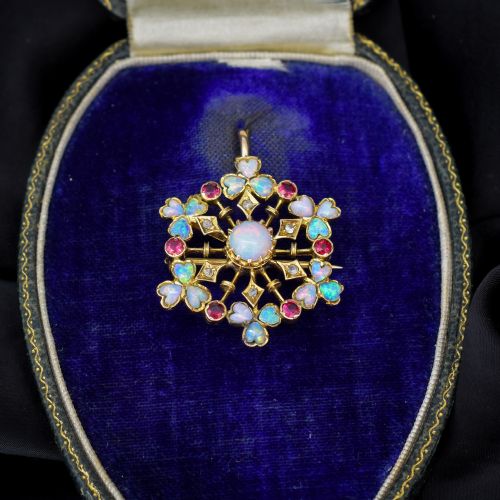
A gold starburst pendant captures the celestial romance of Victorian and Edwardian design, bringing fiery diamonds and lustrous pearls to the neckline.
Gold Starburst Pendant
A gold starburst pendant embodies the enduring fascination with celestial motifs, taking the form of multi-pointed radiant stars designed to catch the light. When you search for a gold starburst pendant, you encounter pieces that span the Victorian and Edwardian eras through to mid-century modern revivals.
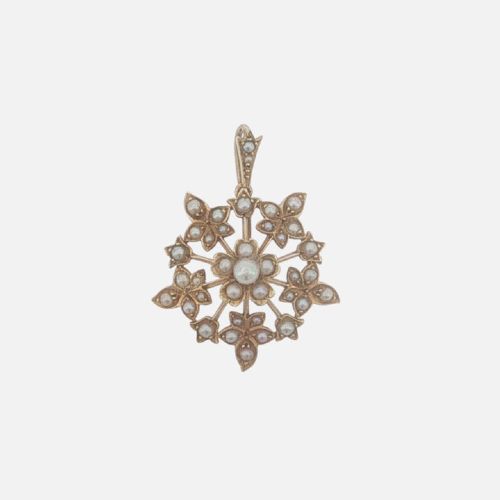
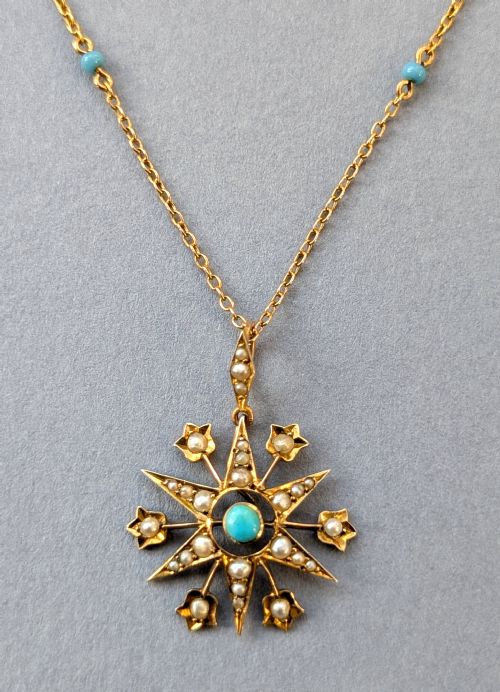
These ornaments frequently double as brooches, possessing integrated pin mechanisms and hidden bails on the reverse to allow versatile wear as both necklaces and dress ornaments. The prevailing versions met on this page combine yellow gold settings with old-cut diamonds, seed pearls, or turquoise stones arranged in symmetrical ray patterns.
How they were made
Goldsmiths constructed these pieces utilising various carats of yellow gold, frequently combining silver-topped gold settings in nineteenth-century examples to enhance the brilliance of old-cut diamonds. Stones were secured using delicate claw settings, grain settings, or closed-back foil linings depending on the period.
Seed pearls and turquoise cabochons were meticulously drilled and pegged or glued onto gold wire frames to form the shimmering points of celestial motifs. Articulation was often engineered into rays and central clusters to create subtle movement when worn.
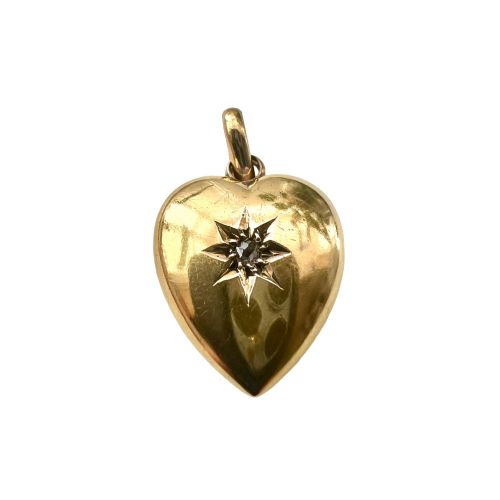
Some Victorian stars hide secret locket compartments behind their radiant faces, keeping locks of hair close to the heart.
What varies in quality
The distinction between tiers rests upon the precision of the stone-setting and the weight of the gold utilised in the foundational frame. Master goldsmiths achieved razor-sharp symmetry in the graduating rays, ensuring each diamond or pearl is held securely without excessive metal obscuring the gem.
The integration of convertible mechanisms also dictates distinction, where a hidden bail and a sturdy pin hinge operate seamlessly without compromising the clean silhouette of the starburst design.
Hirsch & Oppenheimer
The Gold Starburst Pendant Glossary
- Old-cut diamond
- A hand-cut diamond shape popular before modern machinery, characterised by a smaller table, higher crown, and deep pavilion that produces a warm candlelight sparkle. These stones define the authentic look of nineteenth-century celestial jewellery.
- Seed pearl
- A very small, naturally formed or cultured pearl used extensively in cluster and starburst arrangements during the Victorian and Edwardian periods. They are typically threaded on silk or pegged individually to gold stems.
- Convertible brooch pendant
- An item of jewellery designed with both a pin fitting and a suspension loop, allowing the wearer to attach it to a chain or pin it directly to fabric. This dual functionality was highly popular for high-value nineteenth-century pieces.
- Silver-topped gold
- A historical manufacturing technique where a thin layer of silver is soldered to the front of a gold mount, allowing diamonds to be set in white metal while the back remains warm yellow gold. It prevents tarnish from contacting clothing while enhancing diamond brilliance.
- Turquoise cabochon
- A smooth, rounded, non-faceted gemstone cut with a convex surface, frequently utilised in Victorian star clusters to provide a vibrant robin-egg blue contrast against yellow gold.
Gold Starburst Pendant: Frequently Asked Questions
How do I wear a convertible brooch pendant?
These versatile pieces feature a fold-down or detachable loop called a bail through which a gold chain is threaded.
When you wish to wear the piece as a brooch, simply tuck the chain away and secure the hinged pin on the reverse to your garment.
What stones are typically found in these stars?
Old-cut diamonds and seed pearls dominate the surviving examples, often accompanied by turquoise, garnets, or peridots.
Diamonds provide the brilliant sparkle for the central points, while pearls offer a soft, iridescent contrast.
How can I tell the period of a star pendant?
Victorian pieces often employ silver-topped gold settings for diamonds and feature high-carat yellow gold backs with intricate hand-engraving.
Edwardian and later iterations show lighter openwork galleries and stamped hallmarks indicating specific assay offices and purity.