


Gold Star Pendant Necklace
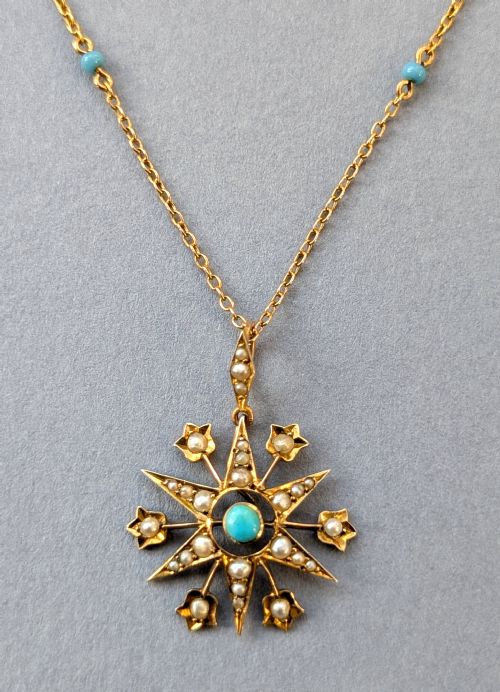
A gold star pendant necklace catches the light with celestial brilliance, spanning periods from Victorian to Mid-Century.
Gold Star Pendant Necklace
A gold star pendant necklace combines celestial motifs with precious metals, drawing collectors through distinct historical eras. When searching for a gold star pendant necklace, buyers encounter pieces configured as pendants, necklaces, pendant brooches, and charms. These items appear across Victorian, Edwardian, Art Deco, and Mid-Century periods, reflecting shifting tastes in jewellery design.
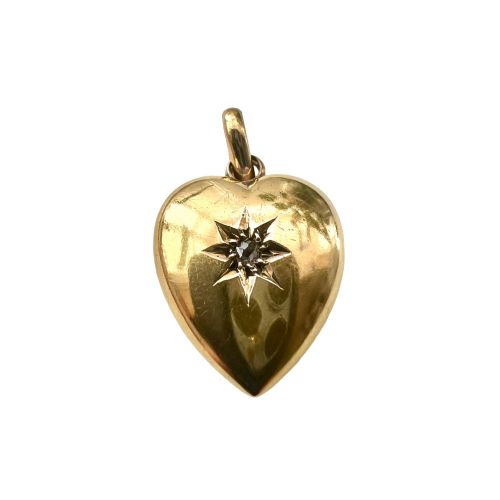
The materials paired with gold in these listings include diamond, seed pearl, turquoise, ruby, sapphire, peridot, garnet, opal, emerald, and red rock crystal. Many items function as convertible pieces, operating simultaneously as pendants and brooches. The forms range from simple single-stone stars to elaborate starbursts set with multiple gemstones.
Materials and construction
The base metal of these pieces spans 9ct gold, 12ct gold, 14ct gold, 15ct gold, 18ct gold, and white gold, often paired with yellow gold settings. Goldsmiths mounted old-cut diamonds, seed pearls, and coloured gems directly onto the gold star frames using claw or flush settings. Many Victorian and Edwardian examples utilise hollow or puffy heart and star constructions to create volume without excessive weight.
Techniques varied from delicate seed pearl clustering to heavy casting and hand-finishing seen in later zodiac charms and fringe drops. Jewelers integrated hinged bails and pin stems, allowing a single ornament to transition between a necklace pendant and a lapel brooch.
Some stars double as puffy hearts, ensuring your chest carries both literal and emotional gravity.
Assessing quality and execution
Quality rests in the precision of the stone setting and the carat weight of the gold utilised by the maker. Higher-tier examples display well-matched diamonds and natural seed pearls secured tightly within substantial 15ct or 18ct gold frames. Lower tiers often rely on lighter 9ct gold and simpler stamped mounts with synthetic or lesser-grade stones.
The intricacy of the starburst design and the presence of hallmarks or maker stamps elevate a piece. Finer items exhibit hand-carved details, symmetrical stone arrangements, and convertible mounts that function flawlessly as both pendants and brooches.
French Perroud·Hirsch & Oppenheimer
The Gold Star Pendant Necklace Glossary
- Starburst
- A motif featuring multiple rays emanating from a central stone or point, commonly seen in Victorian celestial jewellery. This design mimics the appearance of a glowing star in the night sky.
- Seed Pearl
- A very small, naturally occurring pearl, often drilled and threaded onto silk or wire. These tiny pearls form delicate floral and star patterns in Edwardian and Victorian pieces.
- Pendant Brooch
- A dual-purpose jewellery item fitted with both a loop for a chain and a pin with a safety catch. This versatility allowed owners to wear the piece pinned to clothing or suspended from a neck chain.
- Old-Cut Diamond
- A diamond cut prior to the development of the modern brilliant cut, typically featuring a small table and a high crown. These stones exhibit a distinctive, softer scintillation under candlelight.
- Hallmark
- An official stamp or marks pressed into precious metal indicating purity, origin, and maker. These marks help verify the age and gold carat of antique pieces.
Gold Star Pendant Necklace: Frequently Asked Questions
What periods do these necklaces span?
The listings include pieces from the Victorian and Edwardian eras, running through 1900, 1830, 1950, and 1960. These dates reflect changing aesthetic preferences over more than a century of jewellery production.
Victorian and Edwardian items often feature seed pearls and old-cut diamonds, while Mid-Century pieces introduce zodiac themes and white gold settings.
How do I wear a pendant brooch?
A pendant brooch includes a hidden or fold-down loop alongside a secure pin backing. You can thread a chain through the bail to wear it as a necklace or fasten the pin to a lapel.
This dual functionality was popular in the nineteenth century, allowing a single precious item to serve multiple styling purposes.
What is the difference between seed pearl and diamond stars?
Seed pearl stars utilise tiny organic pearls arranged in clusters or borders around a central mount. Diamond stars feature faceted stones set in gold or silver-on-gold to maximise brilliance.
Both styles were popular during the celestial revival periods of the late nineteenth and early twentieth centuries.
Are these items marked with gold carats?
Many pieces carry stamps indicating gold purity, ranging from 9ct and 14ct up to 15ct and 18ct yellow or white gold. Some antique items rely on traditional hallmarking systems specific to their manufacturing decade.
Testing and maker marks help confirm the composition of older jewellery where stamps may have worn away.