
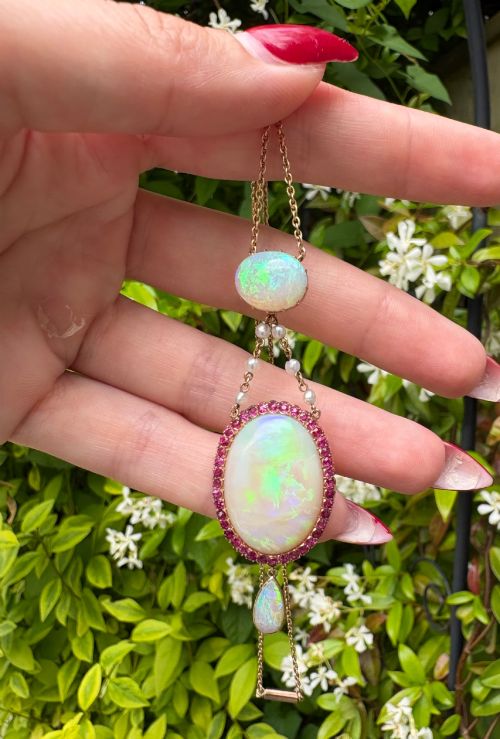


Antique Pearl Cluster Pendant
An antique pearl cluster pendant gathers lustrous pearls into tight floral or geometric arrangements, offering enduring grace and delicate historic charm.
Antique Pearl Cluster Pendant
An antique pearl cluster pendant centres on luminous pearls arranged tightly in floral, star, or geometric formations, often accompanied by contrasting gemstones. Buyers searching for an antique pearl cluster pendant typically encounter pieces originating from the Victorian and Edwardian eras, alongside later Art Deco and mid-century interpretations.
The evidence shows these jewels frequently double as brooches, presenting versatile mounting options with integrated loops or pin stems. Materials span from seed pearls and natural pearls paired with gold, platinum, and rose gold, to combinations incorporating diamonds, rubies, garnets, amethyst, peridot, sodalite, turquoise, and sapphires.
Forms include dedicated pendants, lockets with cluster borders, and pieces belonging to larger parure sets alongside matching earrings. The prevailing aesthetic relies on concentric or floral clusters where the central stone or pearl commands attention, ringed by smaller pearls.
How they were made
Maker techniques rely heavily on combining high carat gold, such as 15ct and 18ct, with platinum in later pieces to securely set delicate seed pearls and larger gems. Stones are frequently mounted in closed or open back settings, utilising rose cut diamonds and intricate wirework to support clustered arrangements.
Enamel work and detailed gold casting appear in period examples, particularly when forming heart shaped lockets or starburst motifs. Metal components are shaped by hand, soldering pin mechanisms and suspension loops directly onto the reverse of the cluster frame.
Antique Pearl Cluster Pendant Retail Price Guide 2026
Typical asking prices for pearl cluster pendant among the pieces listed under this phrase on Sellingantiques today, from the lower quarter to the upper quarter. They describe what is for sale here now, not the wider market.
Some Victorian hearts twist with romantic melancholy into witches heart shapes, surrounded by tiny seed pearls.
What varies in quality
Quality separates by the uniformity, orient, and matching of the pearls utilised in the cluster, alongside the presence of rarer precious stones like diamonds, rubies, or natural turquoise. Finer examples display meticulous claw or bezel work that holds each seed pearl securely without crowding the central motif.
The weight and purity of the gold, moving from 9ct up to verified 15ct and 18ct or platinum, dictates the intrinsic calibre of the mounting. Structural integrity where the pendant bale meets the main cluster also distinguishes superior execution from simpler production.
The Antique Pearl Cluster Pendant Glossary
- Seed pearl
- A very small, naturally formed or cultured pearl, often un-drilled or half-drilled, used densely in clusters during the Victorian and Edwardian periods.
- Parure
- A matched set of jewellery intended to be worn together, which in the evidence includes earrings and pendants forming a unified suite.
- Rose cut
- An antique diamond cut featuring a flat base and a domed crown composed of triangular facets, common in eighteenth and nineteenth-century cluster settings.
- Locket
- A hinged pendant designed to hold a miniature portrait or lock of hair, frequently ornamented with a pearl cluster border on the cover.
- Witches heart
- A specific heart-shaped motif with an asymmetrical, twisted tail, seen in Edwardian pendant designs incorporating pearls and coloured stones.
Antique Pearl Cluster Pendant: Frequently Asked Questions
What periods do these pendants come from?
The available evidence points primarily to the Victorian and Edwardian eras, with occasional pieces extending into the 1930s Art Deco period and the 1960s.
These varied decades bring distinct stylistic markers, from romantic floral clusters to geometric platinum mountings.
How were these pendants worn historically?
Many examples function as both pendants and brooches, offering historic versatility through integrated folding loops and pin stems.
Owners pinned them directly to garments or suspended them from delicate gold chains around the neck.
What gemstones accompany the pearls?
The listings show pearls paired with diamonds, rubies, garnets, amethysts, peridots, sapphires, turquoise, and sodalite.
These coloured stones act as focal centres or contrasting accents within the surrounding pearl cluster.
Are these pieces made of solid gold?
The recorded metal purities include 9ct, 14ct, 15ct, and 18ct yellow and rose gold, alongside platinum.
Some items feature specific hallmarks or professional testing notes confirming the gold standard.