



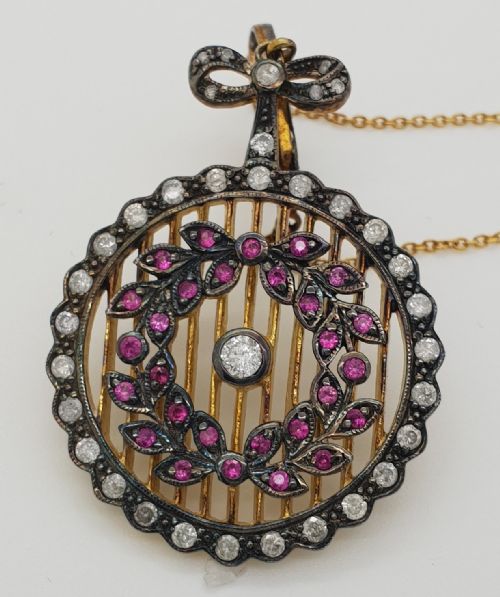


Gold Ruby Necklace
When you search for a gold ruby necklace, you are looking at centuries of craftsmanship where rich red corundum meets yellow and white precious metals.
Gold Ruby Necklace
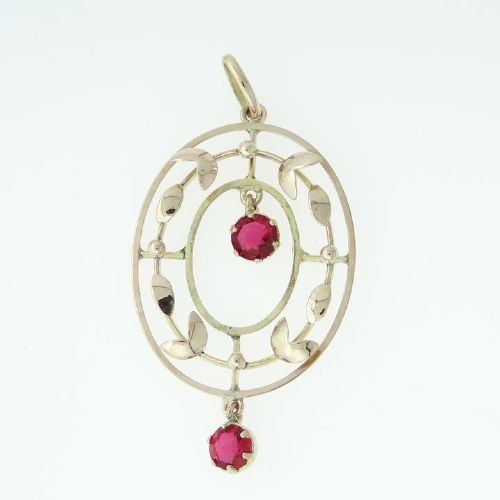
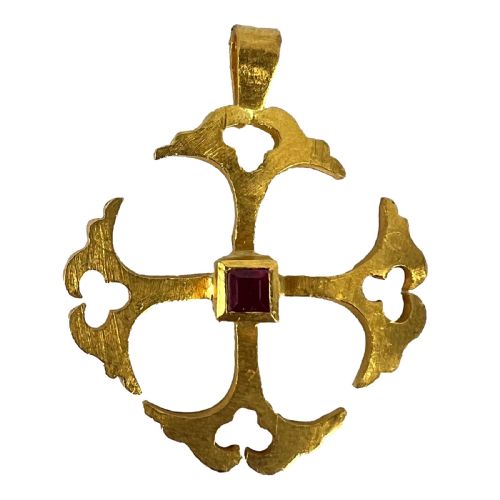
A gold ruby necklace combines the deep crimson tones of ruby with settings forged from various purities of gold, ranging from nine carat to twenty-four carat. These pieces span the nineteenth century through the Victorian and Edwardian eras into mid-century modern designs.
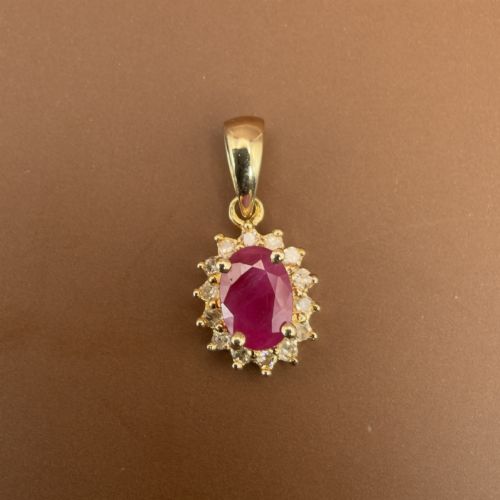
You will frequently encounter cluster pendants, floral motifs, and snake designs suspended from fine chains or integrated into riviere collars. Many examples function as both pendants and brooches, offering versatile wearability characteristic of period jewellery.
The aesthetic shifts from the romantic symbolism of Victorian heart and serpent motifs to the delicate filigree and platinum accents of the Edwardian period. Mid-century items often present bolder gold work alongside geometric diamond and ruby arrangements.
Materials and construction
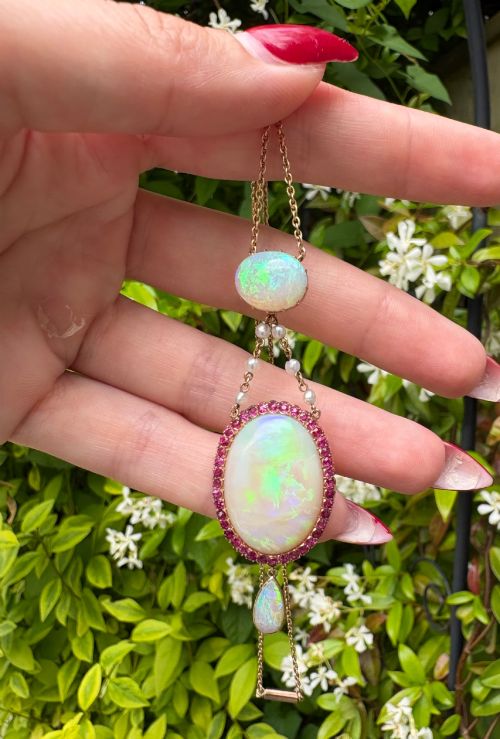
Goldsmiths utilised yellow gold, rose gold, and white gold, alongside platinum in Edwardian mountings, to secure rubies alongside diamonds, pearls, opals, and sapphires. Stones appear in oval cuts, pear cuts, and rose cuts, held by claw settings or closed-back foils in older pieces.
Construction techniques include casting, hand-bezeling, and delicate wirework for seed pearl clusters. Many Victorian and Edwardian necklaces integrate convertible elements allowing a pendant to detach and function as a brooch.
Several Victorian and Edwardian necklaces depict serpents, dragonflies, and flower vases with ruby eyes keeping watch over the wearer.
Assessing quality in period pieces
Quality rests on the saturation and clarity of the rubies, the precision of the stone cutting, and the integrity of the gold setting. Superior examples display well-matched rubies with vibrant colour and minimal inclusions, securely mounted without excess solder.
The refinement of the metalwork distinguishes finer items, particularly in Edwardian platinum-topped gold and Victorian chased elements. Original fitted components, intact seed pearls, and legible hallmarks elevate the standing of a piece.
The Gold Ruby Necklace Glossary
- Riviere necklace
- A continuous line of gemstones of uniform cut and graduated size, linked closely together.
- Cluster pendant
- A central gemstone surrounded by a border of smaller accent stones, typically diamonds or pearls.
- Seed pearl
- Very small natural or cultured pearls, frequently drilled and strung on silk or wired in floral clusters.
- Rose cut
- An antique stone cut featuring a flat base and a domed crown with triangular facets.
Gold Ruby Necklace: Frequently Asked Questions
How do I date a gold ruby necklace?
Dating relies on stylistic clues such as the presence of platinum-topped gold for Edwardian pieces or heavy yellow gold casting for mid-century items. Hallmarks and maker's marks also provide specific chronological markers.
Construction methods further aid identification, as closed-back settings and rose-cut diamonds typically point to nineteenth-century manufacture.
Can these necklaces be worn daily?
Many vintage and antique gold ruby necklaces withstand regular wear if handled with care, particularly sturdier nine-carat or eighteen-carat gold settings. Delicate Edwardian pieces with seed pearls require more cautious handling.
Removing the jewellery before swimming, sleeping, or engaging in rigorous physical activity preserves the security of the stones and the integrity of the chain.
Are the rubies in these necklaces natural?
Period pieces frequently incorporate natural rubies, sometimes originating from Burma, alongside historical alternatives like red paste or simulated stones in specific items. Gemmological testing confirms stone origin and treatment status.
Listings specify details such as Burmese origin or simulated materials where documented by testing or certification.