


Gold Porcelain Demitasse Cups
Gold porcelain demitasse cups are small vessels for dark coffee, prized for their rich gilding and delicate ceramic bodies.
Gold Porcelain Demitasse Cups
When you search for gold porcelain demitasse cups, you encounter small after-dinner coffee vessels alongside larger teacups and complete coffee services. These items span periods from the Georgian and Regency eras through the Victorian, Edwardian, and early twentieth century.
The forms range from miniature cabinet cups and pedestal cups to cased sets and coffee cans with saucers. Many pieces originate from traditional English potteries and continental European manufactories, reflecting distinct regional tastes in ceramics.
Styles on this page cover French Empire, Rococo Revival, and Neoclassical designs, as well as English Revival and traditional British decoration. Buyers select these objects for their combination of small scale and elaborate metallic ornamentation.
Materials and manufacture
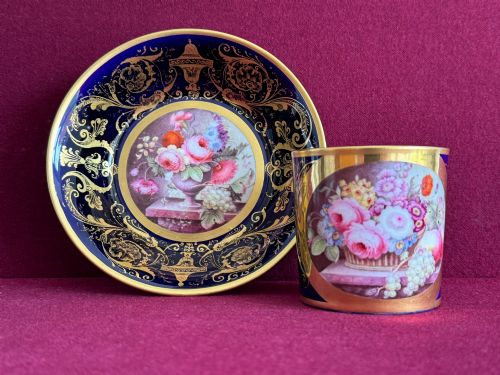
These pieces utilise hard-paste porcelain, bone china, and standard porcelain bodies as the structural foundation for the ceramic forms. Makers then applied gold leaf, gold gilt, and heavy gilding to accent handles, rims, and exterior surfaces.
Hand-painted enamel decoration often complements the metallic highlights, creating intricate visual patterns across the coffee cups and saucers. Certain items feature specialised techniques such as hand-painting executed by named decorators on porcelain bodies.
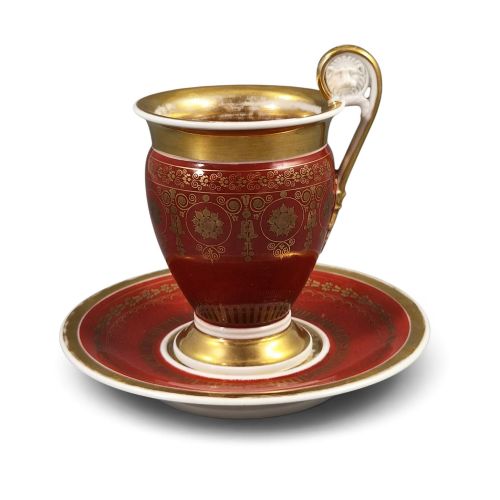
Lion masks peer from porcelain handles while tiny pedestal cups wait for very small sips of strong coffee.
Evaluating quality and execution
The standard of a piece rests upon the precision of the hand-painting and the thickness and purity of the gold gilding applied to the porcelain. Finer examples display crisp modelling in forms such as lion mask handles or pedestal bases, alongside well-preserved enamel colours.
Maker attribution and the presence of documented artists elevate the standing of individual items within the broader range of ceramic production.
Royal Worcester·Coalport·Minton·KPM Berlin·Hutschenreuther Saxonia·Hirsch Dresden·Spode Copeland
The Gold Porcelain Demitasse Cups Glossary
- Demitasse
- A small cup used for serving strong black coffee after a meal. The name translates from French as half cup.
- Hard-Paste Porcelain
- A durable ceramic composition fired at very high temperatures, made from kaolin and petuntse. It creates a dense, vitreous body resistant to scratching.
- Gilding
- The application of gold leaf or powdered gold onto the surface of porcelain. It provides the characteristic metallic sheen seen on these cups and saucers.
- Coffee Can
- A straight-sided cylindrical cup designed specifically for drinking coffee during the eighteenth and nineteenth centuries. It typically lacks the flaring rim found on traditional teacups.
- Enamel
- Vitreous coloured glass fused to the porcelain surface through firing. It supplies the vibrant pigments used in hand-painted floral or figural motifs.
Gold Porcelain Demitasse Cups: Frequently Asked Questions
What is the difference between a teacup and a demitasse cup?
A demitasse cup is significantly smaller in capacity, designed specifically to hold strong espresso or black coffee rather than tea.
They often feature narrower, more cylindrical bodies, such as coffee cans, paired with matching saucers.
How do I identify the period of a gold porcelain cup?
Dating relies on stylistic clues like Regency neoclassical forms, Victorian revival motifs, or early twentieth-century shapes.
Maker marks stamped or painted on the underside provide the most precise indication of origin and date.
Can I use antique demitasse cups for daily coffee?
While structurally sound, antique porcelain and delicate gold gilding require careful handling and gentle hand washing.
Many collectors prefer to display these fragile items in cabinets or use them sparingly for special occasions.
Why do some cups feature lion mask handles?
Lion mask handles and classical motifs were popular decorative elements during the French Empire and Georgian periods.
These sculptural details reflect the influence of neoclassical design on European and British porcelain manufacture.