
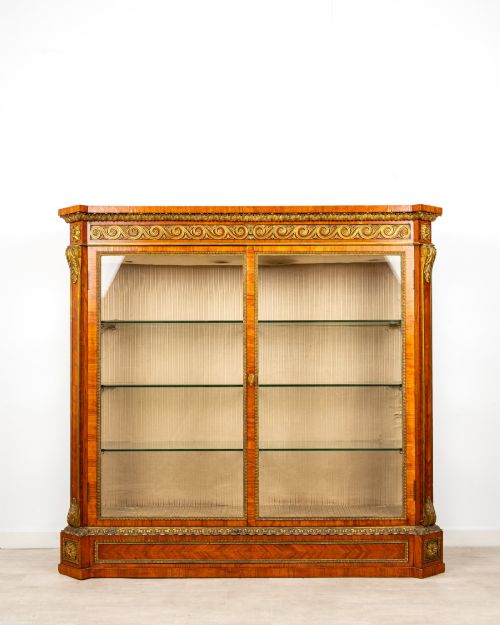


Gold Mounted Display Cabinet
A gold mounted display cabinet brings French and Victorian elegance to a room, holding precious objects behind glass.
Gold Mounted Display Cabinet
A gold mounted display cabinet groups together refined pieces from the nineteenth century, including Victorian examples and French revival forms like the credenza and pier cabinet.
These items range from walnut and kingwood vitrines to ebonised side cabinets, often paired with glass panels for showing collections.
The selection here draws primarily upon Victorian and French Napoleon III designs, uniting gilt bronze mounts with rich timbers.
Materials and construction
Cabinet makers utilised dense hardwoods such as walnut, kingwood and ebonised timber as a dark foundation for intricate marquetry and tortoiseshell inlay.
Ormolu and gilt bronze mounts were cast and applied to corners, borders and door frames, providing metallic contrast against the polished wood.
Interior shelving is typically enclosed by glazed doors, sometimes accompanied by velvet linings and porcelain plaques.
One listed key cupboard once served night porters, proving that even the most elaborate gilt furniture occasionally had a purely practical night job.
Judging quality in these cabinets
Quality rests in the crispness of the ormolu casting and the precision of the marquetry or Boullework set into the carcass.
Finer examples display superior timber selection, such as figured walnut or rich kingwood, combined with heavier, more detailed gilt bronze mounts rather than pressed brass.
Exhibition pieces often integrate hand-painted porcelain plaques or Vernis Martin panels, distinguishing them from standard production items.
H. J. Hatfield & Sons·Francois Linke
The Gold Mounted Display Cabinet Glossary
- Ormolu
- Gilded bronze used for decorative mounts on furniture. It provides a bright golden surface that highlights the contours of a cabinet.
- Boullework
- Marquetry technique utilising tortoiseshell and brass inlaid in intricate patterns. Named after the French cabinet maker André-Charles Boulle.
- Vitrine
- A glass-fronted cabinet designed for displaying fine objects and porcelain. These pieces often feature glazed sides to maximise light.
- Pier cabinet
- A narrow cabinet built to fit the wall space between windows. Victorian examples frequently employ ebonised wood and gilt bronze.
- Credenza
- A low cabinet, often fitted with doors and central display sections. Nineteenth-century versions frequently incorporate porcelain panels and extensive ormolu.
Gold Mounted Display Cabinet: Frequently Asked Questions
Where should I place a display cabinet?
These cabinets suit reception rooms and drawing rooms where natural light can strike the glass panels and gilt bronze mounts.
Ensure the floor is level so the doors hang correctly and close smoothly against the frame.
How do I care for ormolu mounts?
Dust the gilt bronze gently with a soft, dry brush to prevent dirt accumulation in the recessed areas of the casting.
Avoid chemical polishes entirely, as they strip the original gilding from the bronze.
What is Boullework?
Boullework is a decorative inlay technique combining brass and tortoiseshell, creating elaborate patterns across the surface of the wood.
It requires stable indoor humidity to prevent the delicate materials from lifting over time.
How do I distinguish French and Victorian styles?
French pieces often draw on Louis XV or Napoleon III revival designs featuring serpentine curves and extensive ormolu.
Victorian cabinets tend to utilise figured walnut with restrained marquetry and classical proportions.