




Gold Marble Mantel Clock
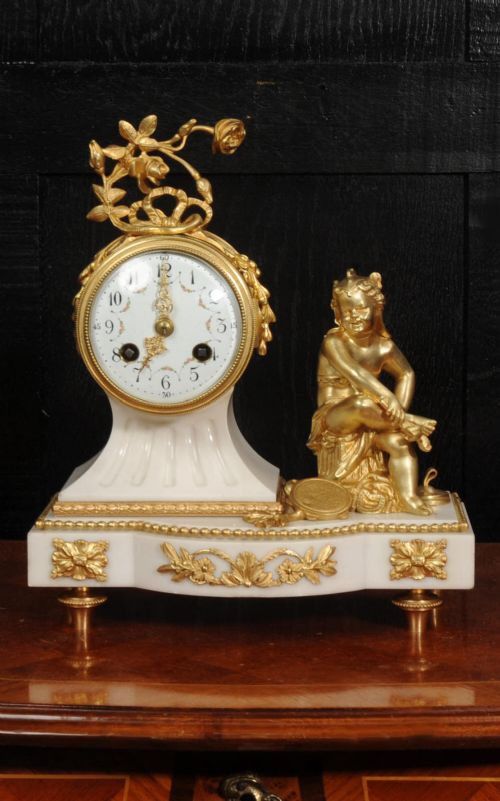
A gold marble mantel clock brings together heavy stone and cast gilt bronze to anchor a room with architectural presence.
Gold Marble Mantel Clock
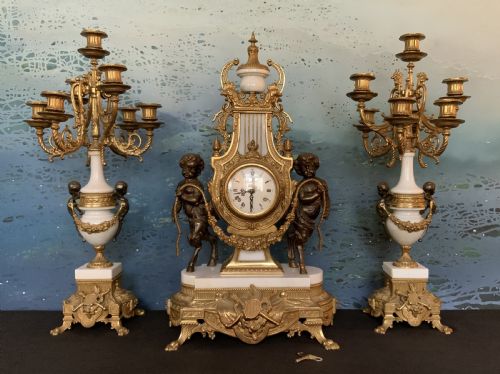
When you search for a gold marble mantel clock, you encounter heavy stone bodies paired with cast metal mounts, predominantly originating from French workshops during the nineteenth century. These objects function as domestic timepieces and decorative centerpieces, often surviving alongside matching candelabras as complete garniture sets.
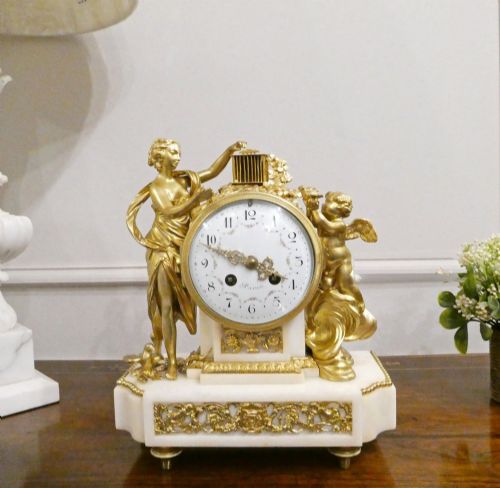
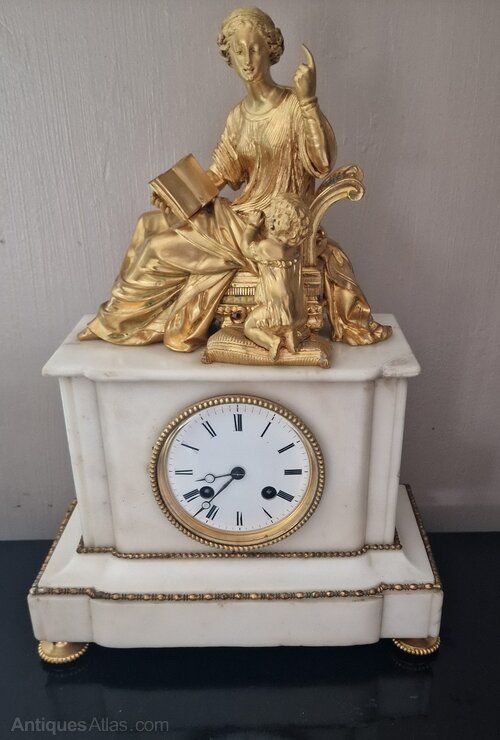
The most common examples on this page date from the Victorian era and the decades spanning eighteen eighty to nineteen hundred. They draw heavily on neoclassical vocabularies, featuring white or coloured marble bases decorated with gilt bronze or ormolu figures, urns, and foliate scrolls.
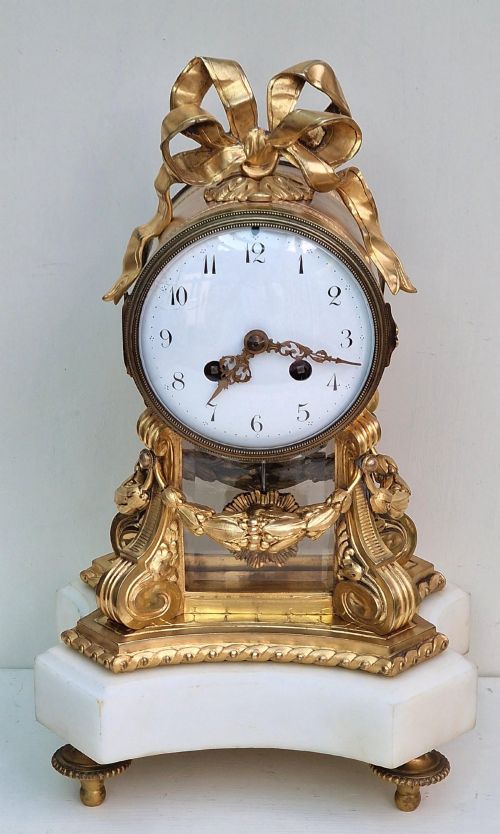
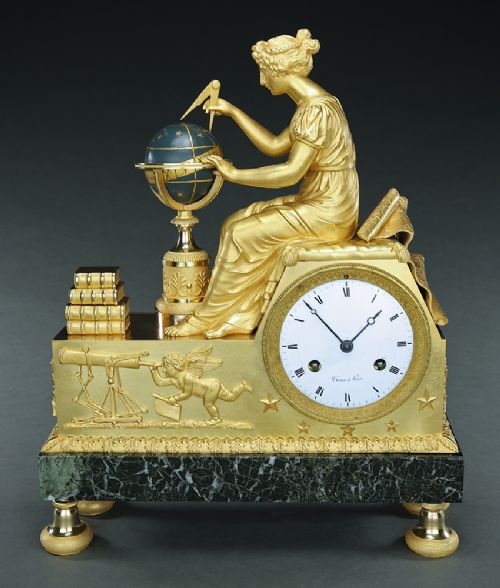
Beyond standard single mantel clocks, the selections include portico forms, calendar mechanisms, and architectural designs influenced by Louis XVI and Empire styles. Makers such as Japy Freres and Paris retailers appear frequently among these nineteenth-century survivals.
Materials and construction
Makers constructed these clocks by combining turned or slab-cut marble with fire-gilded bronze, known as ormolu, or electroplated gilt metal. The heavy stone plinths provide a stable foundation for brass clock movements driven by springs or pendulums.
Dials are typically white enamel with painted Roman or Arabic numerals, often protected behind convex glass within a brass bezel. Cast bronze components are pinned or screwed directly into the stone housings, uniting metalwork and masonry.
Listings feature Victorian and nineteenth-century pieces alongside eighteenth-century examples, using white marble, gilt bronze, and enamel.
Evaluating craftsmanship
Quality reveals itself in the crispness of the bronze chasing and the depth of the mercury or fire gilding on the metal mounts. Finer pieces display sharply defined acanthus leaves, figures, and architectural mouldings rather than soft, cast-in-the-rough surfaces.
The integration of the marble body also dictates standing. Solid white or coloured marble fitted with substantial, heavy ormolu mounts represents a higher grade of production than hollowed-out frames or thin gilt metal casings.
Japy Freres·Louis Goret·William Hardy
The Gold Marble Mantel Clock Glossary
- Ormolu
- Finely chopped leaf gold applied to a bronze base through a mercury amalgamation technique, producing a durable, warm metallic lustre. This finish characterises the finest French mantel clocks from the eighteenth and nineteenth centuries.
- Garniture
- A set consisting of a central clock flanked by matching decorative objects such as candelabras or urns. These matched sets were designed to sit symmetrically upon a fireplace mantel.
- Portico clock
- A clock movement suspended within a freestanding architectural frame supported by four or more marble columns. This classical style gained popularity during the late eighteenth and early nineteenth centuries.
- Enamel dial
- A metal face coated with fused glass powder and fired in a kiln to create a smooth, glossy white surface. Numerals are hand-painted onto this vitreous layer before firing.
Gold Marble Mantel Clock: Frequently Asked Questions
How do I wind a marble mantel clock?
Most nineteenth-century mechanical movements require a key inserted into the winding arbours on the enamel dial once every eight days. Turn the key gently until you feel resistance, taking care not to over-wind the mainspring.
Keep the pendulum locked or secured if you move the clock to another room. Shifting the position without securing the pendulum can knock the beat out of alignment and stop the mechanism.
What styles define these clocks?
The dominant styles draw on French neoclassical idioms, specifically Louis XVI, Empire, and Rococo Revival aesthetics. These designs favour symmetry, urn motifs, columns, and classical figures cast in gilt bronze.
Later Victorian interpretations often blend these classical elements with bolder architectural proportions. Some pieces also incorporate Egyptian Revival or industrial nautical motifs depending on the specific decade of production.
How should I clean the marble and ormolu?
Dust the marble gently with a dry, soft cloth and avoid using acidic household cleaners that can etch the polished stone surface. Mild soapy water on a damp cloth is sufficient for removing surface grime.
Do not use abrasive polishes on the gilt bronze mounts, as harsh friction strips the delicate gold layer. A soft dry brush works best for clearing dust from crevices in the chased metalwork.
Are garniture sets complete?
Garniture sets comprise the central clock and matching side pieces, such as candelabras, designed to display together. Many surviving sets remain intact from their original nineteenth-century domestic settings.
Inspect the materials and casting styles of the flanking pieces to confirm they share the same origin as the clock. Matching marble veining and identical bronze mounts indicate a true factory pair.