



Gold Harvest Scene Artwork
Gold harvest scene artwork captures the timeless labour of the fields in oil, watercolour, and gilt wood.
Gold Harvest Scene Artwork
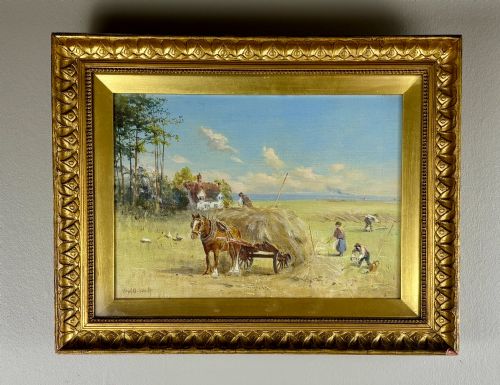
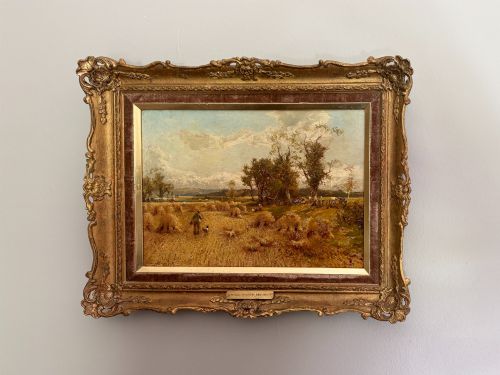
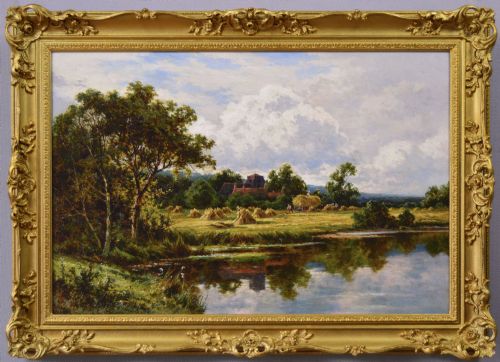
Gold harvest scene artwork comprises paintings executed across the nineteenth and twentieth centuries, capturing agricultural landscapes and farming labour. These pieces primarily take the form of oil paintings on canvas and watercolours on paper, reflecting rural life through periods such as the Victorian era, Edwardian period, and mid-twentieth century.
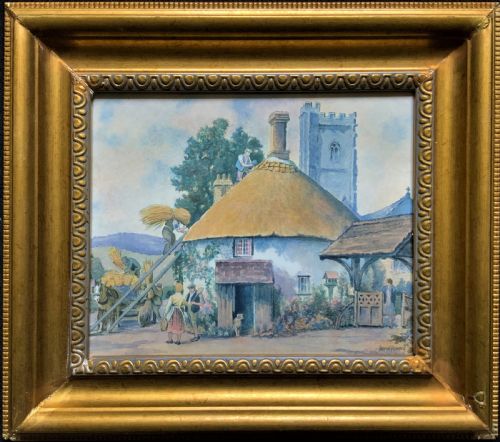
The subjects range from tranquil cornfields and hay cutting to figures gathering wheat by rivers and rural windmills. Buyers encounter depictions signed by named artists alongside naive school compositions, spanning pastoral scenes from various British counties and European settings.
How They Were Made
Artists created these works using oil paint on canvas or watercolour applied to paper, mounted within wooden frames often finished with gold leaf and gilt. The application of oil paint allows for rich, textured depictions of crops and evening light, whilst watercolour offers delicate precision for rural watercourses and skies.
The framing frequently incorporates gilt wood, enhancing the warmth of the harvest palettes. These materials reflect traditional studio practices of the nineteenth and twentieth centuries, preserving pigment and support through careful layering.
Geese occasionally supervise the corn harvest alongside hardworking nineteenth-century farmers.
What Varies in Quality
Quality rests in the handling of light, atmosphere, and the naturalism of the figures within the landscape. Works by established painters demonstrate a distinct command of depth and tonal transition in depicting cornfields and sunset skies compared to simpler naive school pieces.
The preservation of the canvas, paper, and gilt wood frame influences the overall integrity of the piece. Brushwork dexterity and the naturalistic rendering of agricultural activity separate standard decorative watercolours from fine art oil paintings.
John Atkinson·J.C. Grey·Henry H Parker·Helmut Reuter·Walter Heath Williams·Walter Williams·Arthur Walker Redgate·Joseph Paulman·Henry John Kinnaird·Walter Duncan·Joseph Thors·David Heward·John Clayton Adams·Arthur Heinrich Wilhelm Fitger
The Gold Harvest Scene Artwork Glossary
- Oil on Canvas
- Pigment mixed with drying oil applied to a woven fabric stretched across a wooden frame. This medium permits rich colour blending and textured brushstrokes suited to landscapes.
- Watercolour Painting
- Pigments suspended in a water-soluble vehicle applied to paper. It produces translucent washes of colour often utilised for detailed rural views.
- Gilt Wood
- Timber treated with gold leaf, gold paint, or powdered gold finish. It surrounds the artwork to provide a reflective, warm border.
- Impressionist Realism
- A style combining realistic subject matter with loose, visible brushwork that captures transient effects of light. It appears in depictions of nineteenth-century field labour.
- Pastoral
- Pertaining to rural life, agriculture, and shepherd or farming scenes. Such artwork romanticises the simplicity of country existence.
Gold Harvest Scene Artwork: Frequently Asked Questions
What periods do these artworks cover?
The pieces span the nineteenth century, including Victorian and Edwardian eras, through to the mid-twentieth century. Artists worked across these decades in distinct styles ranging from fine art realism to naive school interpretations.
Date markers in the titles, such as eighteen-eighty or nineteen-hundred, help situate the specific evolution of rural painting traditions.
How should I hang a gilt wood frame?
Gilt wood frames require stable indoor environments away from direct sunlight and excessive humidity to protect the gold leaf and wood substrate. Secure wall fixings matched to the weight of the canvas or framed watercolour ensure safe suspension.
Positioning the artwork where natural light enhances the gilt finish brings out the warmth of the harvest palette.
What subjects feature in harvest scenes?
Common subjects include figures cutting hay, gathering wheat, and tending cornfields alongside rivers or near country windmills. Some compositions incorporate livestock such as geese within rural Nottinghamshire or Hampshire settings.
The depictions focus primarily on traditional agricultural labour before mechanisation transformed European and British farming.
Are watercolours as durable as oil paintings?
Watercolours on paper require protection behind glass to prevent atmospheric damage, whereas oil paintings on canvas present a more robust surface. Both mediums have survived from the nineteenth century when housed with appropriate conservation care.
Displaying works away from direct sunlight preserves the pigments in both paper and canvas formats.