





Gold Gilt Clock Garniture
A gold gilt clock garniture brings monumental presence and matched symmetry to a mantelpiece, pairing a central clock with flanking candelabras or urns.
Gold Gilt Clock Garniture
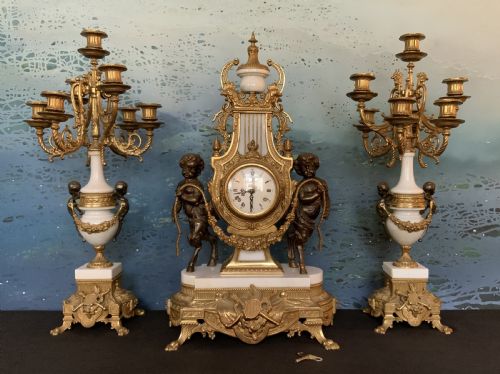
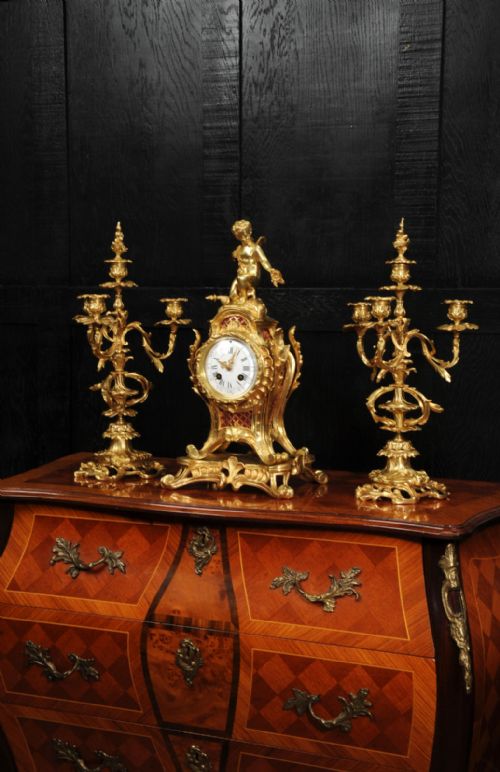
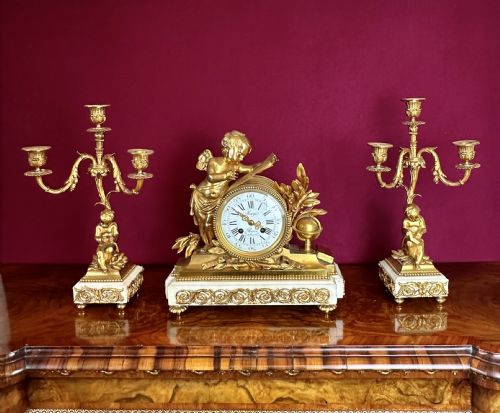
A gold gilt clock garniture comprises a central mantel timepiece accompanied by two matching side pieces, typically candelabras, urns or vases designed to display together. When you search for a gold gilt clock garniture, you encounter matched three-piece and multi-piece sets created to anchor the interior decor of a nineteenth-century interior.
The pieces appearing on this page date predominantly from the nineteenth century, spanning Victorian and Napoleon III periods alongside Louis XV and Louis XVI revival styles. These sets originate largely from French workshops and Parisian makers, utilising substantial forms that combine timekeeping with sculptural metalwork.
Most examples pair a clock with matching candelabras holding multiple candle arms, though four-glass clocks and figural subjects featuring cherubs or mythological figures also appear. The unifying element across these configurations is the bright gilded metal surface that unites the central clock with its flanking companions.
Materials and construction
Maker workshops constructed these sets using cast bronze, brass and ormolu, applying heavy gold gilt finishes over the metal surfaces to create a luminous, reflective appearance. Foundries combined patinated bronze and gilded elements to provide textural contrast within the figural mounts and architectural frames.
White and coloured marble formed sturdy plinths and bases for the clock bodies and side pieces, whilst enamelled dials marked the hours with Roman or Arabic numerals. Mechanical movements drove the eight-day strikes and visible pendulums housed behind bevelled glass panels.
Cherubs and cupids frequently guard the clock faces, apparently keeping time while suspended in everlasting ormolu slumber.
Assessing quality and execution
The refinement of the cast bronze and ormolu ornamentation dictates the upper tier of these sets, where chiselled details and crisp relief work distinguish master foundries from routine production. Weight and substance in the marble bases and metal housings also signal superior execution.
The reputation of the movement maker, such as Japy Freres, A.D Mougin or Vincenti, elevates a piece through reliable mechanical engineering and precision gear-cutting. Complete sets retaining their original matching candelabras and unblemished enamel dials represent the finest survivals of the genre.
Henry Dasson·Raingo Fres Paris·Deniere Paris·Vincenti·Japy Freres·A.D Mougin
The Gold Gilt Clock Garniture Glossary
- Garniture
- A set of matched ornamental objects designed to be displayed together on a mantelpiece or sideboard. A clock garniture typically includes a central clock flanked by two matching candelabras or urns.
- Ormolu
- Finely ground high-carat gold mercury-gilded to a bronze or brass object. This technique produces a rich, durable metallic lustre characteristic of nineteenth-century decorative arts.
- Candelabra
- A branched candlestick holder designed to hold multiple candles. In clock sets, these pieces mirror the style and height of the central timepiece.
- Japy Freres
- A prominent nineteenth-century French clockmaking firm known for producing robust mechanical movements. Their machinery powered many mantel clocks of the period.
- Louis XVI Style
- A neoclassical design vocabulary characterised by straight lines, symmetry and classical motifs. Pieces in this style often feature urns, swags and geometric proportions.
Gold Gilt Clock Garniture: Frequently Asked Questions
What is included in a clock garniture?
A standard garniture consists of a central clock accompanied by two matching side pieces, such as candelabras or decorative urns. These items are designed in the same material and style to create a unified display across a mantel.
Additional pieces, such as multi-light candelabras holding ten candles, occasionally complete larger monumental sets.
How do these clocks keep time?
Most nineteenth-century sets utilise mechanical eight-day brass movements driven by springs or weights, requiring a key wind to operate the gear train and strike the hours. Pendulums regulate the beat, and some models feature visible glass windows to display the swinging motion.
Professional cleaning and adjustment ensure these vintage mechanisms maintain accurate timekeeping in a modern home.
How do I identify a revival style?
Revival pieces draw upon earlier historical aesthetics, such as the ornate curves of Louis XV or the geometric symmetry of Louis XVI and neoclassical design. Makers in the nineteenth century reinterpreted these court styles using contemporary casting methods and mercury gilding.
Examining the casting quality, dial construction and movement serial numbers helps confirm the nineteenth-century manufacturing date.
Where should I place a garniture set?
These substantial pieces require a deep mantelpiece, large sideboard or dedicated console table capable of supporting their considerable weight in marble and bronze. Placing the clock centrally with the flanking candelabras spaced evenly outward achieves the traditional balanced arrangement.
Direct sunlight and damp environments should be avoided to protect the delicate enamel dials and the gold gilt finish.