
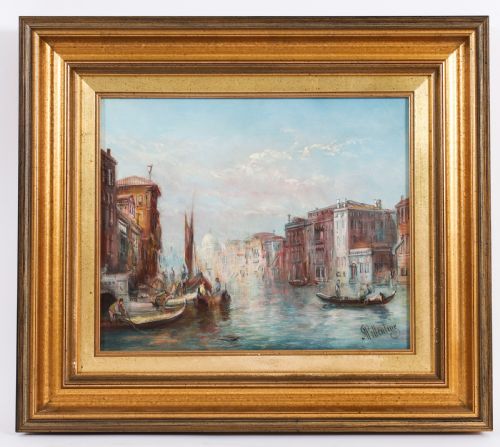
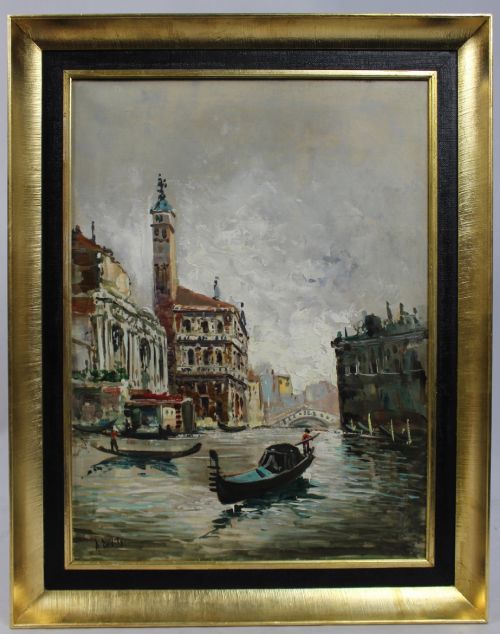
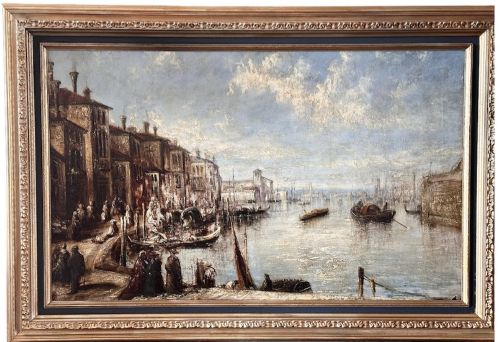
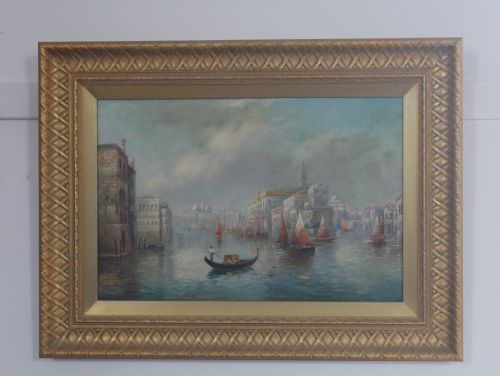
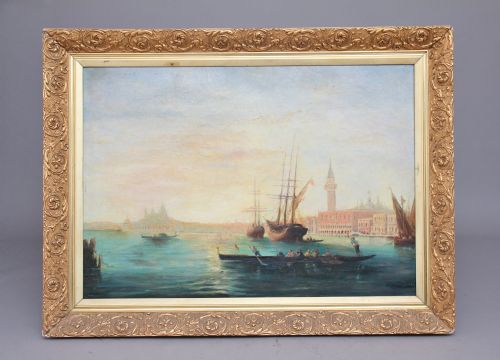

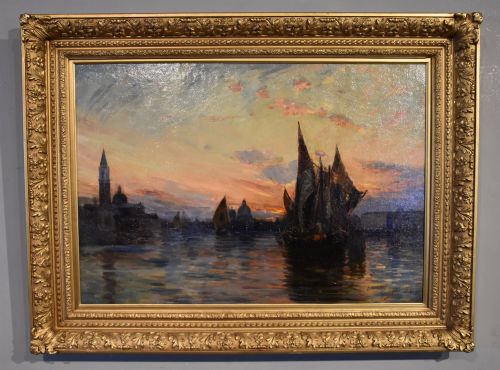


Gold Frame Venetian Landscape
A gold frame venetian landscape brings the light and architecture of Italy into a room through historic oils and watercolours.
Gold Frame Venetian Landscape
A gold frame venetian landscape captures the canals, palaces, and lagoons of Venice through historical painting. The works range from the nineteenth century into the mid-twentieth century, recording famous sights such as the Grand Canal, the Doge's Palace, and the Santa Maria della Salute.
The most common version met on this page is an oil painting on canvas housed in a gilded wooden frame. These canvases depict bustling waterways and quiet lagoons under various lights, from evening glows to bright midday sun.
The selection includes watercolours, pastels, and gouache alongside oil paintings. Dating spans from the Victorian era through the Edwardian period and into mid-century impressions.
How they were made
Artists painted primarily with oil paint on canvas or board, applying pigment to capture the distinct light reflecting off Venetian water. Some works utilise watercolour, gouache, or pastel on paper to achieve softer atmospheric effects over ink pen drawings.
The frames are constructed from wood and gesso, finished with layers of gilding to create a gold surface. These frames complement the maritime scenes by adding depth and a traditional decorative boundary to the artwork.
Listings feature oil paintings, watercolours, and gouache works created across the nineteenth and twentieth centuries.
What varies in quality
The precision of brushwork and the handling of light separate standard topographical records from masterful artistic interpretations. Stronger pieces convey the humidity, movement, and distinct luminosity of the Venetian lagoon with confidence.
Frame craftsmanship contributes significantly to the overall presence of the piece. Hand-carved or deeply moulded gesso frames with original gilding elevate the presentation compared to plain or later replacements.
Alfred Pollentine·Antonio DeVity·Francis Moltino·Thomas Hodgson Liddell·F J Aldridge·Antonietta Brandeis·Antoine Bouvard Senior·Jane Vivian·William Raymond Dommersen·William Knox·Helen Donald-Smith
The Gold Frame Venetian Landscape Glossary
- Giltwood
- Wood carved and coated with gold leaf or a gold-coloured finish. This material forms the ornate borders common on nineteenth-century paintings.
- Gesso
- A plaster mixture applied to wood frames to create a smooth surface for gilding. It allows for intricate moulded details and relief ornamentation.
- Lagoon
- A stretch of salt water separated from the sea by a low sandbank. Venetian scenes frequently depict these open expanses alongside the inner canals.
- Topography
- The detailed mapping or descriptive painting of physical places. Many of these townscapes accurately record specific Venetian palazzos and monuments.
Gold Frame Venetian Landscape: Frequently Asked Questions
What periods do these paintings date from?
The works span from the nineteenth century through the Edwardian era into the mid-twentieth century.
Most pieces originate in the Victorian period, reflecting a strong British and European fascination with Italian views.
Are these works painted on canvas?
Many examples use oil paint on canvas, while others employ oil on board.
Works on paper also appear, utilising watercolour, gouache, and pastel mediums.
Which Venetian landmarks appear most often?
Painters frequently recorded the Grand Canal, the Doge's Palace, and the Santa Maria della Salute.
Views of the Venetian lagoon and quiet side canals also recur across the selection.
How do I care for a gilded frame?
Keep the wood away from direct sunlight and moisture to protect the delicate metallic leaf.
Dust the surface gently with a dry, soft brush without applying liquid cleaners.