




Gold Flower Pendant Necklace
A gold flower pendant necklace gathers bright botanical motifs in precious metals, offering wearable garden blooms shaped by Victorian and mid-century hands.
Gold Flower Pendant Necklace
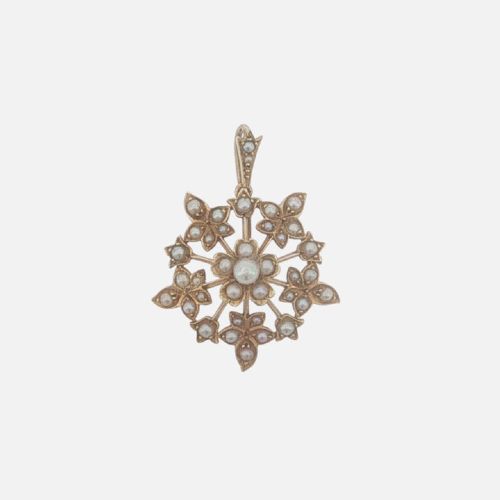
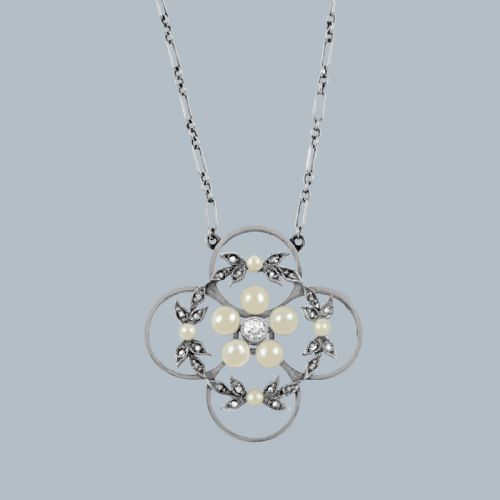
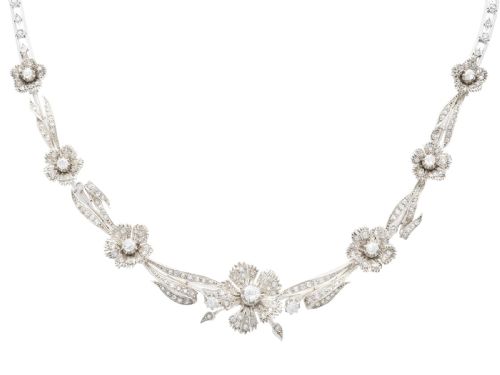
A gold flower pendant necklace presents floral forms fashioned from yellow gold, rose gold, platinum, and silver, often centred on bright gemstones. These pieces range from substantial Victorian cluster designs to delicate Edwardian seed pearl arrangements and structured mid-century starburst motifs.
The most common versions encountered here date across the Victorian, Edwardian, and mid-century eras, reflecting changing botanical tastes from naturalistic petal arrangements to stylised geometric blooms. Many examples combine pendant and brooch fittings, serving dual roles as hanging neck ornaments and pinned dress jewels.
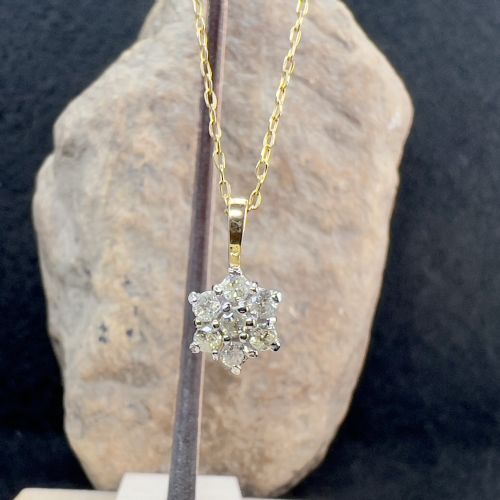
Formats vary from single-stone cluster centres surrounded by diamond petals to intricate multi-tiered constructions incorporating enamel, pearls, and coloured gemstones. Buyers selecting a gold flower pendant necklace find both romantic antique creations and crisp twentieth-century interpretations.
Materials and construction
Craftsmen built these pendants using high-carat gold, 15ct gold, 9ct gold, and platinum, frequently pairing silver with gold in earlier pieces to enhance the brightness of set diamonds. Gemstones such as diamonds, rubies, sapphires, peridots, garnets, and aquamarines form the petals and centres, supported by delicate seed pearls.
Metalwork techniques combine cast or hand-formed gold frameworks with intricate prong, bezel, and collet settings to secure small stones closely together. Many Victorian and Edwardian examples utilise fine millegrain edges and pierced backing plates to maximise light passage through diamonds and pearls.
One listed pendant cleverly doubles as a miniature double-sided flower vase holding carved sapphire, ruby, and emerald blooms.
Separating the ordinary from the exceptional
Quality rests in the harmony of the botanical design and the precision with which stones are matched and set into the metal petals. Superior examples display thoughtful stone selection, where colour saturation in rubies or sapphires and clean cut proportions in diamonds elevate the floral realism.
The finesse of the metalwork defines the upper tier, visible in crisp gallery wire, secure claw settings, and well-preserved convertible fittings. Pieces that retain their original stones and balanced proportions without heavy past repairs command greater attention from collectors.
Merrin
The Gold Flower Pendant Necklace Glossary
- Seed pearl
- A very small, naturally formed saltwater pearl, frequently drilled and strung or set en masse to form delicate flower petals in Edwardian and Victorian jewellery.
- Cluster pendant
- A jewellery configuration featuring a central prominent stone surrounded by a ring of smaller accent stones, naturally lending itself to floral petal motifs.
- Millegrain
- A decorative technique involving a row of tiny raised metal beads along the edge of a setting, characteristic of Edwardian fine jewellery.
- Old cut diamond
- A hand-faceted diamond cut before the standardisation of modern brilliants, featuring a smaller table and higher crown that produces a softer, warmer candlelit sparkle.
- Rose-cut diamond
- A vintage gemstone cut with a flat base and a domed crown of triangular facets, resembling an unopened rosebud.
Gold Flower Pendant Necklace: Frequently Asked Questions
How do I date a gold flower pendant necklace?
Dating relies on material clues, gemstone cuts, and mounting styles characteristic of specific periods like the Victorian, Edwardian, or mid-century eras.
Earlier pieces often combine silver-topped gold with old-cut diamonds and seed pearls, whilst later mid-century examples feature streamlined gold wirework and distinct gemstone pairings.
Can these pendants double as brooches?
Many antique floral pendants include integrated pin stems and safety catches on the reverse alongside hidden or removable suspension loops.
This dual functionality allowed nineteenth and early twentieth-century wearers to pin the flower to a lapel or suspend it from a chain depending on fashion.
What stones are used in these floral pieces?
Jewellers used diamonds, seed pearls, rubies, sapphires, garnets, peridots, and aquamarines to represent natural petals, stamens, and flower centres.
White stones often form the petals whilst coloured gems create vibrant centre points, sometimes enhanced by enamel details on high-carat gold.