
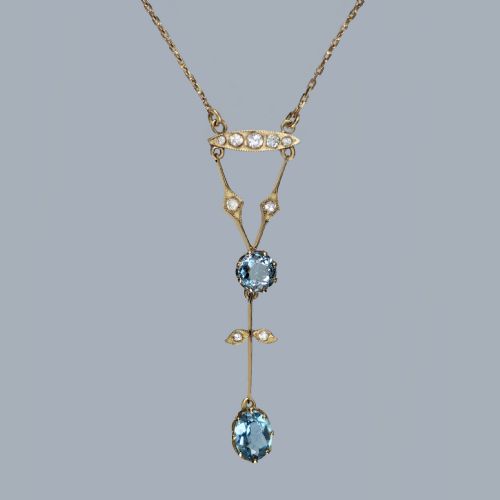


Gold Aquamarine Necklace
A gold aquamarine necklace brings together pale blue beryl and yellow gold in pendants spanning the Edwardian era to mid-century.
What a gold aquamarine necklace is
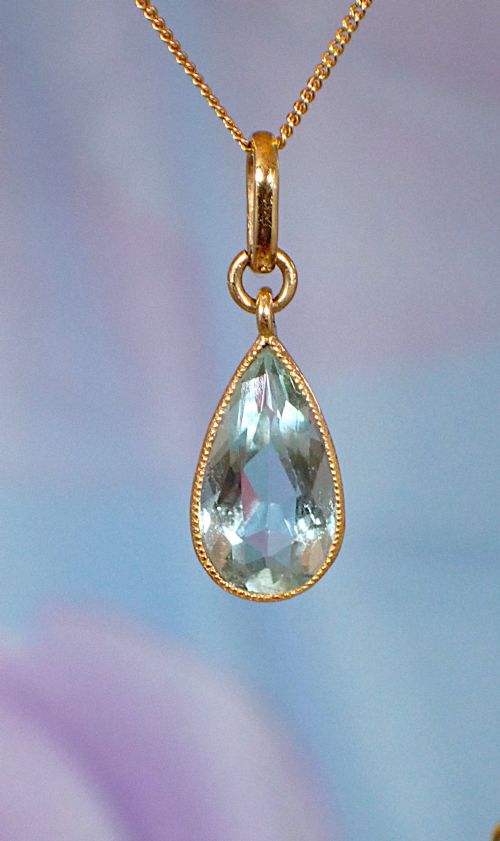
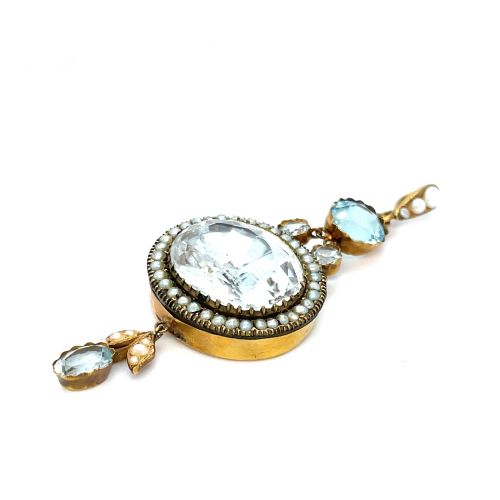
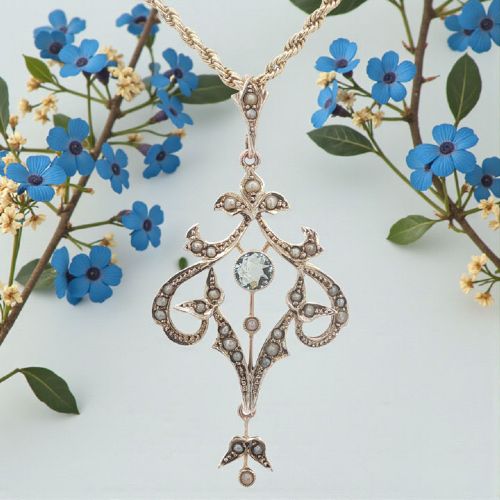
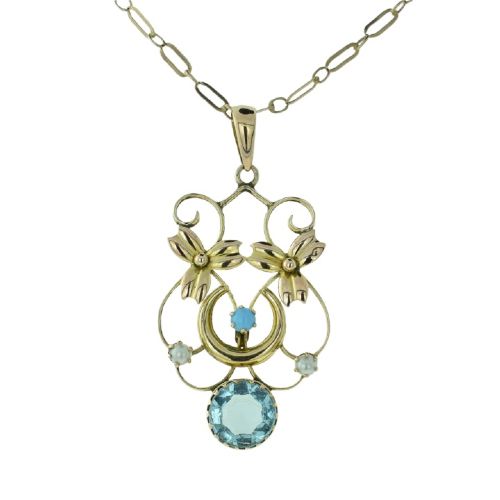
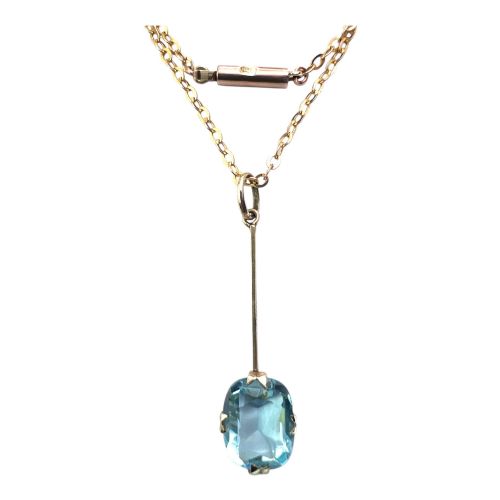
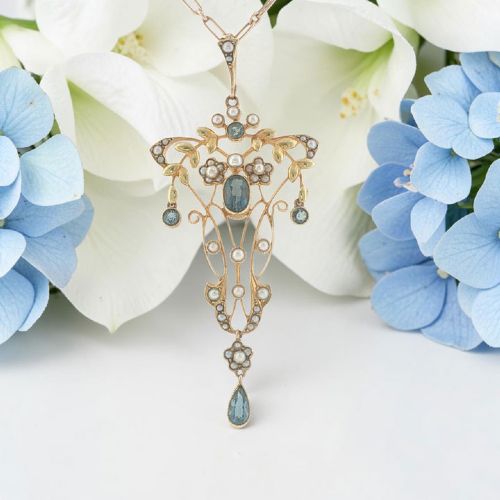
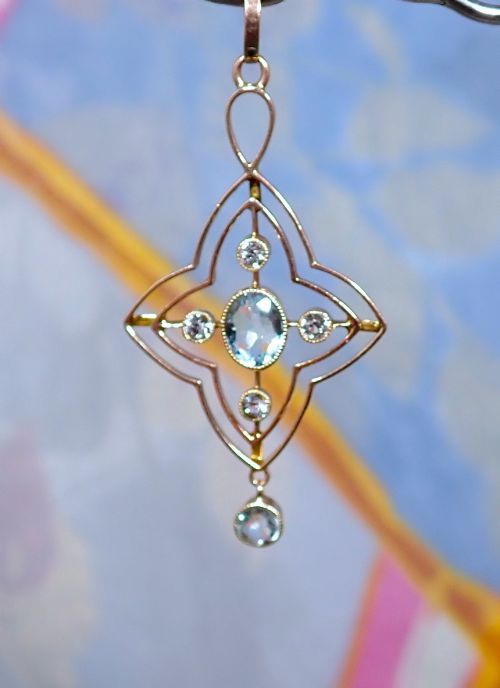
A gold aquamarine necklace centres on pale blue beryl set in yellow gold mountings, most frequently found as drop pendants from the Edwardian period and the early twentieth century. These pieces combine faceted or cabochon aquamarines with delicate chains, often incorporating seed pearls or foliate motifs.
The selection ranges from early twentieth-century drop pendants and lavalier designs to mid-century yellow gold statements, taking the form of necklaces, pendants, and convertible brooch-pendants.
How they were made
Craftsmen set aquamarines into 9ct yellow gold, 15ct gold, and higher purities like 22ct yellow gold, utilising hollow or solid fabrication techniques depending on the era. Seed pearls are painstakingly wired or pegged into position alongside the central stones.
Makers employed knife-edge drops, openwork frames, and claw or bezel settings to secure the stones, often incorporating delicate articulated connections between the pendant components.
Retail Price Guide 2026
Typical UK retail prices for gold aquamarine necklace, calculated from the Sellingantiques database of over a million retail prices indexed since 2003. This retail price guide relies exclusively on Sellingantiques data; no external sources or auction records are used, so the figures do not describe the wider market.
Swallow motifs occasionally flutter into the design, carrying secret Victorian messages right against the collarbone.
What varies in quality
Quality rests on the depth of colour and clarity of the aquamarine itself, alongside the weight and purity of the gold mount. Higher tier pieces utilise substantial 15ct or 22ct gold settings paired with well-matched seed pearls and clean, vibrant beryl.
The finesse of the metalwork defines the upper range, particularly in Art Nouveau pieces where hand-formed curves and precise foliate wirework demand high technical skill.
Murrle Bennett
The Gold Aquamarine Necklace Glossary
- Aquamarine
- A pale blue to light greenish-blue variety of beryl utilised as the primary gemstone in these necklaces. It derives its name from seawater.
- Seed pearl
- A very small, natural or cultured pearl utilised in clusters and borders around central gemstones. They add delicate texture to Edwardian designs.
- Lavalier
- A pendant necklace featuring a central suspended stone or drops hanging below the main neckline. This style gained popularity during the early twentieth century.
- Foliate
- A decorative style employing leaf and plant motifs. It appears frequently in Edwardian pendant metalwork.
- Trillion cut
- A triangular gemstone cut with three straight or slightly curved sides. It provides a distinct geometric profile for modern and vintage stones.
Frequently Asked Questions
What periods do these necklaces come from?
The pieces span several decades, with a strong concentration of Edwardian examples from around nineteen hundred to nineteen ten.
Additional specimens reach back to the Victorian era and forward into mid-century nineteen fifty designs.
What metals are used in the settings?
Makers utilised various gold purities, predominantly nine carat and fifteen carat yellow gold. Some heavier mid-century iterations incorporate twenty-two carat yellow gold.
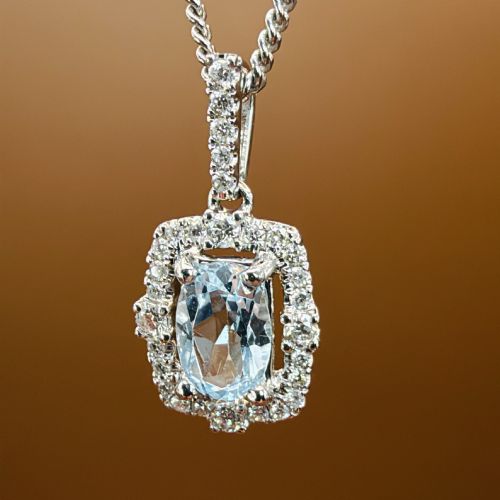
White gold also appears in select vintage items.
Are seed pearls original to the pieces?
Seed pearls form an integral part of the Edwardian and Art Nouveau designs, often clustered around the central aquamarine.
They are mounted securely into the gold framework alongside the main stones.
How do drop pendants differ from lavaliers?
Drop pendants typically feature a single suspended element hanging directly below the chain or bail. Lavalier designs incorporate multiple tiers or dangling components that sway independently.