


Gold Diamond Crescent
These gold diamond crescent pieces capture the celestial motifs beloved by Victorian and Edwardian jewellers, offering wearable history set with sparkling stones.
Gold Diamond Crescent
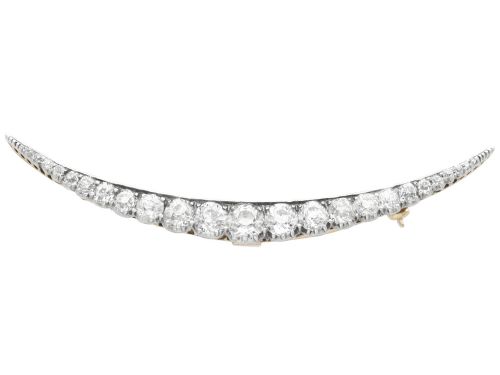
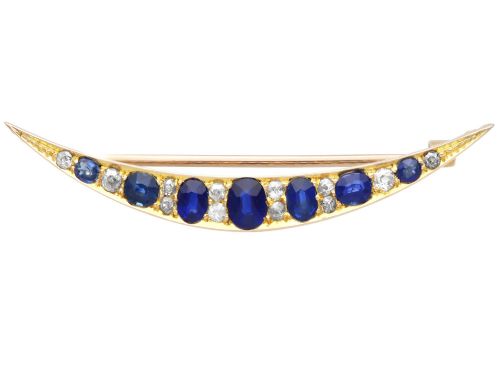
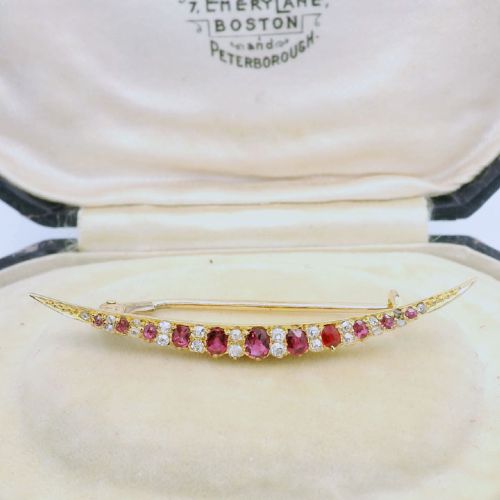
When you search for gold diamond crescent, you find delicate brooches and pendants shaped like the moon, often embellished with rubies, sapphires, or pearls alongside diamonds. These pieces span the Victorian, Edwardian, and Art Deco periods, capturing a fascination with celestial symbolism that dominated late nineteenth and early twentieth century design.
The most common form on this page is the crescent brooch, frequently mounted with graduated diamonds that catch the light with every movement. Makers combined the curved motif with floral accents, stars, or heart shapes, creating versatile pieces that pin easily to lapels or convert into pendants.
Materials and construction methods
Goldsmiths utilised varied alloys including 15ct gold, 18ct gold, and platinum-topped silver, mounting stones by hand in secure collet or claw settings. Platinum surfaces appear alongside yellow gold in Edwardian examples to provide a bright white backdrop that enhances the brilliance of old cut diamonds.
Stones such as rubies, sapphires, and pearls alternate with diamonds along the crescent curve, secured carefully to maintain the clean arc of the design. The reverse of these brooches often reveals hollow or pierced gold construction designed to reduce weight while maintaining structural strength.
Listings feature yellow gold, rose gold, 15ct gold, 18ct gold, and platinum across Victorian, Edwardian, and Art Deco periods.
Evaluating quality and craftsmanship
Quality rests in the regularity of the stone sizing and the crispness of the gold work forming the crescent curve. Finer examples display meticulously matched diamonds and coloured gemstones with minimal gaps between settings, reflecting high standards of bench work.
The integration of secondary elements like pin mechanisms, safety chains, or pendant loops also distinguishes superior pieces. Original, well-preserved fixings and crisp hallmarks indicate careful preservation and superior initial manufacture.
The Gold Diamond Crescent Glossary
- Crescent brooch
- A decorative pin shaped in the form of a crescent moon. This motif gained immense popularity during the Victorian era as a symbol of female empowerment and new beginnings.
- Old cut diamond
- A hand-faceted diamond typical of the nineteenth and early twentieth centuries. These stones feature smaller tables and larger culets, producing a softer, warmer candlelit sparkle.
- Rose cut diamond
- A historic diamond cut featuring a flat base and a domed crown with triangular facets. They resemble opening rosebuds and possess a subtle, translucent glow.
- Platinum-topped silver
- A technique where a thin layer of platinum or silver is soldered over gold. This method provided a bright white metal surface for diamond settings while retaining the strength of gold underneath.
Gold Diamond Crescent: Frequently Asked Questions
How do I wear a antique crescent brooch?
These brooches pin securely to heavy fabrics like wool coats, velvet lapels, or thick scarves using their original pin stems and safety catches.
Several pieces also feature hidden loops that allow you to suspend the crescent from a chain as a pendant necklace.
What periods do these pieces come from?
The selection spans the late Victorian and Edwardian eras, with occasional pieces from the Art Deco period.
Victorian examples often feature rich yellow gold and rose gold, while Edwardian pieces frequently incorporate platinum and silver-topped mountings.
Are coloured stones common in these designs?
Rubies, sapphires, and pearls frequently accompany diamonds along the crescent curve to create pleasing contrast and colour.
These coloured gemstones alternate with the sparkling diamonds in floral or star-accented arrangements.
How should I care for antique gold jewellery?
Clean these delicate pieces gently with a soft brush and warm soapy water, avoiding harsh ultrasonic cleaners that can dislodge pearls or old stones.
Store them separately in lined boxes to prevent the gold and gemstones from scratching against other items.