

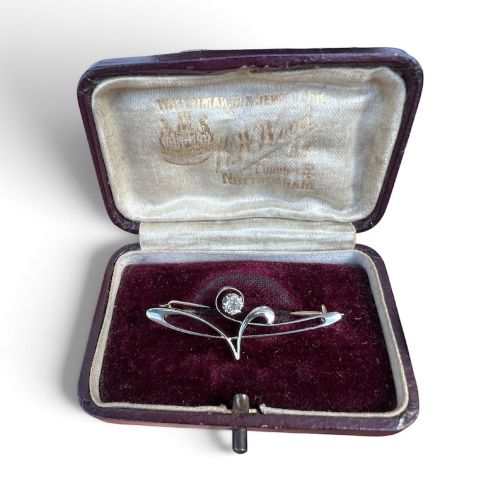
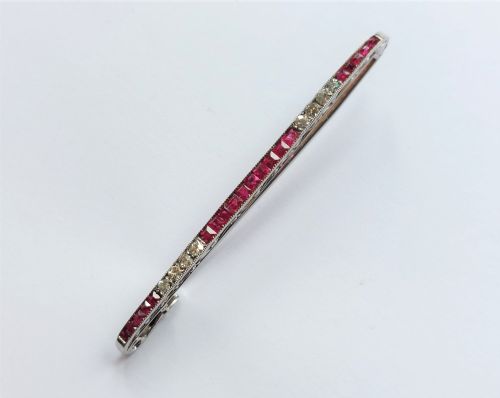
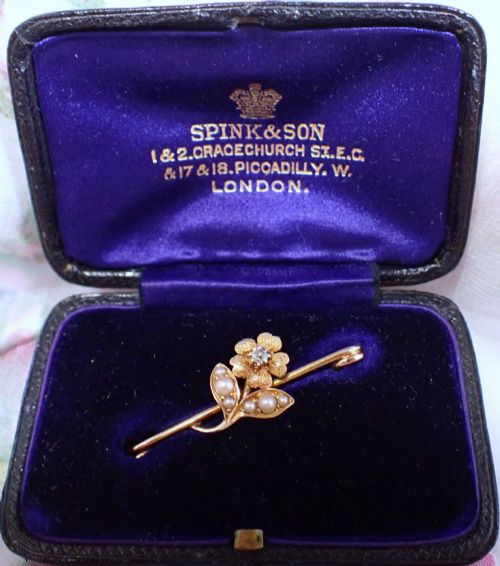

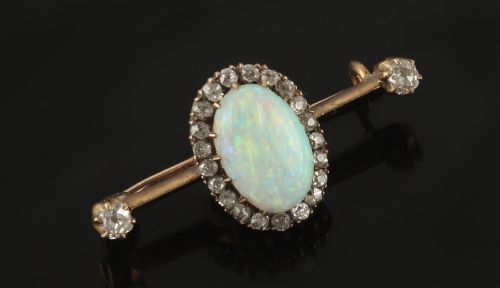


Gold Diamond Bar Pin
A gold diamond bar pin brings delicate lapel work and period sparkle together, offering refined fastening for everyday wear.
Gold Diamond Bar Pin
A gold diamond bar pin represents a specific class of antique and vintage jewellery designed to secure garments while displaying gemstones along a linear mount. When you search for a gold diamond bar pin, you encounter pieces spanning from the Victorian era through the Edwardian period and into Art Deco and Mid-Century designs.
Originating across British, French, and international workshops, these brooches function as wearable art pieces that reflect changing aesthetic movements. The selection preserves the craftsmanship of distinct decades, maintaining the original fastenings and gemstone settings employed by period jewellers.
How they were made
Goldsmiths utilised varying purities of gold, including 9ct, 14ct, 15ct, and 18ct variants, often combining platinum elements during the Edwardian and Art Deco periods to frame diamonds securely. Silver also appears alongside gold in specific nineteenth-century settings to enhance the brilliance of mounted stones.
Lapidaries cut stones by hand, producing old-cut European diamonds and rose-cut diamonds that catch candlelight and daylight differently than modern brilliant cuts. Settings rely on meticulous claw work, bezel mounting, and platinum-topped gold overlays to hold diamonds, pearls, rubies, and sapphires in place.
Listings feature items from the Victorian, Edwardian, Art Deco, and Mid-Century eras, constructed in gold, platinum, and silver.
What varies in quality
The level of craftsmanship distinguishes standard production pieces from finer workshop outputs, visible in the precision of stone setting and the delicacy of metal piercing. Heavier gold weight and integrated platinum work indicate higher production investment.
Gemstone selection and matching drive distinctions across the range, where uniform diamond clarity, well-matched natural pearls, and vibrant rubies or emeralds elevate the piece. The preservation of original box packaging and intact mechanical pins further separates exemplary survivals from altered examples.
The Gold Diamond Bar Pin Glossary
- Bar pin
- A narrow, elongated brooch designed with a pin mechanism spanning the reverse to fasten securely onto fabrics.
- Old-cut diamond
- A vintage diamond cut characterised by a smaller table, higher crown, and open culet, shaped by hand before modern machine standards.
- Rose-cut diamond
- A gemstone cut featuring a flat base and a domed crown faceted with triangular shapes, resembling an unopened rosebud.
- Platinum-topped
- A manufacturing method where a thin layer of platinum is applied over gold to provide a bright, durable white metal surface for diamond setting.
- Natural pearl
- An organic gem formed naturally within a mollusc without human intervention, prized for its distinct lustre and irregular orient.
Gold Diamond Bar Pin: Frequently Asked Questions
How do I wear a bar pin safely?
Fasten the pin diagonally through heavier fabrics like wool or velvet to distribute weight evenly across the garment. Ensure the safety clasp or C-clasp is fully engaged before moving.
Avoid securing these delicate mounts to thin silks or loose weaves that might stretch or tear under the pressure of the metal stem.
Were these pins used only for lapels?
Victorian and Edwardian garments required closures in varied locations, meaning these pieces secured collars, cravats, and hats as well as coat lapels. They also served to anchor decorative sashes and lace fichus in place.
Contemporary styling often places them on sweaters, scarves, and handbags to add a touch of period detail to modern outfits.
How can I tell an Edwardian pin from a Victorian one?
Victorian pieces often feature warmer yellow or rose gold, heavier gemstone clusters, and naturalistic motifs like flowers, insects, or clover leaves. They frequently utilise 15ct gold standards.
Edwardian items lean towards lighter white aesthetics, introducing platinum-topped gold mounts, delicate pierced openwork, and airy floral or garland designs.
What is the difference between old-cut and modern diamonds?
Old-cut diamonds possess hand-carved facets that produce a softer, broader flash under low lighting conditions rather than the sharp brilliance of modern stones. Their proportions reflect the hand-working methods of nineteenth and early twentieth-century lapidaries.
This specific facet arrangement gives antique diamonds a distinct visual depth that matches the surrounding period goldwork.