
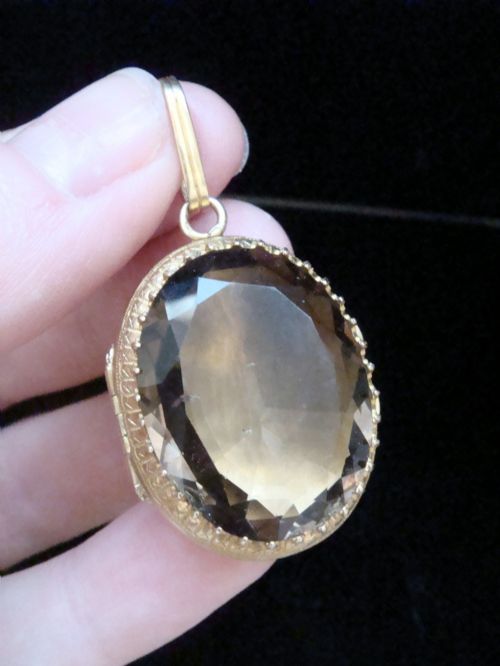


Gold Citrine Pendant
These gold citrine pendant pieces combine warm yellow quartz with precious metal settings to offer wearable colour that spans multiple centuries.
Gold Citrine Pendant
When searching for a gold citrine pendant, a buyer encounters a diverse selection of jewellery spanning from the Georgian and Victorian eras through to mid-century modern designs. These pieces range from simple faceted drops mounted in yellow gold to elaborate multi-stone clusters accompanied by pearls, diamonds, or garnets.
The version most commonly met on this page is the mid-century or vintage pendant, often realised in nine-carat yellow gold and suspending a large faceted citrine or yellow quartz crystal. Alongside these, earlier nineteenth-century locket pendants and fob seals appear, demonstrating heavier gold work and chased floral motifs.
Various forms exist within this category, including heart-shaped charms, spinner fobs, and lavalier necklaces. These items function primarily as neck ornaments, though some hybrid pieces double as brooches.
How they were made
Makers constructed these items primarily using nine-carat and eighteen-carat yellow gold, shaping the metal into bezels, claw settings, and ornate chased mountings. Stones were faceted to catch the light, or occasionally left as smooth polished cabochons and paste insertions.
Craftsmen frequently paired citrine with secondary gems such as seed pearls, diamonds, rubies, and amethysts to create contrastive colour schemes within cluster and lavalier formats. Metalwork techniques included hollow stamping, wire twisting, and detailed hand engraving on fob seals and locket backs.
A witch's heart charm offers a romantic twist on the standard pendant, curving enticingly to represent affection.
What varies in quality
The standard of a piece depends heavily on the depth of the gold colour and the clarity of the central quartz crystal. Deeper orange-yellow hues command more attention than pale stones, while clean, transparent facets elevate the visual impact of the drop.
Workmanship in the setting metal also separates standard items from finer examples. Hand-chased floral motifs, secure prong work, and integrated precious stones like small diamonds or natural pearls indicate a higher grade of manufacture.
The Gold Citrine Pendant Glossary
- Citrine
- A transparent yellow variety of quartz valued for its warm, honey-like or amber colouration. It serves as the primary gemstone in these pendants.
- Fob
- A small ornamental pendant attached to a pocket watch ribbon, often adapted historically or later converted to wear on a necklace chain. Many examples feature rotating faceted stones.
- Lavalier
- An antique or vintage necklace style featuring a central pendant drop that hangs below a delicate chain or decorative bow motif. These frequently incorporate pearls and multiple gem drops.
- Paste
- A heavy, highly refractive lead glass used historically as an imitation gemstone. It was meticulously cut and foiled to mimic true quartz or topaz.
- Carat
- A unit of measurement indicating the fineness of gold alloyed in the setting. Common variations seen include nine, fourteen, and eighteen parts pure gold.
Gold Citrine Pendant: Frequently Asked Questions
How do I date a gold citrine pendant?
Dating relies heavily on mount styles, gold hallmarks, and the cut of the stones. Georgian and Victorian examples typically display closed-back settings, chased floral motifs, or high-karat gold.
Mid-century pieces shift toward bolder, cleaner lines, often utilising nine-carat yellow gold alongside emerald-cut or trillion-cut citrines.
Are these pendants suitable for daily wear?
Citrine is a durable quartz scoring seven on the Mohs hardness scale, making it resilient enough for regular use. However, antique settings with delicate claws or seed pearls require gentle handling.
Removing the necklace during physical activities prevents undue wear on older gold chains and prong mountings.
What is the difference between citrine and yellow quartz?
Citrine is technically a naturally occurring yellow or orange quartz, though commercial trade terms sometimes distinguish them by saturation and origin. Both share identical mineral properties and hardness.
Listings use both descriptors to indicate the warm, sunny hue of the primary central stone.
How were antique fob pendants worn?
Original fob seals and spinner fobs hung from pocket watch chains used in the eighteenth and nineteenth centuries. They were designed to display a family crest or polished stone.
Modern conversion allows these substantial pieces to function as striking pendant necklaces on contemporary or antique gold chains.