


Gold Celestial Pendant
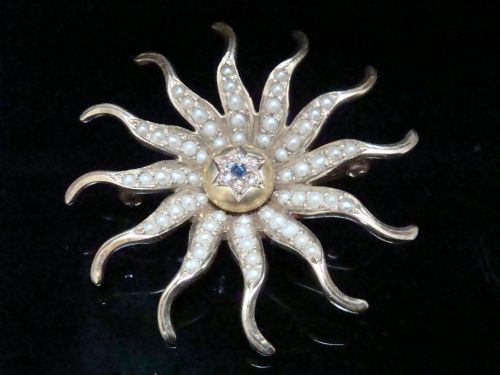
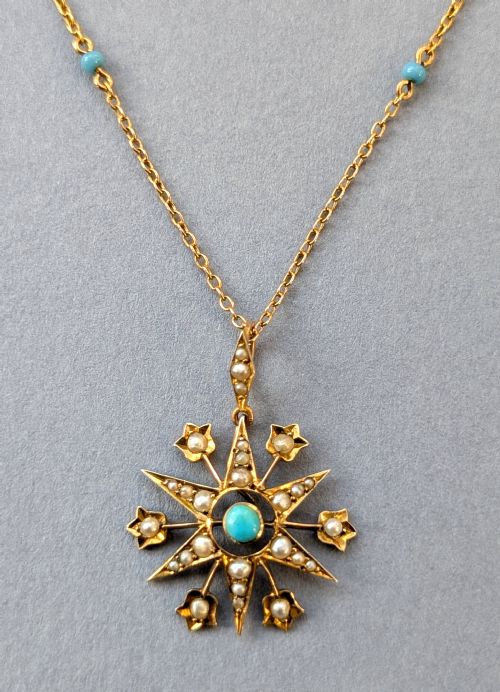
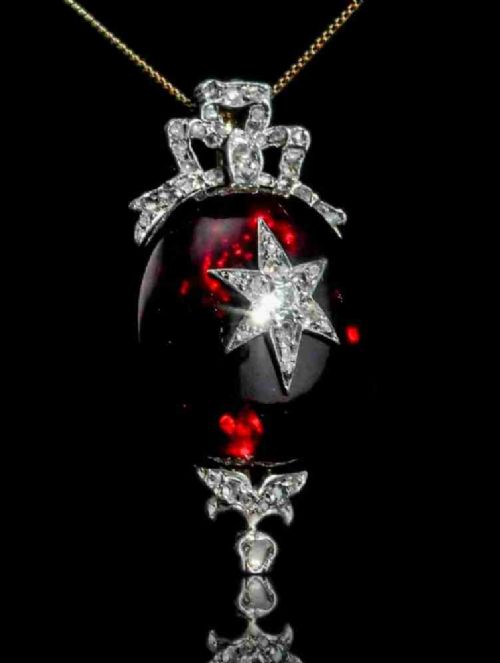
A gold celestial pendant captures the night sky in precious metal, offering a wearable piece of the cosmos set with diamonds, pearls, or turquoise.
How they were made
Goldsmiths constructed these pendants using yellow gold in various purities, alongside platinum and silver-topped gold settings that provided a bright, white backdrop for diamonds. Silver was traditionally used on the face of nineteenth-century pieces to hold stones securely while reflecting maximum light.
Craftsmen set small diamonds, seed pearls, turquoise cabs, and garnets using star settings, grain settings, and closed-back foils where appropriate to the period. Convertible mechanisms, allowing a brooch to function as a pendant, required precise hinge and pin work integrated discreetly into the rear framework.
What varies in quality
The standard of execution in a celestial pendant depends on the precision of the stone setting and the symmetry of the rays or crescent arms. Finer examples maintain crisp proportions and secure flush or bead work that holds each gem firmly without obscuring its neighbour.
Material selection also dictates the tier of the piece, distinguishing high-carat gold and clean, well-matched diamonds or natural seed pearls from simpler alloys and treated stones. The preservation of original convertible fittings adds further weight to the integrity of the object.
Listings feature gold purities ranging from nine carat to eighteen carat, alongside silver-topped and platinum settings.
Hirsch & Oppenheimer
The Gold Celestial Pendant Glossary
- Starburst
- A decorative motif radiating outward from a central stone to mimic the twinkle of a star. This form dominates nineteenth-century celestial jewellery.
- Cabochon
- A gemstone shaped and polished with a smooth, convex surface rather than faceted. Turquoise and garnet frequently appear in this cut within these listings.
- Convertible
- A piece of jewellery engineered to function as both a brooch and a pendant. These designs often feature a fold-down bail and a removable pin.
- Seed pearl
- A very small, natural or cultured pearl used in clusters or fringes. They lend a delicate, luminous texture to Victorian star and crescent motifs.
- Old-cut diamond
- A vintage diamond cutting style characterised by a small table, high crown, and open culet. These stones catch candlelight and low illumination distinctively.
Gold Celestial Pendant: Frequently Asked Questions
What periods do these celestial pendants come from?
The listings span the Victorian and Edwardian eras, alongside mid-century and contemporary twentieth-century interpretations.
Nineteenth-century examples frequently utilise silver-topped gold and seed pearls, while later decades introduce distinct white gold and platinum variations.
Are the pearls natural in antique pieces?
Victorian and Edwardian jewels typically incorporate natural seed pearls gathered before the advent of modern cultured pearl production.
These small pearls create the soft, shimmering borders characteristic of nineteenth-century star and crescent designs.
How do I care for gold and pearl pendants?
Seed pearls are sensitive to moisture, chemicals, and cosmetics, requiring gentle wiping with a soft, dry cloth after wear.
Store your pendant away from harder jewellery to prevent scratching the gold surface and the softer gemstone elements.