


Gold Bronze Candle Sticks
Gold bronze candle sticks bring warm weight to a room, cast in heavy metal and finished with fire-gilding.
Gold Bronze Candle Sticks
Gold bronze candle sticks encompass pairs and single holders produced across the eighteenth, nineteenth and early twentieth centuries. You will most frequently meet nineteenth-century French examples, alongside Regency Grand Tour pieces and occasional Art Deco designs.
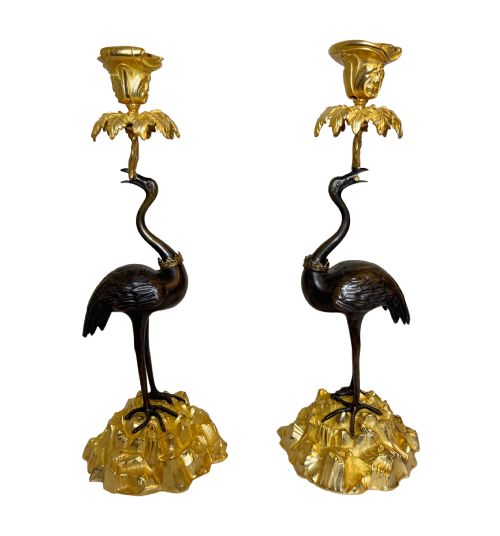
Origins stretch from English workshops to Venetian foundries, though French makers dominate the surviving inventory. Buyers find both simple domestic items and grand garnitures featuring sculptural motifs like flamingos.
How they were made
Foundries cast these pieces using the lost-wax method or sand-casting, producing thick bronze bodies that were subsequently turned on a lathe or chased by hand to sharpen the decorative details. Ormolu and gilt bronze components received a thin layer of gold amalgam applied through fire-gilding, a hazardous technique that bonded the precious metal to the bronze base.
Casting combined separate turned and modelled elements that were pinned, screwed or brazed together into a sturdy whole. Combination pieces integrate contrasting materials such as white marble, carved alabaster and patinated bronze alongside polished brass and bright ormolu.
What varies in quality
The crispness of the hand-chasing on the bronze surface dictates the initial visual impact, separating sharp, deeply articulated foliage and figures from soft, shallow casts. Superior examples retain their original mercury gilding, which exhibits a deep, soft lustre rather than the brash, flat yellow of modern electroplating.
Weight and structural integrity also divide standard production from exceptional work, with better pieces utilising heavy, thick-walled castings that sit solidly without wobble. The quality of secondary materials like carved marble or layered alabaster adds further distinction to the finished object.
The Gold Bronze Candle Sticks Glossary
- Ormolu
- Finely chopped gold amalgamated with mercury and applied to bronze through heat, creating a rich golden surface. This historic French technique produces a warm finish that does not tarnish like modern brass.
- Gilt Bronze
- Bronze metal that has been coated with a layer of gold. It appears across nineteenth-century revival styles and earlier neoclassical lighting.
- Patinated Bronze
- Metal treated with chemical solutions to darken the surface and create deep brown or black tones. Makers often contrasted this dark finish with bright ormolu mounts.
- Grand Tour
- Cultural travel undertaken by wealthy Europeans during the eighteenth and nineteenth centuries. Souvenirs brought back included bronze architectural models and classical candlesticks.
- Rococo Revival
- A nineteenth-century design movement mimicking the asymmetrical scrolls, shells and organic curves of the French eighteenth century. Pieces in this style show lively, flowing ornamentation.
Gold Bronze Candle Sticks: Frequently Asked Questions
How do I clean old ormolu?
Dust gently with a soft dry brush and avoid all chemical polishes that strip remaining gold layers.
Water and mild soap can remove surface grime if dried immediately with a soft cloth.
How do I spot fire-gilding?
Fire-gilding shows a soft, matte depth with microscopic pitting from the mercury evaporation process.
Modern electroplate presents an even, mirror-like finish lacking the subtle tonal variations of nineteenth-century work.
Why do some candlesticks use marble bases?
Marble and alabaster added weight and stability to slender bronze stems during the neoclassical and regency periods.
Contrasting stone colours also highlighted the bright yellow flash of adjacent ormolu mounts.