


Gold Brass Hardware
Gold brass hardware comprises architectural fittings and home accessories cast in metal, chosen for weight and warmth.
Gold Brass Hardware
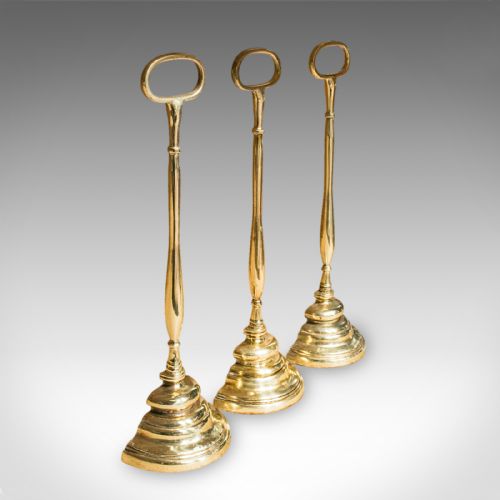
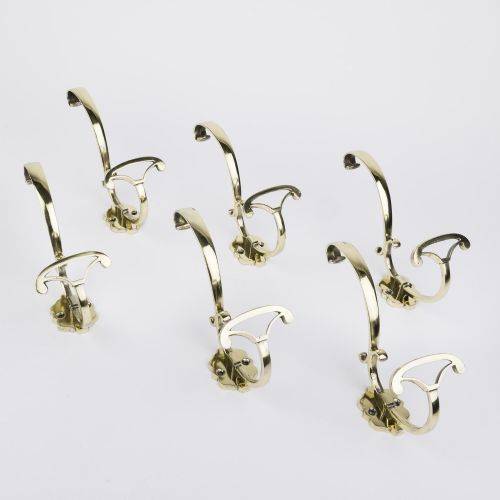
When searching for gold brass hardware, collectors examine domestic functional items made from copper-alloy metals, most commonly encountered here as door furniture, coat hooks, and window fittings from the Georgian, Victorian, and Edwardian eras. These objects range from heavy front door knockers and centre knobs to delicate curtain tie-backs and finger plates.
The version most frequently met on this page is the Victorian brass door furnishing, often cast in domestic designs or revival styles such as Gothic and Rococo. French ormolu curtain tie-backs from the late nineteenth century also appear regularly, alongside Georgian and Regency period door knobs and hardware.
Buyers select these items to restore period properties or to introduce tactile, metal details into contemporary interiors. The selection spans utilitarian hooks and elaborate bell ringers, demonstrating how functional items received decorative treatment.
Materials and methods
Items in this category rely primarily on brass, cast brass, and bronze, often enhanced through gilding or ormolu techniques to impart a rich golden surface. Metalworkers poured molten alloys into sand or lost-wax moulds to shape complex figures like dolphins, ram heads, and foliate scrolls.
Secondary materials appear in combination with the metalwork, including china, lead crystal, enamel, and horn. Handles and pulls often pair a turned ceramic or glass grip with a cast metal backplate, secured by threaded pins.
Quality variations
The distinction between ordinary and superior pieces rests on the crispness of the casting and the depth of hand-chasing applied after the metal left the mould. Finer items exhibit sharp relief in ornamental details such as feathers, fur, and floral motifs, whereas lower tiers show softened edges from worn moulds.
Weight and thickness determine durability and tactile satisfaction in daily use, separating solid brass and heavy bronze castings from thin pressed metal plates. Surface finish also plays a role, with surviving fire-gilt or ormolu retaining a deeper lustre than dipped lacquers.
The Gold Brass Hardware Glossary
- Ormolu
- Gilded bronze or brass, created by applying a mercury-gold amalgam to the base metal and heating it to drive off the mercury. This technique produces a durable, rich golden finish seen on French curtain accessories.
- Cast brass
- Molten alloy poured into a prepared mould to form solid objects. This method allows for complex three-dimensional shapes like door knockers and urn finials.
- Pelmet
- A wooden framework or board placed above a window to conceal curtain fixtures, frequently paired with matching gilt brass pelmet sections.
- Tiller yoke
- A steering arm used on boats, adapted here as a wall-mounted brass architectural element.
- Finger plate
- A protective metal plate screwed to a door around the handle to prevent fingerprints on the paintwork.
Gold Brass Hardware: Frequently Asked Questions
How do I clean antique brass hardware?
Clean antique brass gently with warm soapy water and a soft cloth to remove surface dirt without stripping the historic patina. Avoid harsh abrasive polishes that wear away thin gilding or damage the underlying metal.
Dry the pieces thoroughly after washing to prevent water spots. Preserving the natural ageing enhances the character of nineteenth-century fixtures.
Are these items suitable for modern doors?
Many items fit standard modern doors, though older fixings may require minor adjustments to hole spacings or spindle thicknesses. Centre knobs and door knockers generally install easily with basic household tools.
Latch sets and lock mechanisms need careful measurement against existing mortises before fitting. Consulting a professional carpenter helps protect delicate antique threads and mechanisms during installation.
How do I date Victorian door hardware?
Dating relies on stylistic clues, screw types, and manufacturing marks associated with the Victorian period. Gothic Revival and aesthetic movement motifs place pieces firmly in the mid-to-late nineteenth century.
Hand-cut screws suggest earlier Georgian or Regency origins, while mass-produced machine screws point towards the later Victorian and Edwardian eras. Comparing the weight and casting style with dated examples aids verification.
What is the difference between brass and ormolu?
Brass is an alloy of copper and zinc, valued for its warm metallic tone and strength. Ormolu refers specifically to gilt bronze or brass where a gold layer is bonded to the surface.
Ormolu displays a deeper, more refined golden hue due to the application of genuine gold. It appears frequently on French decorative pieces from the nineteenth century.