


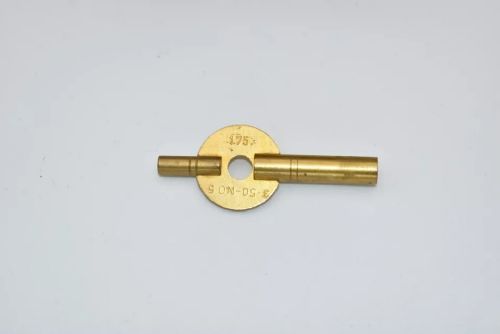
Gold Brass Clock Key
A gold brass clock key sits ready to wind timepieces from the nineteenth century to the twentieth.
Gold Brass Clock Key
A gold brass clock key connects the owner directly to the operation of antique timepieces, fulfilling the practical duty of winding the movement. These items appear alongside carriage clocks, mantel clocks, and clock accessories spanning the Victorian era, the Edwardian period, and the early twentieth century.
The versions most commonly met on this page accompany French carriage clocks and Victorian brass timepieces. They arrive housed within larger setups or as distinct winding tools meant for clocks featuring white enamel dials and Roman numerals.
Makers such as L Epee and Drocourt created carriage clocks that relied upon precise winding mechanisms. Finding a key alongside a fully engraved gilt brass case or an original box demonstrates how these accessories complete the timepiece.
Materials and methods
Makers shaped these objects using brass, gilt brass, gilt bronze, and ormolu to match the metalwork of the associated clocks. These metallic compositions provided the necessary rigidity to turn square winding arbors without stripping the metal over decades of use.
Surface treatments included fire gilding and precision engraving, echoing the ornate French nineteenth-century and Rococo Revival styles seen across the listings. Such decorative work aligned the winding tool aesthetically with the heavy gilt cases of mantel and carriage clocks.
A heavy carriage clock sounds remarkably cheerful when striking the hours in a quiet room.
Distinctions in quality
Quality rests upon the crispness of the metal casting and the depth of any hand-engraving applied to the handle or shaft. Finer examples display sharp architectural details and consistent gilding that mirrors the high-grade carriage clocks produced by premier French workshops.
Weight and balance indicate superior manufacturing, as solid brass and heavy gilt bronze provide a firmer grip than lighter alloy substitutes. Originality also elevates an item, particularly when a key remains paired with its specific nineteenth-century case or fitted box.
L Epee·Dehné of Paris·Drocourt
The Gold Brass Clock Key Glossary
- Gilt brass
- Brass coated with a thin layer of gold or gold-coloured wash. This finish offered the opulent appearance of solid gold while maintaining the structural strength of base metal.
- Ormolu
- Finely ground high-carat gold applied to a bronze base using a mercury amalgamation technique. It provided a deep, warm lustre characteristic of fine French decorative objects.
- Carriage clock
- A portable spring-driven timepiece designed for travel during the nineteenth century. These clocks typically featured glass panels and robust brass frames.
- Grand Sonnerie
- A complex striking mechanism that sounds both the hours and the quarters automatically. Such movements required precise winding arbors and dedicated keys.
Gold Brass Clock Key: Frequently Asked Questions
What fits a gold brass clock key?
These keys fit the square winding arbors found on the back plates of mechanical timepieces, particularly carriage clocks and mantel clocks. Each key must match the precise millimetre measurement of the arbor to avoid damaging the winding square.
Collectors check the gauge of the winding square before attempting to turn the movement. Using an incorrect size can round off the corners of the arbor.
Are these keys from the nineteenth century?
Many examples date from the nineteenth century and the early twentieth century, aligning with the production periods of French and Victorian carriage clocks. Workshops produced them alongside the clock movements to ensure a proper mechanical fit.
Period pieces often exhibit hand-finishing and specific metal patination that distinguishes them from later reproductions.
How do I care for gilt brass?
Gilt brass surfaces require gentle dusting with a soft dry cloth to prevent the accumulation of grime in engraved recesses. Moisture and aggressive metal polishes can strip the thin gold layer from the underlying brass.
Preserving the original surface maintains the historical integrity of the piece. Proper storage away from damp environments prevents corrosion of the base metal.
Why do some clocks need special keys?
Clocks with alarm functions, repeaters, or grand sonnerie complications often utilised specialised winding setups with distinct arbors. The mechanics inside required reliable tools to tension multiple spring barrels fully.
A matching key ensured the owner could wind every function of the clock without slipping or causing mechanical strain.