
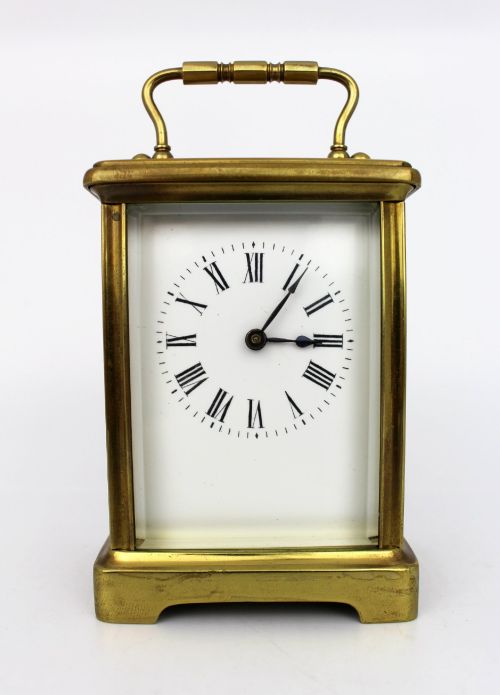


Glass Case Mantel Clock
Glass case mantel clock describes timepieces housed within protective transparent enclosures, offering a clear view of the delicate internal mechanisms.
Glass Case Mantel Clock
A glass case mantel clock brings together several distinct forms, from French four glass designs and crystal regulators to heavy brass carriage clocks and perpetual motion models. The typical version encountered here originates from the nineteenth and twentieth centuries, often housed in polished brass, gilt bronze, or mahogany.
Makers housed these movements in transparent enclosures ranging from architectural four glass library clocks to bell-jar cases and simpler travel cases. French and English workshops dominate the selection, spanning Victorian innovations through to mid-century modern Swiss designs.
Materials and Construction
Brass, gilt brass, and ormolu form the structural framework for many of these transparent cases, frequently combined with bevelled glass panels to showcase the dial and movement. Rosewood, mahogany, and marble occasionally provide substantial bases or framing for English library clocks and French mantel pieces.
Movements rely on intricate steel and brass gear trains, often incorporating platforms, cylinder escapements, fusee mechanisms, or complex perpetual motion systems driven by atmospheric pressure changes.
Glass Case Mantel Clock Retail Price Guide 2026
Typical asking prices for glass case mantel clock among the pieces listed under this phrase on Sellingantiques today, from the lower quarter to the upper quarter. They describe what is for sale here now, not the wider market.
Listings feature brass, mahogany, and gilt bronze combined with bevelled glass across nineteenth and twentieth-century periods.
Distinctions in Quality
Quality rests upon the precision of the movement and the integrity of the housing, distinguishing standard timepieces from exceptional examples with complex complications like striking trains, alarms, or specialised escapements. Engraved gilt brass, finely bevelled glass, and signed movements by known makers elevate a piece above simpler utilitarian versions.
Walker·Dent·Samuel Marti·Drocourt·Jaeger LeCoultre·William Evans·Delépine·John Massey·Joseph Soldano
The Glass Case Mantel Clock Glossary
- Carriage clock
- A small, portable spring-driven timepiece designed for travel, typically fitted with a carrying handle and a glass-panelled brass case. These originated in France during the nineteenth century.
- Fusee
- A conical pulley used in mechanical clocks to equalize the diminishing power of the mainspring as it unwinds. This mechanism ensures more consistent timekeeping.
- Four glass clock
- A mantel clock housed in a brass and glass case that reveals the movement from all sides. They frequently feature mercury pendulums or visible brocot escapements.
- Atmos clock
- A mechanical timepiece manufactured by Jaeger-LeCoultre that is powered by subtle temperature changes in the ambient air. It requires no manual winding.
- Platform escapement
- A self-contained escapement unit mounted on a small platform inside smaller clocks like carriage pieces. It regulates the motion of the gear train.
Glass Case Mantel Clock: Frequently Asked Questions
How do these glass-cased clocks work?
Most models rely on traditional spring-driven mechanical movements that require periodic manual winding with a matching key. Certain specialised twentieth-century versions utilise barometric and temperature fluctuations to power themselves autonomously.
Escapements and gear trains translate this stored or gathered energy into measured ticks, visible clearly through the surrounding glass panels.
Where should a mantel clock be placed?
These timepieces require a stable, level surface away from direct sunlight, major heat sources, and heavy vibrations. Mantelpieces, sideboards, and dedicated display shelves suit them best.
Because the internal mechanisms are visible from multiple angles, placing the clock where light can pass through the glass enhances the visual effect.
How are different periods identified?
Stylistic clues and materials help date a clock, such as the heavy gilt brass and porcelain dials typical of late nineteenth-century French pieces. Mid-century examples often feature cleaner lines, minimalist dials, and modern metal platings like rhodium.
Signatures or maker stamps etched onto the backplates or dials offer more precise chronological markers.
What is a carriage clock used for originally?
Nineteenth-century travellers utilised these compact clocks inside carriages and hotel rooms to keep accurate time on long journeys. They were supplied with protective travel cases for safe transport.
Over time, they transitioned from practical travel accessories into decorative domestic timepieces displayed on desks and mantelpieces.