


Giltwood Salon Furniture
Giltwood salon furniture brings gold-leafed grandeur and upholstered seating into formal rooms.
Giltwood Salon Furniture
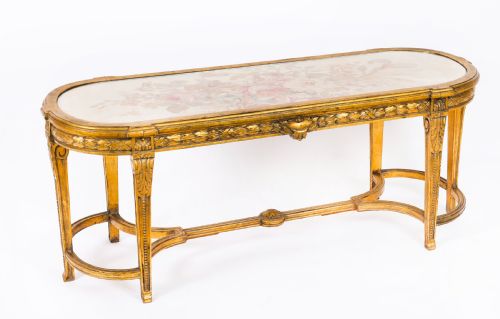
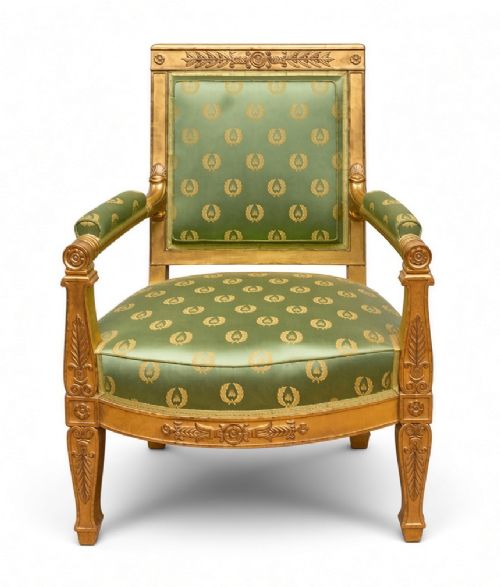
Giltwood salon furniture comprises seating and tables designed for formal reception rooms, featuring carved wooden frames covered in thin gold leaf. The selection here spans armchairs, side chairs, coffee tables, and complete salon suites.
Most examples date from the nineteenth century, encompassing Louis Philippe, French Empire, and various Revival styles such as Louis XV and Louis XVI. Italian Rococo and French Restauration pieces also appear among the offerings.
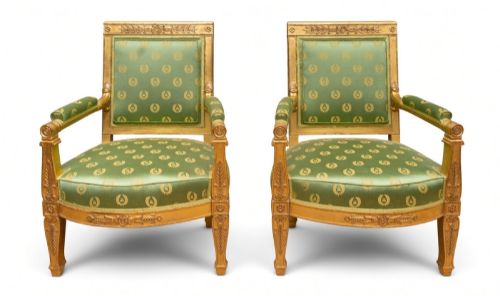
Buyers will encounter single armchairs, matched pairs of fauteuils, and multi-piece salon suites that include settees alongside chairs. These items range from compact early twentieth-century low coffee tables to large eighteenth-century Italian armchairs.
How they were made
Frames are carved from timber, often employing gesso as a smooth preparation layer before the application of gold leaf. This traditional gilding technique creates the bright metallic finish characteristic of the period.
Upholstery forms an integral part of the construction, utilising traditional textiles such as silk, damask, and tapestry. Many pieces incorporate decorative woven tapestries or floral textiles fixed directly to the carved wooden structures.
Upholstery materials across the selection include silk, damask, tapestry, and general textiles.
What varies in quality
The crispness and depth of the wood carving dictate the visual impact of each frame, distinguishing master workshops from standard production. Deeply undercut foliage and scrollwork demonstrate superior craftsmanship compared to shallow, machine-finished detailing.
The application and preservation of the gold leaf significantly influence the overall character of the piece. Intact original gilding with subtle burnishing marks holds greater aesthetic authority than heavy, modern repainting.
Jacob Desmalter·Holland and Sons
The Giltwood Salon Furniture Glossary
- Giltwood
- Timber decorated with thin sheets of gold leaf applied over a prepared gesso base. This finish provides the characteristic metallic sheen seen on formal period seating.
- Fauteuil
- An open-armed upholstered armchair with exposed wooden arms and frame. These French seats typically feature padded armrests and elaborate carved rails.
- Gesso
- A plaster-like mixture applied to wooden frames to create a smooth surface for gilding. It allows carvers to achieve sharp relief details beneath the gold leaf.
- Damask
- A reversible figured fabric traditionally woven on a drawloom with patterns in satin and sateen. It frequently appears as upholstery on nineteenth-century reception suites.
- Louis Philippe
- A mid-nineteenth-century French style favouring comfortable, slightly restrained curves over elaborate ornamentation. Furniture from this period balances decorative carving with practical domestic scale.
Giltwood Salon Furniture: Frequently Asked Questions
What is a salon suite?
A salon suite is a coordinated set of seating furniture, typically comprising a settee and multiple matching armchairs or side chairs designed for a formal parlour.
These suites ensure a unified decorative scheme within a reception room, sharing identical carved frames, gilding, and upholstery fabrics.
How do I care for giltwood?
Giltwood requires gentle maintenance to protect the delicate gold leaf surface from abrasion and moisture damage. Dusting should be performed lightly with a dry, soft brush without applying cleaning chemicals.
Keep these items away from direct sunlight and strong heat sources, which can cause the underlying gesso and wood to crack.
Where were these pieces used?
Giltwood furniture was historically placed in the primary reception rooms and salons of grand residences, palaces, and townhouses. These spaces were dedicated to entertaining guests and displaying status.
Today, they function effectively as statement seating in modern drawing rooms, libraries, or master bedrooms.
How do I identify French Revival styles?
French Revival pieces borrow decorative motifs from earlier reigns such as Louis XV and Louis XVI, including cabriole legs, acanthus leaves, and fluted columns. Nineteenth-century makers reinterpreted these classical forms with contemporary workshop techniques.
Examining the construction methods, timber ageing, and upholstery style generally helps determine whether a piece is eighteenth-century or a later nineteenth-century revival.