



Gilt Salon Settee
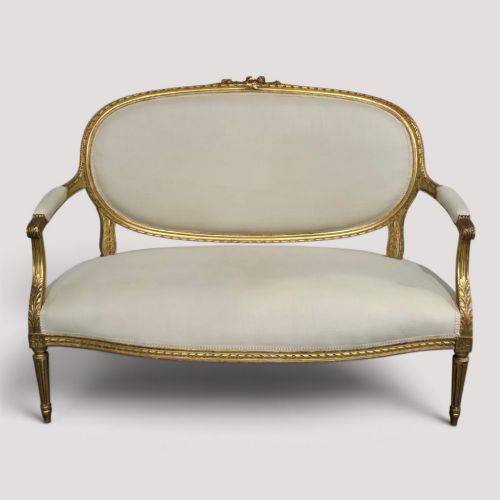
These gilt salon settee pieces bring French and English grandeur to a room, offering seats designed for formal display and comfortable conversation.
Gilt Salon Settee
A gilt salon settee is a formal upholstered seat designed for reception rooms, drawing rooms and boudoirs. These pieces emerge primarily from the nineteenth century, drawing heavily on French decorative vocabulary.
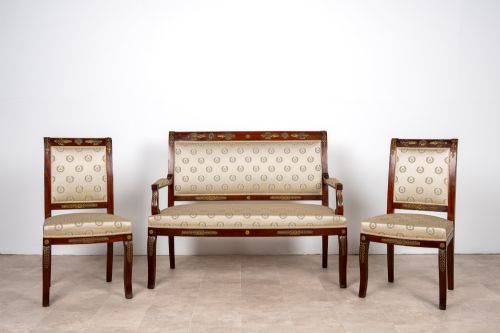
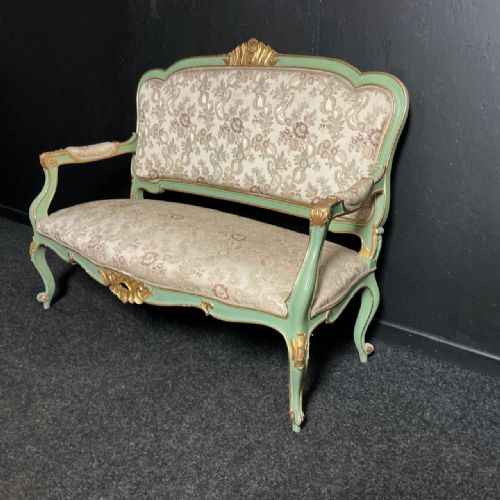
Origins span France, England, Sweden and Vienna, showing that makers across Europe adopted the gilded salon aesthetic. Forms vary from cane-backed day seats to silk-upholstered canapés and parcel-ebonised frames.
How they were made
Makers shaped the structural frames from beech and other hardwoods, applying gold leaf or paint directly over the wood to achieve the characteristic metallic surface. Some examples incorporate contrasting ebonised wood and parcel-gilding to highlight carved details.
Upholstery relies on traditional textiles, including silk and patterned fabrics, occasionally paired with cane panels for lightness. Frames feature detailed carving in revived historical styles, sometimes augmented by specialised inlays or enamel mounts.
Gilt Salon Settee Retail Price Guide 2026
Typical asking prices for gilt salon settee among the pieces listed under this phrase on Sellingantiques today, from the lower quarter to the upper quarter. They describe what is for sale here now, not the wider market.
Listings demonstrate that nineteenth-century makers utilised beech, cane, silk and gold leaf to construct formal European salon seating.
What varies in quality
The standard of a gilt salon settee depends heavily on the crispness and depth of the frame carving, which dictates how well the gilded finish catches the light. Hand-applied gold leaf demonstrates greater longevity and refinement than simple metallic paint.
Structural integrity of the hardwood frame and the choice of upholstery materials set finer pieces apart from standard workshop output. Original suites and signed pieces indicate a higher tier of nineteenth-century craftsmanship.
John Tesch
The Gilt Salon Settee Glossary
- Giltwood
- Wood that has been coated with a thin layer of gold leaf. This surface treatment gives furniture a bright, metallic sheen characteristic of formal salon pieces.
- Canapé
- A traditional French term for an upholstered sofa or settee. These pieces typically feature exposed wooden frames and generous seating for multiple people.
- Louis XV Style
- A decorative aesthetic defined by asymmetrical curves, naturalistic leaf motifs and cabriole legs. This style heavily influenced nineteenth-century seating design.
- Parcel Gilt
- A technique where only specific portions of a wooden object are gilded, leaving the underlying wood or ebonised finish visible for contrast.
- Regency
- An English design period spanning the early nineteenth century. Furniture from this era often incorporates classical motifs and bold architectural lines.
Gilt Salon Settee: Frequently Asked Questions
Where should I place a gilt salon settee?
These settees suit formal reception spaces, large bedrooms or hallways where their decorative frames can be viewed from multiple angles. They function well as statement pieces rather than casual lounging seats.
Keep them away from direct sunlight to protect delicate silk and textile upholstery, and position them where heavy traffic will not scuff the gilded wooden frame.
How do I identify a Louis XV style frame?
Louis XV style frames show distinct curved lines, cabriole legs and carved floral ornamentation without heavy geometric rigidity. The wood is often shaped organically around the backrest and arm terminals.
Compare the carving depth and symmetry against standard nineteenth-century revival pieces to understand the relative ambition of the workshop that made it.
What is the difference between a settee and a canapé?
In historical furniture terms, a canapé specifically denotes an upholstered French-style sofa with an exposed wooden frame. A settee is a broader English term that covers similar two- or three-seat upholstered benches.
Both forms served identical social functions in nineteenth-century drawing rooms, providing formal seating for guests during afternoon visits.
Are these settees comfortable for daily use?
Nineteenth-century salon seating prioritized upright posture and formal entertaining over relaxed sinking. The seats are typically firm and supportive rather than soft.
Pairing the settee with scatter cushions can adjust the seating depth, though the primary design intent remains decorative and conversational.