
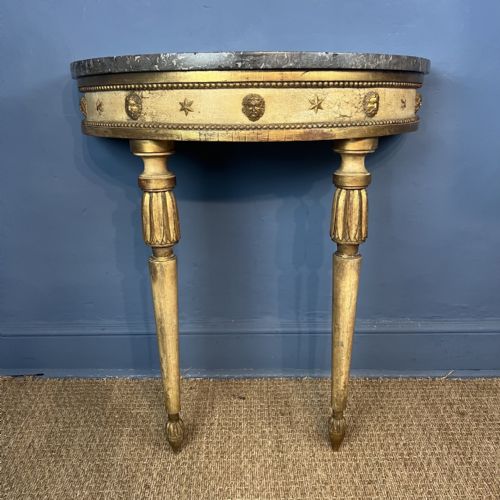


Gilt Painted Hall Table
These gilt painted hall table pieces bring architectural presence and metallic light into a narrow space, offering surface and form in equal measure.
Gilt Painted Hall Table
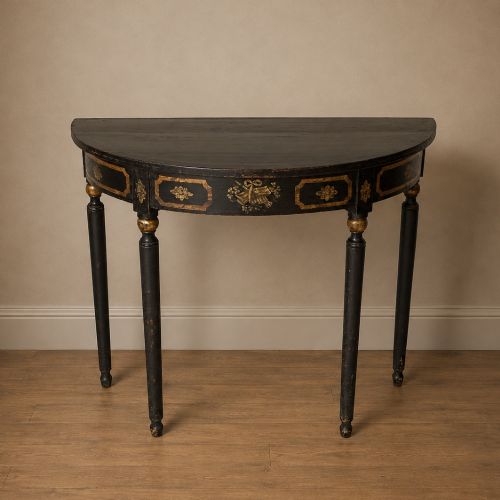
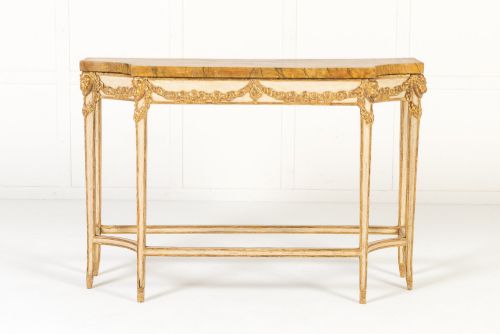
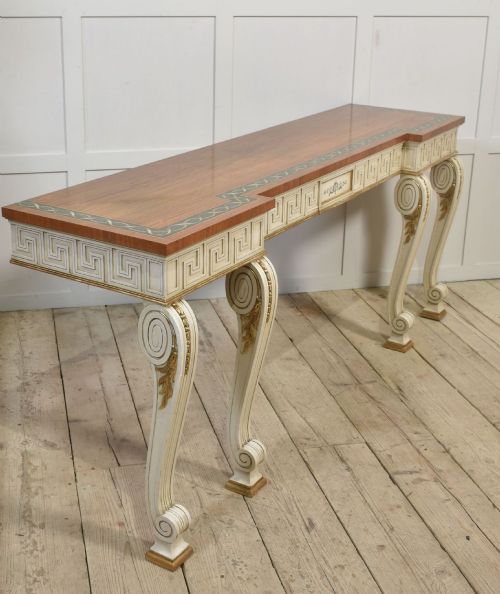
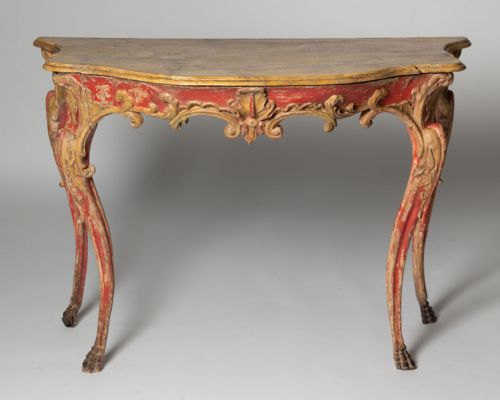
A gilt painted hall table acts as a focal point for an entrance, combining decorative painted timber with reflective metal leaf. When searching for a gilt painted hall table, buyers encounter console tables, side tables, and centre tables designed to stand flat against a wall or anchor a hallway.
The selection ranges from eighteenth-century Italian designs to nineteenth-century French, Regency, and Swedish pieces, alongside early twentieth-century interpretations. Console tables with marble tops appear frequently alongside half-moon and demi-lune forms.
Makers drew on Neoclassical, Rococo, Chinoiserie, and French styles to shape these surfaces. Many examples include carved wood and gesso frames finished with paint and gold leaf.
Materials and construction methods
Carved wood provides the structural carcass for these tables, often built with gesso applied to smooth the surface before decoration. Artisans then layered paint and gold leaf to create the characteristic gilt and painted finish.
Marble tops feature on numerous pieces, resting upon the timber bases to provide a cool, durable surface. Gold leaf and parcel gilt details highlight carved mouldings, aprons, and legs.
Materials recur across marble tops, carved wood frames, gesso layers, and applied gold leaf.
Assessing quality in painted and gilt tables
Quality rests in the crispness of the carved wood beneath the paint and the depth of the gilding itself. Finer examples display hand-carved details and carefully layered paint finishes rather than flat, uniform modern applications.
The integration of materials dictates distinction, particularly how the marble slab fits the wooden frame or how the gesso supports the gold leaf. Period execution from the eighteenth and nineteenth centuries reveals precise joinery and nuanced patination across the painted surfaces.
The Gilt Painted Hall Table Glossary
- Console table
- A table supported by brackets or legs against a wall, frequently topped with marble. These form the majority of narrow hall furniture.
- Gesso
- A plaster mixture applied to wood to create a smooth base for painting and gilding. It allows for sharp relief carving beneath the metallic leaf.
- Parcel gilt
- A decorative technique where only specific portions of an object are gilded, leaving painted wood visible elsewhere. This creates contrast between the timber ground and the gold leaf.
- Demi-lune
- A half-moon shape characteristic of many period console and card tables designed to sit flush against a wall. This form saves floor space in narrower entranceways.
- Neoclassical
- A style drawing on classical antiquity, defined by symmetry, straight lines, and restrained ornament. It appears frequently across eighteenth and nineteenth-century Italian and French pieces.
Gilt Painted Hall Table: Frequently Asked Questions
Where should I place a console table?
These tables suit hallways, corridors, and entrance spaces where floor depth is restricted. Their shallow profiles allow them to sit flat against a wall without obstructing movement.
Pinned beneath a mirror or art piece, they anchor the room visually while providing a surface for small objects.
How do I care for marble tops?
Marble requires gentle cleaning with a damp cloth and mild soap to protect the stone surface. Avoid acidic cleaners and abrasive pads that can etch the polish.
Using coasters and mats prevents liquid rings and scratching on antique stone.
What is the difference between a console and a side table?
Console tables are traditionally designed to stand against a wall, sometimes requiring wall attachment for stability. Side tables are free-standing items meant to be accessed from multiple sides.
In narrow hallways, both terms often describe similar wall-adjacent forms.
How do I identify a period piece?
Period pieces display traditional joinery methods, hand-applied gesso, and natural wear across the painted and gilt surfaces. Examining the underside and the back reveals the age of the timber and construction techniques.
Stylistic markers like Neoclassical symmetry or Rococo curves also help indicate the era of manufacture.