
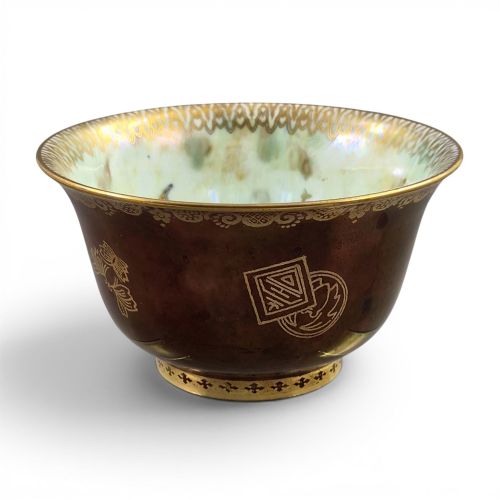
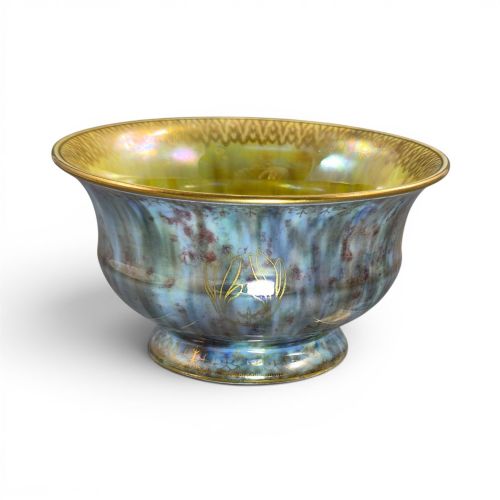


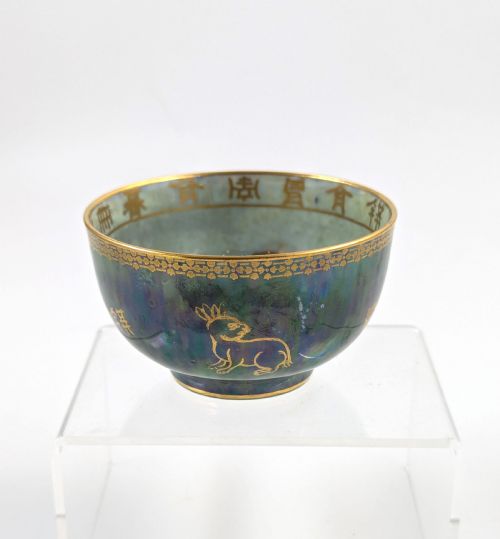

Gilt Lustreware Bowl
A gilt lustreware bowl brings extraordinary iridescent colour and intricate gilding to a room, capturing the absolute height of early twentieth-century ceramic artistry.
Gilt Lustreware Bowl
A gilt lustreware bowl is a decorative ceramic vessel defined by a shimmering metallic surface and rich decorative motifs, predominantly originating from the Edwardian period and the decades immediately following around nineteen ten and nineteen twenty. These pieces take various forms including round and octagonal shapes, showcasing the intricate designs typical of the era.
Buyers encountering this selection will predominantly find works associated with designer Daisy Makeig-Jones and produced by Wedgwood. The designs span specific artistic movements, incorporating distinct elements of Art Nouveau and Art Deco alongside fantastical subjects.
Materials and construction
These bowls utilise fine porcelain and bone china as a base, providing a smooth, uniform foundation for complex surface decoration. Artisans then applied specialised glaze and lustre glaze techniques to achieve the signature iridescent sheen that catches the light from every angle.
The distinctive finish relies on the careful application of gold leaf, gold gilding, and general gilt work. This metallic detailing outlines whimsical creatures and geometric patterns, fusing traditional ceramic firing with meticulous precious metal embellishment.
Listings in this category span the Edwardian period alongside the nineteen tens and nineteen twenties, uniting porcelain and bone china with gold leaf and lustre glaze.
Distinctions in quality
The standard of a gilt lustreware bowl depends heavily on the complexity and precision of its painted motifs, particularly those featuring intricate subjects like dragons, phoenixes, or butterflies. Pieces displaying exceptionally detailed hand-painting and multi-layered lustre effects sit distinctly above simpler, more uniform colourways.
Execution of the gilding also dictates the tier of the piece, with crisp, accurately aligned gold leaf work demonstrating superior craftsmanship. The architectural sharpness of moulded shapes, such as well-defined octagonal edges, further separates standard production from the finest output.
Daisy Makeig-Jones·Wedgwood
The Gilt Lustreware Bowl Glossary
- Lustre glaze
- A type of ceramic glaze containing metallic oxides that produce an iridescent, pearl-like sheen upon firing. This finish is central to the visual appeal of these decorative bowls.
- Bone china
- A type of soft-paste porcelain incorporating animal bone ash, known for high strength, chip resistance, and a milky white translucency. It serves as the canvas for intricate lustre designs.
- Gilding
- The decorative application of gold in leaf, powder, or liquid form to a solid surface. In these pieces, it highlights borders, motifs, and structural rims.
- Octagonal
- Having eight sides and eight angles, describing the geometric form of several prominent bowls in this category. This shape offers multiple flat picture planes for complex decorative scenes.
Gilt Lustreware Bowl: Frequently Asked Questions
What are gilt lustreware bowls?
These pieces are highly decorative ceramic vessels finished with iridescent glazes and metallic gold details. They showcase imaginative pictorial subjects developed during the early twentieth century.
Produced primarily by Wedgwood and designed by Daisy Makeig-Jones, the forms range from standard rounded bowls to structured octagonal shapes that highlight the shimmering surface effects.
How were these bowls used?
Gilt lustreware bowls were intended purely for display as ornamental objects rather than for practical dining use. Their delicate metallic surfaces and intricate painted scenes made them centrepieces for Edwardian and later interiors.
Collectors placed them on mantelpieces, sideboards, and occasional tables where ambient light could catch the shifting colours of the lustre glaze and gold leaf.
How do I date a lustre bowl?
Dating relies on stylistic markers and manufacturing periods, most commonly linking pieces to the nineteen tens and nineteen twenties. Edwardian and Art Deco influences often provide a reliable chronological window.
Specific pattern names and backstamps associated with the maker further narrow down the production era for individual vessels.
How do I care for lustreware?
Protecting these bowls requires keeping them away from direct, harsh sunlight and handling them with clean, dry hands. The delicate gold gilding and iridescent glaze can be sensitive to abrasive cleaning agents.
Dusting gently with a soft, dry cloth is sufficient to maintain the brilliant metallic sheen without risking damage to the antique surface.