

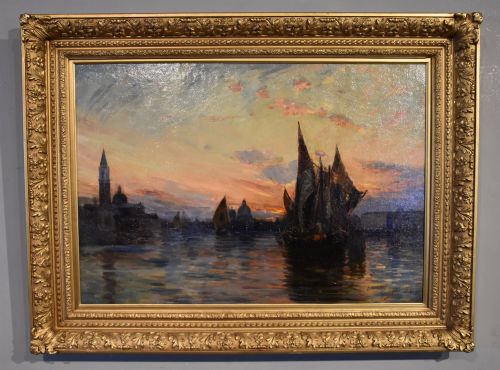


Gilt Frame Venetian Art
Gilt frame venetian art brings the warmth of the lagoon and historic canals into a room through oil paint and watercolour.
Gilt Frame Venetian Art
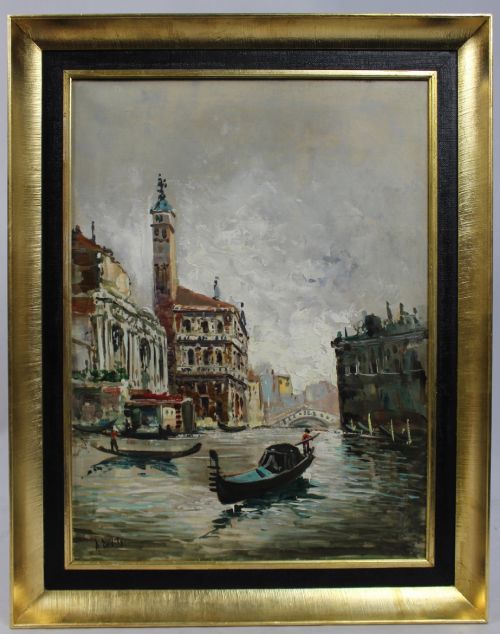
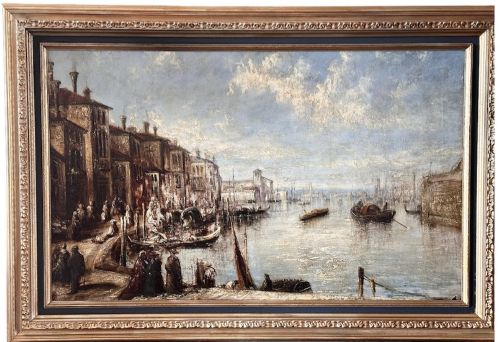
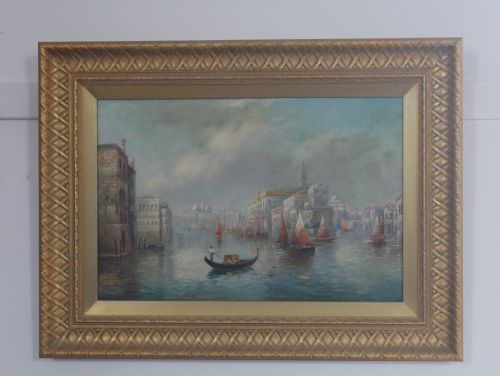
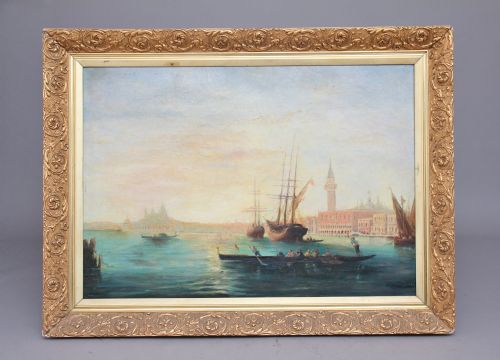
When you search for gilt frame venetian art, you are looking at oil paintings and watercolours depicting the canals, lagoons, and historic architecture of Venice. These works range from grand canal views and townscapes of the Doge's Palace to portraits and theatrical scenes.
The version you are most likely to meet on this page is a nineteenth century oil painting on canvas or board, framed in gilded wood. Many capture specific landmarks like the Santa Maria della Salute or the Grand Canal under various atmospheric conditions.
The selection extends from eighteenth century academic and school pieces through Victorian interpretations up to mid-century impressionism. Each format offers a distinct window into the artistic fascination with the Italian city over several centuries.
How They Were Made
These works rely primarily on oil paint applied to canvas or wood board, alongside watercolours on paper. Artists built up their compositions using traditional brushwork, capturing light on water and stone.
The frames are constructed from wood and finished with layers of gilding to create the characteristic gold metallic sheen. This framing protects the edges of the canvas and complements the warm palettes typical of Venetian subjects.
Alfred Pollentine and Jane Vivian emerge frequently among the listed artists, capturing recurring views of the Doge's Palace and the Grand Canal.
What Varies in Quality
Quality rests in the handling of light, atmosphere, and architectural perspective by the artist. A superior canvas manages the complex reflections on the water and the detailed stonework of historic palazzos with confident brushstrokes.
The condition of both the painted surface and the wooden gilt frame dictates the integrity of the piece. Well-preserved pigment layers and original or period-appropriate gilding maintain the intended visual impact of the artwork.
Antonio DeVity·Francis Moltino·Thomas Hodgson Liddell·Paolo Veronese·F J Aldridge·Antonietta Brandeis·Antoine Bouvard Senior·E. Perez Senet·Jane Vivian·Alfred Pollentine·William Raymond Dommersen·Andrea Celesti·Richard Geiger·William Knox
The Gilt Frame Venetian Art Glossary
- Giltwood
- Wood carved and covered with a thin layer of gold leaf or metallic powder. This material forms the ornate frames typical of these artworks.
- Grand Canal
- The main waterway threading through Venice, serving as the central subject for many townscape paintings. Artists frequently painted its bustling traffic and historic bridges.
- Lagoon
- The enclosed bay of the Adriatic Sea in which Venice sits. Paintings often depict its expansive skies and tranquil open waters away from the city centre.
- Townscape
- A genre of painting representing urban scenery and architectural views. These works focus on the distinctive buildings and canals of the Italian location.
- Impressionism
- A style of painting emphasising immediate visual impressions through unblended colour and short brush strokes. Italian variations of this style appear across later nineteenth and twentieth century pieces.
Gilt Frame Venetian Art: Frequently Asked Questions
What subjects appear in these paintings?
The subjects focus on Venetian topography, including the Grand Canal, the Doge's Palace, and the Santa Maria della Salute. Other works show scenes of the lagoon, portraits, and theatrical or masquerade compositions.
These depictions range from bustling waterway traffic to quiet architectural studies under evening light.
How do I date these artworks?
Dating relies on the recorded periods, artist lifespans, and stylistic markers visible in the brushwork and framing. Nineteenth-century Victorian pieces often feature detailed townscapes, while later works lean towards impressionistic techniques.
Signatures, inscriptions, and canvas stamps also help establish the chronological context of each piece.
Where should I hang these pieces?
These works suit traditional living spaces, studies, or hallways where their warm gilt frames can catch natural light. Pairing them with neutral wall colours helps the gold finish and the painted palette stand out.
Direct sunlight should be avoided to protect both the oil pigments and the gilded wooden frames.
Are watercolours common in this category?
Watercolour paintings on paper form a notable portion of the available depictions alongside oil on canvas and board. Artists utilised watercolours to capture the luminous atmospheric conditions and bright light of the Venetian lagoon.
These paper works require glass protection within their frames to preserve the medium over time.