
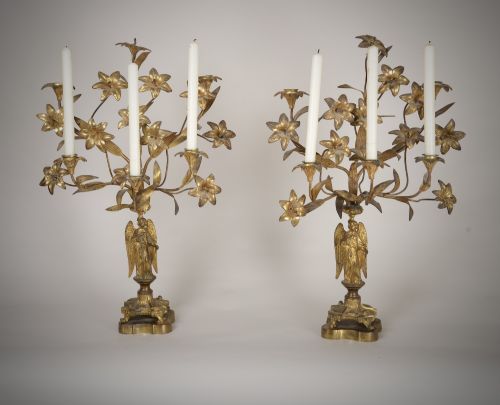


Gilt Floral Branch Light
These gilt floral branch light pieces bring botanical elegance to an interior, offering ornate illumination shaped like climbing vines and blossoms.
Gilt Floral Branch Light
When you search for a gilt floral branch light, you are looking at decorative lighting and metalwork designed to mimic natural boughs and leaves. The pieces on this page span several decades from the late nineteenth century through to the mid twentieth century, originating primarily from French and Italian workshops.
You will most commonly meet multi-branch chandeliers, wall lights, and paired candelabra rendered in forms inspired by historical design movements. These range from French Chateau and Louis XVI style creations to Italian Florentine, Art Nouveau, and Gothic revival interpretations.
The objects frequently incorporate sculptural elements such as cherubs, ceramic flowers, and polychrome pigments alongside gilded metal frames. Table lamps and smaller brooches also appear within the selection, showing the same botanical focus on branches and floral motifs.
How they were made
The construction relies heavily on cast and chased metalwork, utilising gilt brass, ormolu, gilt bronze, and gilded metal to form the structural branches and arms. Artisans shaped these metals into curving boughs to support multiple light points.
Surface decoration frequently involves applied gold leaf or mercury gilding to impart a luminous finish that catches the light. Enamel work, polychrome paint finishes, and ceramic floral additions are integrated into the metal armatures to enhance the botanical realism.
Some pieces combine metal frames with carved marble bases or incorporate detailed mouldings characteristic of specific stylistic periods like Art Nouveau and Louis XVI.
Listings feature items spanning the 19th Century, 1890, 1920, 1930, and 1940.
What varies in quality
The distinction between standard and finer examples rests on the crispness of the casting and the depth of the metalwork. Superior pieces display finely articulated leaves, individually modelled petals, and hand-chased details that bring organic forms to life.
The quality of the gilding and surface finish plays a major role in how the piece ages and reflects light. Rich ormolu and thick silver gilt hold a warmer tone compared to flat, uniform modern plating applied over base metals.
Cohesiveness of design and the integration of secondary materials, such as enamel or polychrome pigments, separate ordinary production items from masterworks of decorative metalwork.
The Gilt Floral Branch Light Glossary
- Ormolu
- A gilded bronze technique used extensively in French decorative arts for mounts and lighting. This process involves applying a fine amalgam of gold and mercury to a bronze base before heating.
- Toleware
- Painted or lacquered sheet metal items popular in domestic decoration. These objects often feature floral or polychrome decoration applied over a dark metal ground.
- Gilt Bronze
- Bronze metal that has been coated with a thin layer of gold leaf or gold paint. It provides durability while maintaining a bright metallic lustre.
- Silver Gilt
- Silver object that has been coated with a thin layer of gold on its surface. This combination offers the lustre of gold combined with the substantial weight of silver.
- Gothic Revival
- An architectural and decorative style drawing inspiration from medieval design. Pieces in this aesthetic often feature pointed arches, heavy tracery, and dark or ornate metalwork.
Gilt Floral Branch Light: Frequently Asked Questions
What periods do these lights come from?
The pieces available span from the late nineteenth century through the early twentieth century, encompassing periods like the 1890s, 1920s, 1930s, and 1940s.
You will find items reflecting distinct historicist and artistic revivals from those decades, including Art Nouveau and Louis XVI styles.
Are these pieces mostly French or Italian?
The evidence shows a strong representation of French origins, particularly associated with French Chateau, country, and Toleware designs.
Italian pieces are also present, notably represented by Florentine silver-gilded chandeliers and wall lights.
What materials are typically used?
The items are constructed from various metals finished with gold or silver coatings, including gilt brass, ormolu, gilt bronze, and gilded metal.
Additional materials include enamel, polychrome paint, ceramic floral elements, and marble bases paired with the metal branches.
What object types can I find?
The selection includes large multi-branch chandeliers, wall lights, paired candelabra, and smaller table lamps.
Non-lighting decorative items sharing the same botanical theme, such as loving bird brooches, also appear in the listings.