
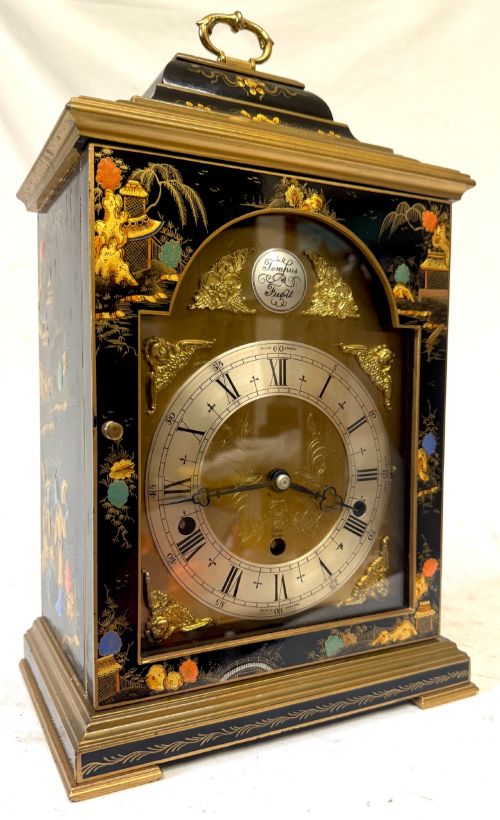
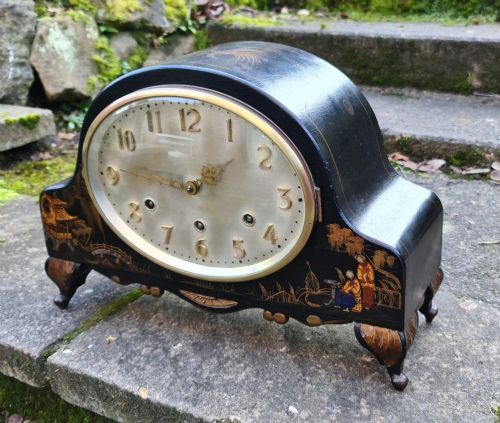
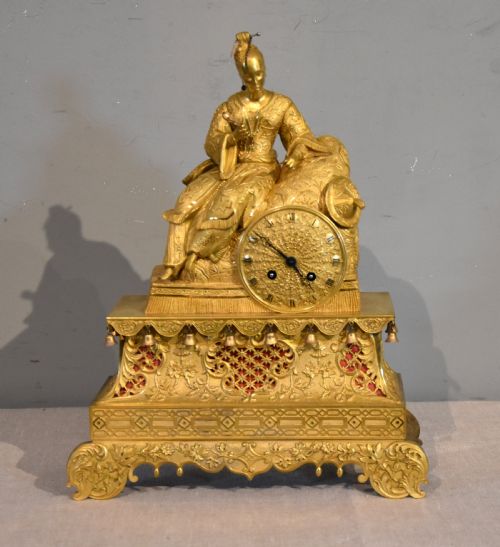
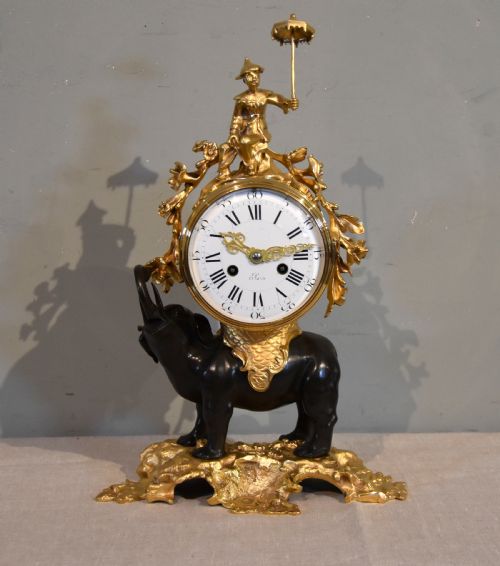


Gilt Chinoiserie Table Clock
A gilt chinoiserie table clock brings together lacquered surfaces, gilt bronze mounts and striking horological movements from several centuries.
Gilt Chinoiserie Table Clock
A gilt chinoiserie table clock is a timekeeper housed in a decorated case, drawing on Asian motifs interpreted through European craftsmanship.
The pieces on this page span several centuries, with examples ranging from the eighteenth century to the mid-twentieth century.
How they were made
Casework relies on wood finished with lacquer, often incorporating painted or gilt decoration in red, green or black.
Metalwork utilises brass, ormolu and gilt bronze for mounts, dials and figural elements, paired with glass panels where appropriate.
One clock takes the sculptural form of an elephant, proving that timekeeping can occasionally march with a heavy tread.
What varies in quality
The refinement of the painted and lacquered decoration dictates much of the visual success, alongside the crispness of the gilt bronze or ormolu mounts.
Horological sophistication differs between simple timepieces and complex examples featuring three train movements, musical capabilities or alarm functions.
James Smith London·Chater And Son London·Jaeger Le Coultre
The Gilt Chinoiserie Table Clock Glossary
- Chinoiserie
- European decorative style reflecting Chinese artistic influences, popular in furniture and clock cases. This aesthetic appears across various periods represented here.
- Ormolu
- Gilded bronze, applied to mounts and decorative details on clock cases. The technique provides a bright metallic finish.
- Bracket clock
- A portable table clock designed originally to sit on a wall bracket or a table. Many examples include carrying handles on top.
- Three train movement
- A clock movement with three gear trains to drive timekeeping, striking and chiming or musical functions. Elliott London clocks often employ this setup.
Gilt Chinoiserie Table Clock: Frequently Asked Questions
How do I wind a bracket clock?
Winding requires a dedicated key inserted into the winding holes on the dial face, turning gently until resistance meets the spring.
Care must be taken not to overwind the movement, as this can damage the internal mechanisms.
Where should I place a lacquered clock?
Position the piece away from direct sunlight and sources of heat to protect the delicate lacquer and gilt surfaces from cracking.
A stable mantelpiece or heavy table provides a secure surface free from excessive vibration.
How do I identify the period of a chinoiserie clock?
Examine the construction of the case wood, the style of the painted decoration and the characteristics of the clock movement.
Later reproductions often borrow eighteenth-century motifs while utilising twentieth-century mechanical components.
What is a three train movement?
A three train movement powers the timekeeping, the hour strike and a secondary chime or musical function.
This complexity allows the clock to play tunes or sound quarter hours in addition to standard strikes.