
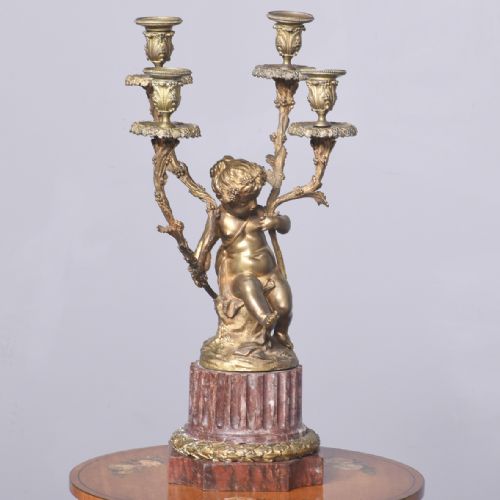


Gilt Cherub Candle Stands
These gilt cherub candle stands bring figurative French elegance to a mantelpiece, cast in bronze and ormolu to hold the light.
Gilt Cherub Candle Stands
When you search for gilt cherub candle stands, you encounter sculptural works designed to support candles in grand interiors. These objects take the form of winged putti or cherubs holding aloft sconces, candle arms or prickets.
The pieces on this page span the eighteenth, nineteenth and Victorian centuries, with a strong emphasis on nineteenth-century French production. You will frequently find them rendered as pairs in revival styles such as Rococo, Empire and Louis XVI.
Forms vary from single desk candlesticks to three-arm candelabra mounted on marble or porphyry bases. The figures themselves appear dancing, supporting branches or standing beside floral motifs.
How they were made
These items rely on the combination of cast bronze, patinated bronze and ormolu, which is finely ground gold mercury-gilded onto the metal surface. Makers often contrasted dark patinated bronze bodies with bright gilt ormolu details to create visual depth on the figures and mounts.
Many examples incorporate carved white marble or porphyry marble bases that anchor the heavier bronze work. Brass and simpler gilt bronze also appear in the construction, shaping the structural stems and drip pans.
These chubby bronze cherubs spend their days frozen in mid-dance while steadfastly refusing to drop their heavy metal burdens.
What varies in quality
The distinction between standard production and exceptional work lies in the sharpness of the chasing and the quality of the bronze casting. Finer pieces display distinct facial expressions on the cherubs and precise feather work on their wings, whereas lesser examples show softer, blurred detailing.
The richness and application of the gilding also define the tier of the piece, with durable ormolu retaining its deep lustre against inferior lacquered finishes. Furthermore, the integration of solid marble or porphyry bases elevates the physical presence of the stand.
Clodion
The Gilt Cherub Candle Stands Glossary
- Ormolu
- Gilded bronze, where a finely ground gold-mercury amalgam is applied to a bronze base and heated to fuse the gold. This technique produces a distinctive warm, rich surface texture characteristic of high-end French metalwork.
- Putto
- A plump, naked male child figure often depicted with wings, frequently used in classical and revival art. In these pieces, the putto serves as the primary sculptural support for the candle arms.
- Porphyry
- An extremely hard igneous rock with large crystals, highly prized for its purple or red colour. It provides a dense, decorative foundation for heavier candelabra.
- Pricket
- A sharp metal spike in a candlestick designed to impale a large candle to hold it steady. This form often appears on older ecclesiastical or formal altar sticks.
- Patinated bronze
- Bronze that has been chemically treated or allowed to age to a dark, controlled surface tone. This dark finish creates a strong tonal contrast against bright ormolu mountings.
Gilt Cherub Candle Stands: Frequently Asked Questions
Where were these pieces originally placed in a room?
These decorative stands typically sat on mantelpieces, sideboards and large desks in formal reception rooms. Their reflective ormolu and gilt surfaces helped amplify candlelight during evening gatherings.
Pairs were usually arranged symmetrically to balance the decor of a nineteenth-century interior.
How do I identify a nineteenth-century French piece?
Nineteenth-century French works frequently draw on earlier historical motifs from the Rococo, Empire and Louis XVI periods. They make extensive use of fire-gilt ormolu paired with patinated bronze and occasionally mount the figures on marble plinths.
The casting quality and sculptural movement of the cherubs offer strong clues to their origin in Parisian workshops.
How should I clean gilt bronze and ormolu?
Gilt bronze and ormolu require gentle dusting with a soft, dry brush to prevent dirt accumulation in the recessed chasings. Avoid harsh metal polishes, abrasive cloths or chemical cleaners, which can permanently strip away the thin gold layer.
Professional conservation is recommended if deeper cleaning becomes necessary.
What are porphyry bases?
Porphyry bases are heavy, polished stone plinths made from a distinctive purple-red igneous rock with visible crystal inclusions. They provide a stable, luxurious foundation that elevates the bronze figures above the furniture surface.
Their inclusion usually signals a piece of higher ambition and cost.