



Gilt Cabriole Leg Ottoman
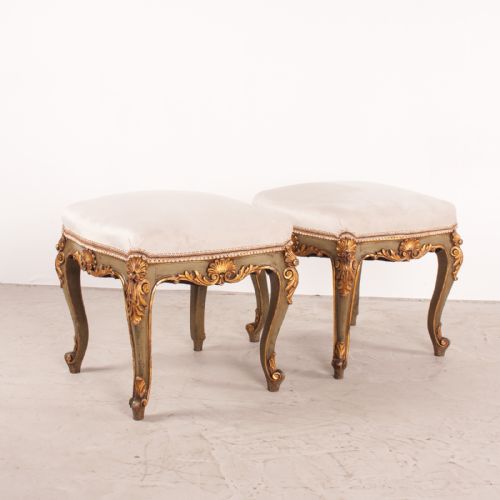
These gilt cabriole leg ottoman pieces bring Continental Rococo and Victorian revival seating into a room with carved wooden curves and gold leaf.
Gilt Cabriole Leg Ottoman
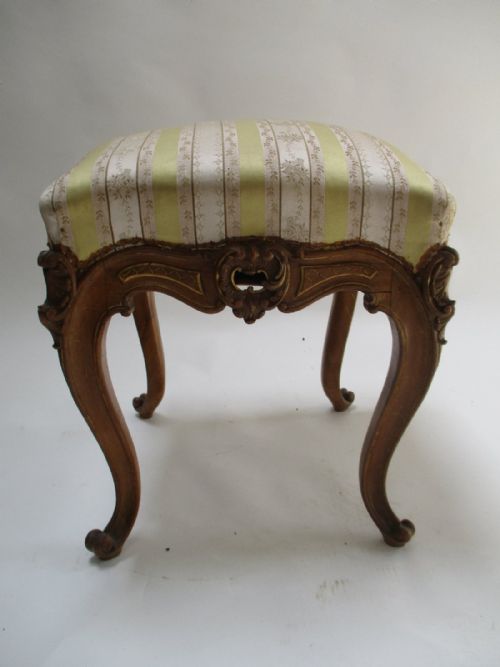
When you search for a gilt cabriole leg ottoman, you are looking at low seating forms that range from small footstools to long benches and pairs of decorative stools. These pieces draw heavily on Continental Rococo, Louis XV revival, and Victorian rococo revival styles, bringing ornate curves and gilded surfaces into domestic spaces.
The versions you are most likely to meet on this page date from the nineteenth century, spanning periods from the Regency era through the late Victorian decades. They combine painted or gilded wooden frames with upholstered tops in fabrics such as linen.
How they were made
Maker workshops shaped these frames from beech, walnut, and other carved woods, applying layers of gesso before finishing the surfaces with gold leaf or paint. Artisans built the characteristic cabriole legs with integrated flowing curves that reference French chateau designs.
Upholstery completed the piece, securing fabric over padded seat foundations atop the wooden structures. Some pieces bear workshop stamps on the timber frames, recording the makers who produced them in centres like Paris.
Gilt Cabriole Leg Ottoman Retail Price Guide 2026
Typical asking prices for gilt cabriole leg ottoman among the pieces listed under this phrase on Sellingantiques today, from the lower quarter to the upper quarter. They describe what is for sale here now, not the wider market.
What varies in quality
The distinction between standard and superior pieces rests on the depth and crispness of the carved wood details upon the cabriole legs and frame rails. Master carvers achieved fluid, naturalistic contours that elevate the sculptural presence of the furniture.
The application of the gilding also separates tiers of quality, with genuine gold leaf and skilled burnishing outperforming simpler painted or metallic finishes. Original stamps from known Parisian workshops add documented provenance to select pieces.
Loidrault Freres Paris
The Gilt Cabriole Leg Ottoman Glossary
- Cabriole leg
- A furniture leg that curves out and then in, resembling the leg of an animal. This form became a defining feature of Louis XV and rococo revival design.
- Giltwood
- Timber that has been coated with gold leaf or gold paint. It provides the bright metallic sheen seen across nineteenth-century revival seating.
- Gesso
- A plaster-like mixture applied to wood surfaces to prepare them for gilding or painting. It creates a smooth base that holds fine carved details.
- Louis XV Revival
- A nineteenth-century design style that imitates the asymmetrical curves and natural motifs of the French eighteenth century. It informs many of the stools found here.
Gilt Cabriole Leg Ottoman: Frequently Asked Questions
What is a cabriole leg?
A cabriole leg is a curved furniture support that bends outward at the knee and tapers inward toward the foot. This classic silhouette defines many period seating pieces.
Craftsmen carved these shapes directly into the timber frame before applying surface finishes like gold leaf or paint.
How were these stools used?
These pieces served as footstools, low seating, or decorative benches in nineteenth-century interiors. They provided movable seating options around drawing rooms and parlours.
Their ornate frames allowed them to function as decorative accents when placed against walls or beside larger upholstery.
How do I date a gilt stool?
Dating relies on stylistic clues, construction methods, and materials such as the type of wood and upholstery foundation. Nineteenth-century pieces often reflect specific revival movements like the Louis XV style.
Makers' stamps or signatures burnt into the wooden frame can also provide precise attribution and production dates.
What is giltwood?
Giltwood is wood that has been covered with thin sheets of gold leaf applied over a prepared gesso ground. This technique creates a luminous and durable metallic surface.
Over time, the underlying red bole may show through areas where the gold leaf has worn thin from handling.