

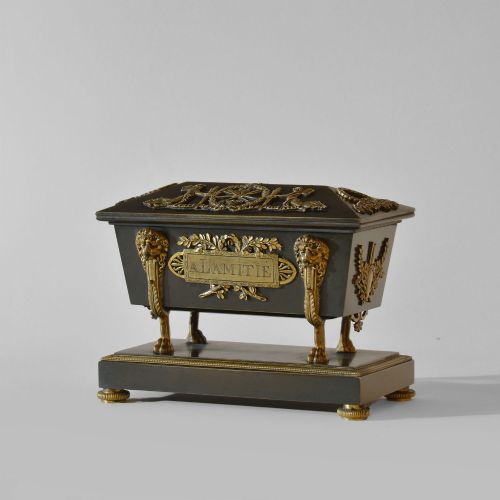


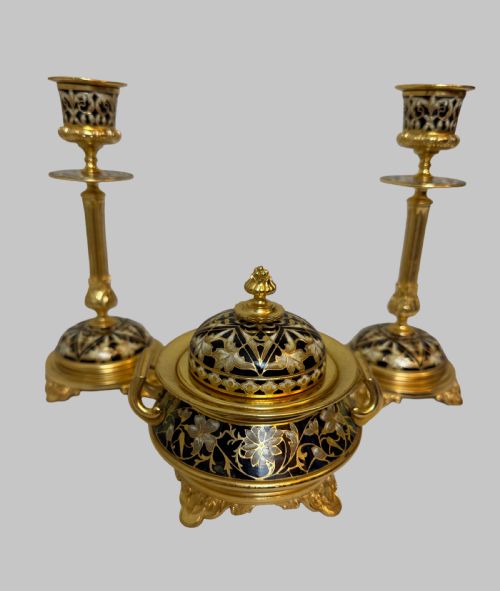


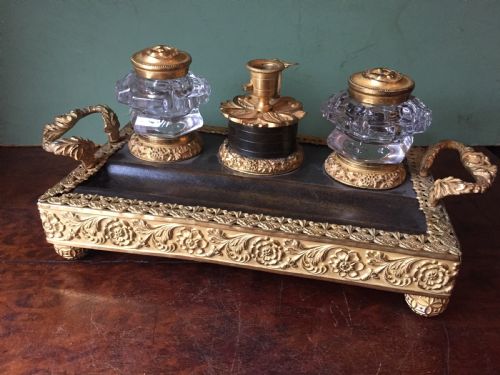


Gilt Bronze Writing Set
A gilt bronze writing set brings sculptural weight and polished refinement to a desk, combining inkwells and stands in cast metal and stone.
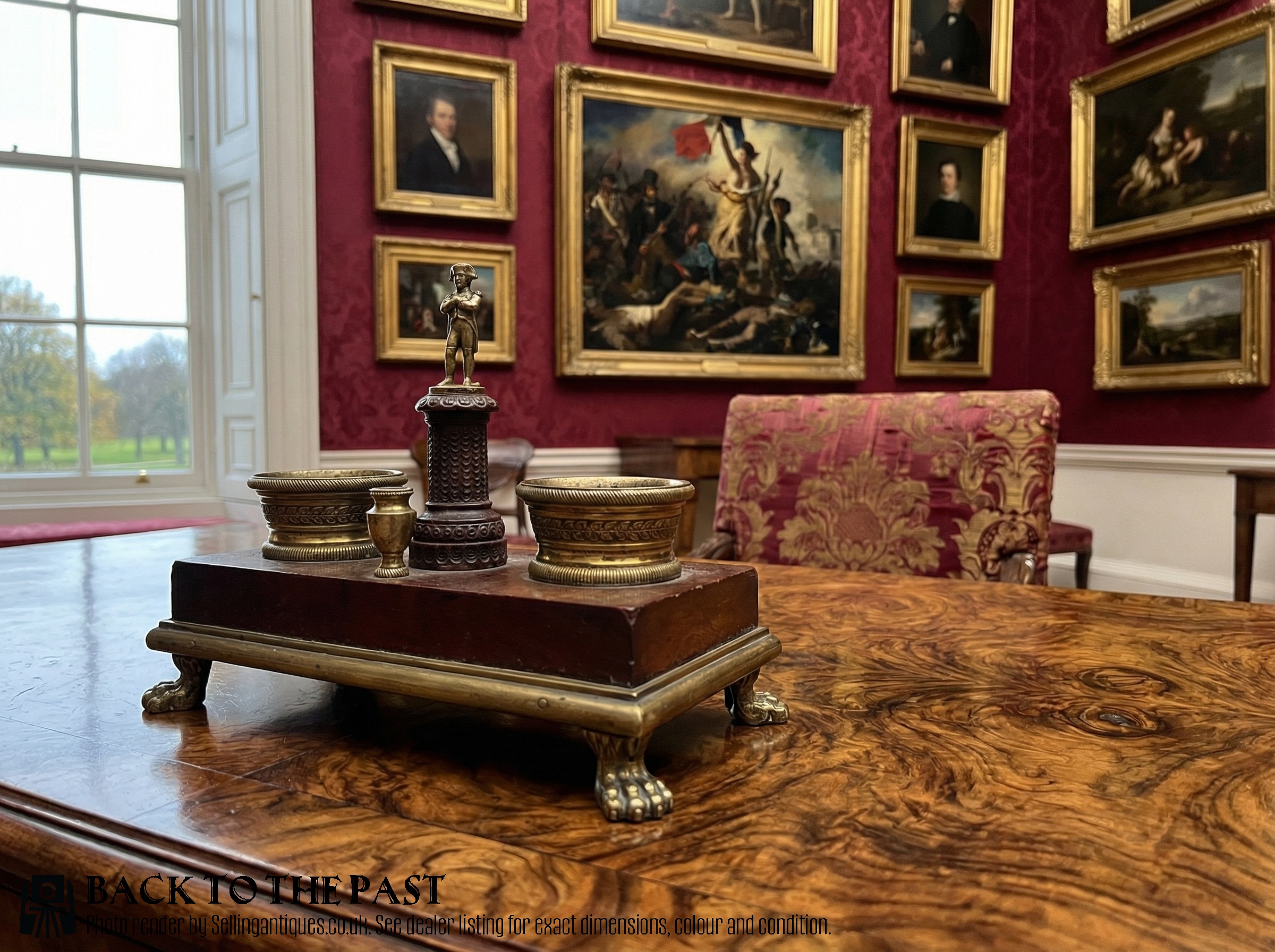
Gilt Bronze Writing Set
A gilt bronze writing set comprises desk accessories designed to hold writing materials, most commonly encountered as inkstands, inkwells, and desk sets mounted on stone bases. These pieces emerge predominantly from nineteenth-century French workshops, spanning styles from French Empire and Napoleon III to Art Nouveau.
Buyers will find individual inkstands paired with matching candlesticks, glass inkwells fitted in ormolu collars, and elaborate desk stands combining bronze figures with marble plinths. The forms range from simple neoclassical basins to figural groups depicting animals or historical busts.
Materials and construction
The foundation of these pieces relies on cast bronze or brass, finished with mercury gilding or modern electroplating to create the characteristic ormolu surface. This metalwork is frequently combined with turned and polished natural stones, including Sienna marble, vert marble, and onyx.
Many examples incorporate decorative details such as champlevé enamel panels, glass ink inserts, and occasional wooden bodies in mahogany or coromandel. The metal components are assembled with threaded pins and screws, uniting heavy cast mounts with stone bases.
Gilt Bronze Writing Set Retail Price Guide 2026
Typical asking prices for gilt bronze writing set among the pieces listed under this phrase on Sellingantiques today, from the lower quarter to the upper quarter. They describe what is for sale here now, not the wider market.
Cats, emus, and Napoleon join the desk sets.
Distinctions in quality
Quality reveals itself primarily in the crispness of the metal chasing and the depth of the gilding. Finer pieces exhibit sharp relief in cast foliage and figures, whereas weaker examples show softened edges and flat surfaces.
The selection and preparation of the stone base also determine the tier of the piece. Dense, unblemished marble with precise bevelling distinguishes superior desk sets from simpler brass and glass combinations.
Albert Marionnet·Moser
The Gilt Bronze Writing Set Glossary
- Ormolu
- Gilded bronze, where a layer of gold is applied to a bronze base using mercury amalgamation or electrochemical processes. This technique produces the warm, golden lustre seen on nineteenth-century French desk sets.
- Encrier
- A French term for an inkstand or inkwell. These portable desk vessels typically house one or more glass or ceramic ink inserts.
- Champlevé
- An enamelling technique where troughs or cells are hollowed out of a metal surface and filled with vitreous enamel paste before firing. It appears as colourful geometric or floral decoration on bronze desk accessories.
- Sienna marble
- A yellow-gold decorative limestone quarried in Italy, featuring dark grey or brownish veins. It provides a striking contrast to mounted gilt bronze ormolu.
Gilt Bronze Writing Set: Frequently Asked Questions
How do I care for gilt bronze?
Dust the metal gently with a soft, dry brush to prevent the accumulation of dirt in recessed chasing. Avoid liquid cleaners, polishes, or abrasive cloths, which can strip the thin gilt layer from the bronze surface.
For stone bases, use a damp cloth followed by immediate drying to protect the polished surface of the marble or onyx.
Are the inkwells functional?
Most antique inkwells retain their original fitted glass or ceramic inserts, which held the liquid ink during the nineteenth century. While they can still hold ink, modern users often keep them dry to preserve the fragile interior materials.
Inspect the collar fittings to ensure the glass inserts lift out safely for cleaning without forcing the surrounding bronze mount.
How do I distinguish French Empire style?
French Empire pieces rely on classical symmetry, clean architectural lines, and martial or neoclassical motifs cast in heavy ormolu. They frequently pair dark marble bases with formal gilt bronze mounts.
This aesthetic contrasts with later nineteenth-century Victorian or Art Nouveau designs, which favour asymmetrical floral curves and naturalistic animal figures.