
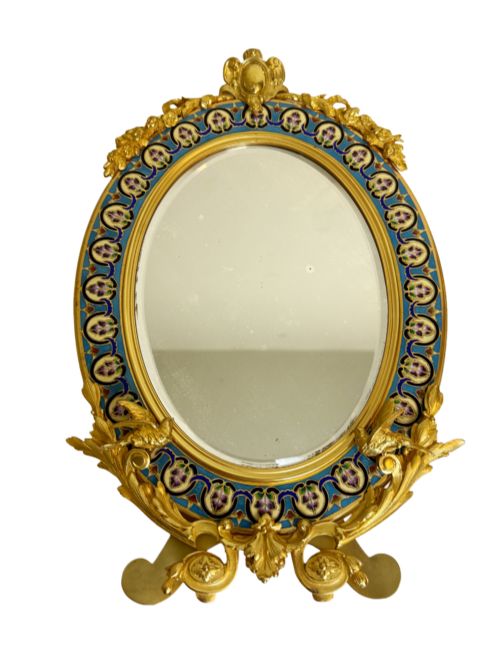
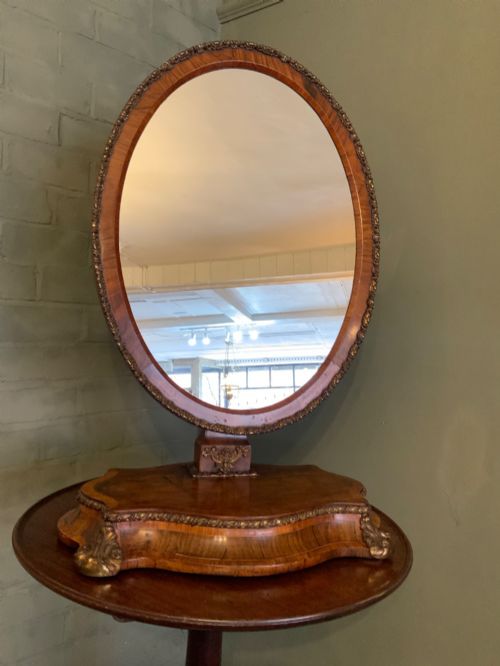


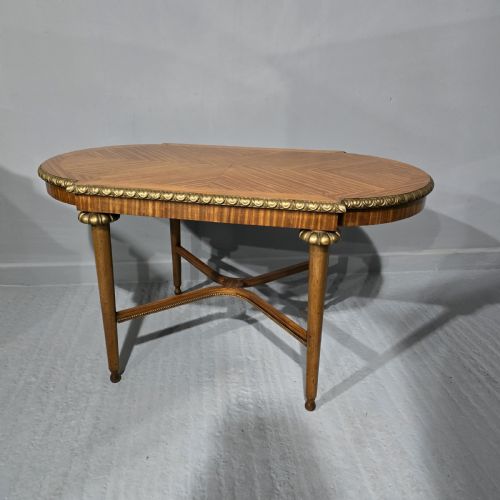


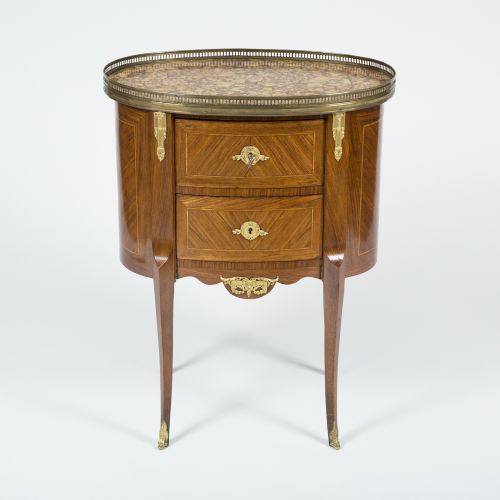

Gilt Bronze Oval Table
These gilt bronze oval table pieces bring French revival elegance and heavy gilt mounts to a room.
Gilt Bronze Oval Table
When you search for a gilt bronze oval table, you encounter nineteenth-century French and English occasional furniture designed with curved tops and cast metal mounts. The examples appearing on this page span centre tables, dressing mirrors, and commodes rather than standard dining furniture.
Most pieces date from the nineteenth century into the early twentieth century, drawing heavily on Louis XV and Louis XVI revival styles. These items typically feature polished timber carcases embellished with bronze, ormolu, or brass details.
The selection ranges from smaller dressing table mirrors and occasional tables to substantial centre tables and planters. Walnut, mahogany, and satinwood form the primary timber bases for these curved designs.
How they were made
The construction relies on combining dense cabinet timbers like mahogany, walnut, and satinwood with cast metal mounts. Artisans shaped timber carcases into curves before applying intricate brass and ormolu decorations.
Surface ornamentation often incorporates champlevé enamel, marquetry inlay, and marble tops to elevate the decorative scheme. Metal mounts are secured to the wooden frames to accentuate the curved outlines.
Listings feature nineteenth-century furniture employing ormolu, brass, and marquetry across various forms including centre tables and dressing mirrors.
What varies in quality
Quality reveals itself in the crispness of the bronze casting and the precision of the timber marquetry or brass inlay. Finer pieces demonstrate superior hand-chiselling on the metal mounts alongside well-figured cabinet woods.
The integration between the stone or glass inserts and the surrounding timber framework also dictates the standard of the piece. Subtlety in the revival styling and structural balance separate standard production from exhibition quality.
A. Beurdeley·Jackson & Graham
The Gilt Bronze Oval Table Glossary
- Ormolu
- Gilt bronze ornamentation applied to furniture and decorative objects. This technique involves coating a bronze base with a finely ground gold-mercury amalgam and heating it.
- Champlevé
- An enamelling technique where troughs or cells are sunk into a metal surface and filled with vitreous enamel. The piece is then fired and polished flat.
- Marquetry
- Decorative veneer applied to furniture in patterned designs using different coloured woods, metals, or shells. This method creates pictorial or geometric surface decoration.
- Etagere
- A piece of furniture consisting of a set of open shelves for displaying small objects. These tiered stands often incorporate brass mounts and slender uprights.
- Breche d'alep
- A type of quarried marble featuring brecciated patterns of brown, cream, and grey. It frequently appears as a decorative top on nineteenth-century commodes and tables.
Gilt Bronze Oval Table: Frequently Asked Questions
What is a gilt bronze oval table used for?
These pieces serve primarily as decorative centre tables, occasional stands, or dressing mirrors within a principal reception room or bedroom.
Their curved profiles allow them to soften the geometry of a room while providing a surface for lamps, decorative objects, or toiletries.
How do I identify Louis XV style?
Louis XV style furniture relies on asymmetrical curves, cabriole legs, and naturalistic scrollwork without straight lines. Gilt bronze mounts typically trace the organic outlines of the piece.
This aesthetic emphasises lightness and movement, contrasting with the heavier symmetry found in earlier periods.
Are marble tops original?
Many nineteenth-century commodes and tables were designed specifically to accept inset marble slabs such as breche d'alep. These stone surfaces provided a durable, cooling top for washing or display.
Matching the thickness and edge profile of the marble to the timber rebate helps confirm its period origin.
How should I clean ormolu mounts?
Ormolu mounts require gentle dusting with a soft dry brush to remove particles from the recessed chiselling. Avoid abrasive metal polishes that strip away the remaining gold surface.
Professional conservation is recommended if the gilding shows active tarnish or green oxidation.