

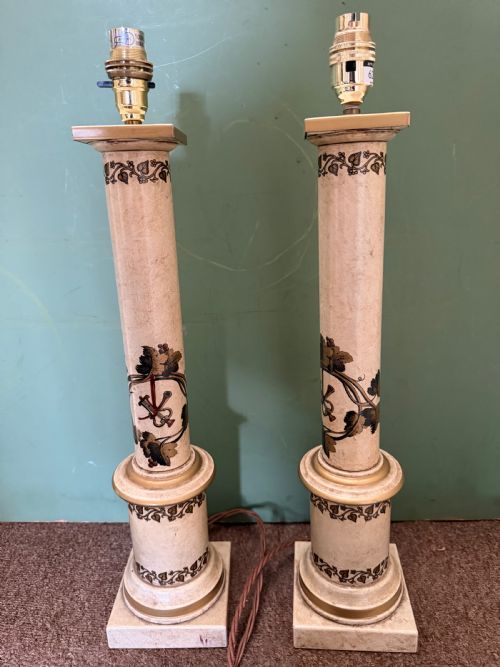


Gilt Brass Column Lamp
A gilt brass column lamp brings architectural dignity and warm illumination to a room, standing on classical foundations of brass, ormolu, and marble.
Gilt Brass Column Lamp
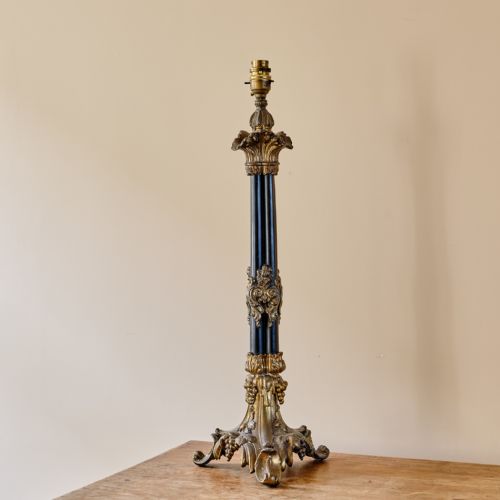
A gilt brass column lamp is a vertical lighting fixture modeled after classical architectural orders, designed to anchor a scheme with formal balance and rich metallic sheen. When you examine a gilt brass column lamp on this page, you encounter pieces spanning the nineteenth century and the early twentieth century, alongside Regency, William IV, and Victorian interpretations.
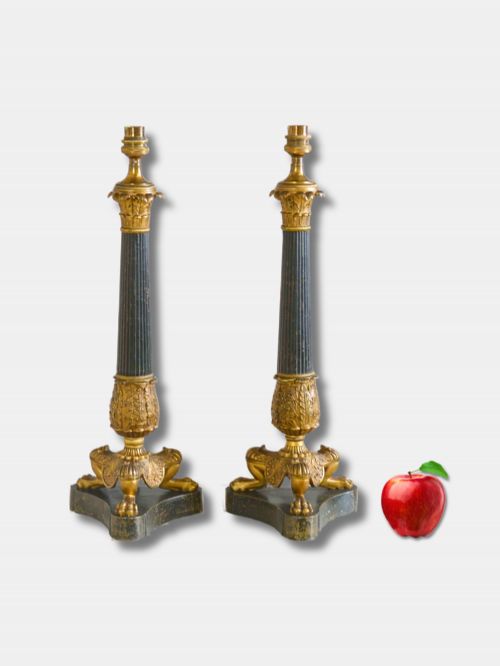
The selections range from compact boudoir table lamps to tall floor standards and converted oil lamps, frequently drawing upon French Empire, Neoclassical, and Rococo Revival design vocabularies. Most examples incorporate columnar shafts supported by square bases, sometimes resting upon lions paw feet or enriched with acanthus leaf capitals.
Many items begin life as church candlesticks, oil lamps, or heavy bronze desk pieces before receiving modern electrical fittings. Pairs appear regularly alongside single standards, offering symmetrical options for sideboard or mantel placement.
Materials and construction
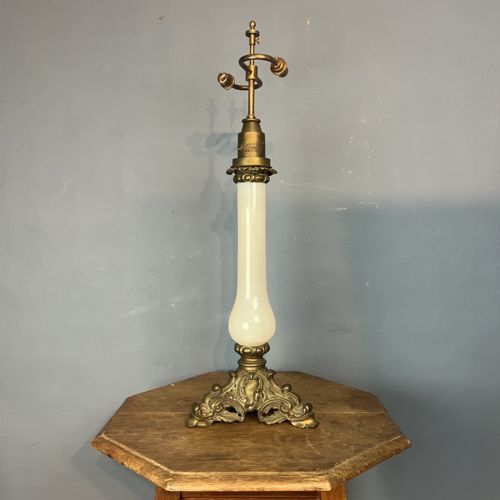
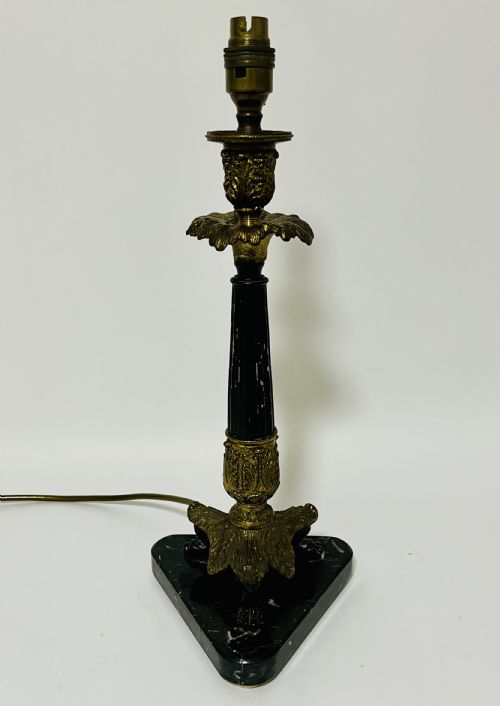
Maker workshops built these standards using heavy cast brass, bronze, and ormolu, often combining the warm metallic surfaces with contrasting columns of white marble, green opaline glass, onyx, alabaster, or ebonised wood. Gilt layers are applied through mercury gilding on older French pieces or standard electroplating on later Victorian and Edwardian productions.
Details such as Corinthian capitals, stepped plinths, and decorative collars are cast in separate sections and mechanically joined or threaded together to form a rigid vertical shaft. Components like opaline glass bodies and tole-peinte metal cylinders introduce vibrant colour contrasts to the polished metal frameworks.
Several heavy column lamps began their careers holding candles in nineteenth-century churches before finding new life beside a modern sofa.
Judging quality and craftsmanship
Quality rests in the crispness of the casting and the depth of the chased ornamentation upon the capitals and bases. Superior models display sharply defined acanthus leaves and clean fluting that retain their original definition beneath the gilding.
The choice of secondary materials marks the distinction between standard production and high-end commissions. Solid marble columns, substantial bronze mounts, and weighted bases provide physical stability and visual authority absent in lighter alloy versions.
Mc Garys Patent
The Gilt Brass Column Lamp Glossary
- Ormolu
- Gilded bronze produced by applying a mercury and gold amalgam to a bronze base and heating it until the mercury vaporised. This historic French technique yields a deep, matte golden finish found on fine nineteenth-century specimens.
- Corinthian column
- An architectural order featuring an ornate capital decorated with carved acanthus leaves and scrolls. This motif frequently caps the tall shafts of formal nineteenth-century lighting standards.
- Tole-peinte
- Painted or enamelled sheet metal, often rendered in black or dark green. It provides a contrasting dark cylindrical body on Empire and Regency style lighting fixtures.
- Opaline glass
- An opaque, slightly translucent glass developed in pale blue or green shades. It appears in column bodies to catch and diffuse the ambient light.
- Etagere
- A set of open shelves supported by columns, occasionally adapted to incorporate a lamp standard. It combines display space with vertical illumination.
Gilt Brass Column Lamp: Frequently Asked Questions
How do I date a gilt brass column lamp?
Dating relies upon stylistic markers such as the proportion of the base, the casting method of the capital, and the presence of registration stamps or patent marks. Regency and William IV pieces often display heavier cast bronze components and crisper hand-chasing than mass-produced Edwardian equivalents.
Material combinations also indicate age. Early nineteenth-century examples frequently pair fire-gilded ormolu with genuine marble or slate bases, while twentieth-century versions may utilise simpler brass plating over turned steel tubing.
Were these always electric lamps?
Most antique examples began life as something else entirely. Many started as oil lamps with heavy brass fonts, while others served as altar candlesticks or decorative architectural columns before conversion.
Conversion work usually occurred during the twentieth century, routing wiring through the central core or adding side-mounted switches while retaining the original metalwork intact.
How should I clean the metalwork?
Preserving the original patina requires minimal intervention. Gentle dusting with a dry microfiber cloth prevents the accumulation of grime without abrading thin gilt surfaces.
Avoid chemical brass cleaners and abrasive polishes, as these agents strip away historic gilding and expose the base metal underneath.
Are these lamps stable enough for floor use?
Floor standards and heavier table columns utilise weighted iron or brass internal bases designed to maintain balance during daily use. Their substantial mass prevents tipping under the weight of standard fabric shades.
Placement on level flooring ensures secure footing for tall structures, particularly those featuring heavy marble or bronze components.