

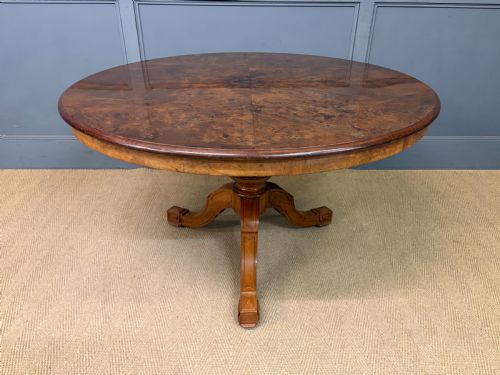


Gillows Style Dining Table
A gillows style dining table brings architectural restraint and fine cabinet work to a room, built by makers who set the standard for English dining furniture.
Gillows Style Dining Table
When you search for a gillows style dining table, you are looking at substantial timber furniture designed for formal dining, mostly originating from the Regency, Georgian, and early Victorian periods. These pieces often draw on the design vocabulary associated with the renowned firm of Gillows of Lancaster and London, showing the clean proportions and structural integrity characteristic of that workshop.
Alongside tables built specifically for dining, the selection includes related serving forms such as sideboards, console tables, and serving tables in mahogany and rosewood. These items share the architectural detailing and precise cabinet work found on the dining boards themselves.
What varies in quality
Quality rests primarily on the selection of timber and the precision of the cabinet work. Tables built with heavily figured flame mahogany veneer and consistent grain matching show a higher degree of workshop ambition than those made with plain secondary woods.
The execution of turnings, brass mounts, and the smoothness of any extending mechanism distinguish standard production from exceptional examples. A well-balanced proportion and crisp detailing indicate the hand of a skilled maker working within the recognised style.
Gillows Style Dining Table Retail Price Guide 2026
Typical asking prices for gillows style dining table among the pieces listed under this phrase on Sellingantiques today, from the lower quarter to the upper quarter. They describe what is for sale here now, not the wider market.
Some tables extend so far they require extra wooden support legs that pop out like startled deer.
Gillows of Lancaster
The Gillows Style Dining Table Glossary
- Flame mahogany veneer
- A thin slice of timber cut from the point where a branch joins the main trunk, producing a distinctive fire-like grain pattern. Cabinet makers applied this veneer to prominent surfaces like table tops to create visual impact.
- Boxwood stringing
- A narrow line of pale yellowish wood inlaid into grooves on table tops or legs. This technique provides a sharp border and accentuates the geometry of the piece.
- Centre table
- A freestanding table designed to be viewed from all sides, placed in the middle of a room rather than against a wall. Many circular breakfast tables double in function as centre tables.
- Regency
- An architectural and decorative style spanning the early nineteenth century, characterised by classical restraint and inspiration from ancient Greece and Rome. Tables from this period often feature reeded legs and brass detailing.
- Jupe style
- A specialised mechanism for extending a circular dining table while keeping the top round. Invented in the nineteenth century, it uses radial leaves that expand outward from the centre.
Gillows Style Dining Table: Frequently Asked Questions
How do I seat more guests?
Many of these tables are extending formats that accept additional leaves to increase the length of the top. Pulling the frame apart reveals channels where extra sections drop in to accommodate larger dining groups.
Once the leaves are secured, the table functions as a single stable surface. When the meal concludes, the leaves lift out and the frame closes back down for daily use.
Can I use a centre table for dining?
Circular centre and breakfast tables from the Regency and Victorian periods often match the standard dining height. Their pedestal bases allow chairs to tuck underneath easily without blocked leg corners.
While they lack the vast length of extending dining boards, smaller households use them comfortably for everyday meals. Their proportion suits smaller dining rooms and libraries.
What is flame mahogany?
Flame mahogany is a decorative veneer sliced from the junction where a branch meets the tree trunk. The grain swirls in a dramatic, feather-like pattern that resembles flickering fire.
Cabinet makers laid these veneers across table tops to catch the light and display the rich red-brown tones of the timber. It marks a piece intended for a principal reception room.
How do I tell Regency from Victorian?
Regency pieces lean towards neoclassical restraint, featuring clean lines, reeded legs, and subtle brass stringing or mounts. The proportions remain light and architectural, reflecting early nineteenth-century taste.
Victorian furniture tends to be heavier in scale, sometimes incorporating bolder carvings, rosewood timbers, or more elaborate mechanical systems for extending boards. The construction remains solid but shifts towards denser forms.