
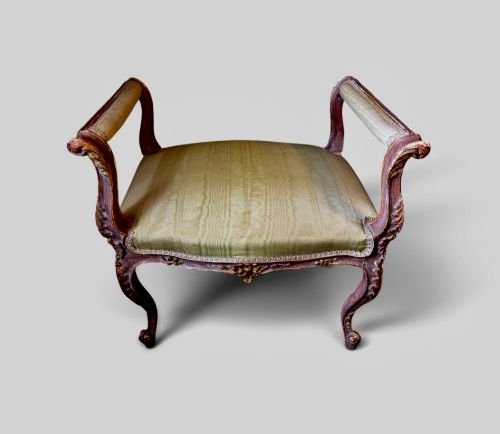
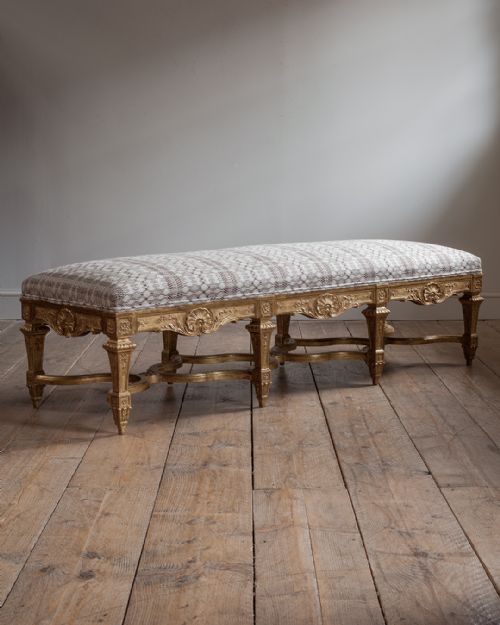
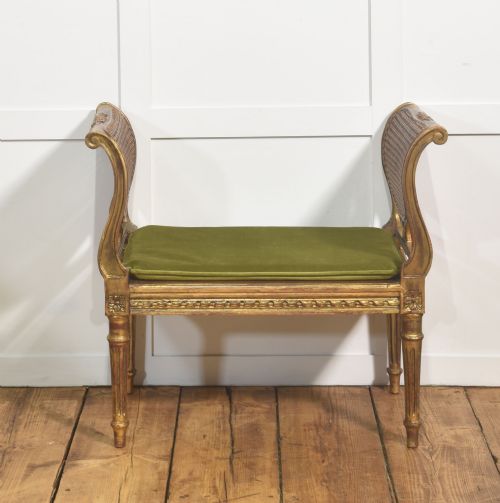
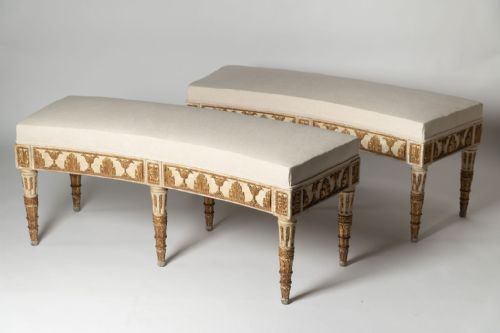


Gilded Window Seat
A gilded window seat brings classical elegance to a room, offering a slender form designed to sit neatly beneath a casement.
Gilded Window Seat
A gilded window seat is a low seating form designed for placement beneath a window or in a hallway, combining architectural presence with functional utility. The examples found here span the nineteenth and early twentieth centuries, drawing heavily upon classical French and Italian design vocabularies.
Most pieces encountered on this page belong to the nineteenth century, including specific Regency, Victorian, and Edwardian interpretations up to the nineteen-thirties. Forms range from compact stools and X-frame curule designs to longer settees and duet stools meant for two.
Stylistic influences lean towards Louis XVI, Neoclassical, and Rococo revivals, reflecting historicist tastes that favoured ornate gilt finishes and balanced proportions. These seating pieces function equally well as standalone decorative accents or practical seats in reception rooms.
What Varies in Quality
Quality reveals itself in the crispness and depth of the wood carving, where hand-tooled gesso and meticulous joinery distinguish superior pieces from simpler utilitarian items. The finesse of the gilding application, whether bright leaf or toned finish, sets the visual standard for the frame.
The integrity of the underlying structure and the authenticity of period upholstery materials dictate the longevity and historical coherence of the piece. Refined proportions and balanced decorative motifs separate exceptional revival pieces from more standard domestic seating.
The inventory includes multiple regional interpretations, notably French Neoclassical and Italian Neoclassical stylistic variations.
The Gilded Window Seat Glossary
- Giltwood
- Wood that has been coated with gold leaf or a metallic substitute. This finish provides the characteristic metallic sheen seen on classical frames.
- Curule stool
- An ancient Roman shape featuring intersecting curved legs forming an X-form base. These portable seats often featured rich surface decoration in later revival periods.
- Gesso
- A plaster-like mixture applied to wood surfaces as a base for paint or gilding. It allows craftsmen to carve intricate relief details before applying gold leaf.
- Canework
- Woven rattan or cane material used for seat panels and backs. This technique introduces a light, airy texture to heavier wooden frames.
- Neoclassical
- A style reviving classical Greek and Roman architectural and decorative motifs. It emphasises symmetry, straight lines, and restrained ornamentation.
Gilded Window Seat: Frequently Asked Questions
Where should I place a window seat?
These low seats fit naturally beneath large windows, narrow hallways, or at the foot of a bed where deep seating is unnecessary. Their slender proportions allow them to occupy transitional spaces without blocking light or movement.
They also serve well as occasional seating in living rooms or studies, providing a decorative focal point when paired with complementary furnishings.
How do I identify a Louis XVI style piece?
Louis XVI pieces are characterised by straight tapered legs, geometric symmetry, and classical motifs like fluting and ribbon twists. This style contrasts with the earlier curving lines of Rococo design.
In giltwood seating, this translates to rectilinear frames and restrained ornamentation that echo classical architecture.
What is a duet stool?
A duet stool is an elongated seating form originally designed for two people to sit together, often placed at a piano or dressing table. They provide extra length compared to standard square stools while maintaining a low profile.
Examples from the nineteenth century frequently feature upholstered tops supported by carved wooden frames.
How do I care for giltwood furniture?
Giltwood requires gentle maintenance to protect the delicate gold leaf and underlying gesso layers from moisture and abrasion. Dusting should be done lightly with a dry, soft cloth rather than chemical polishes.
Keeping these pieces away from direct sunlight and dramatic temperature shifts preserves the metallic finish over time.