

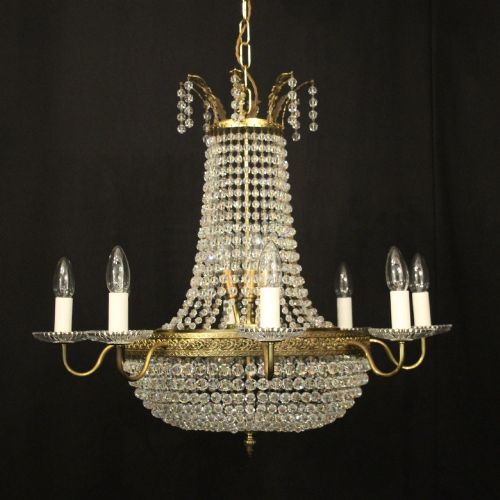
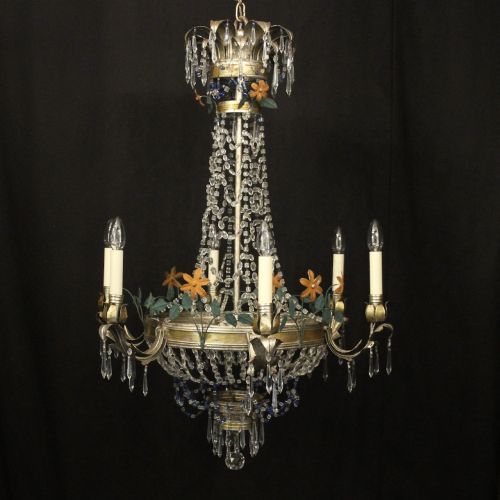
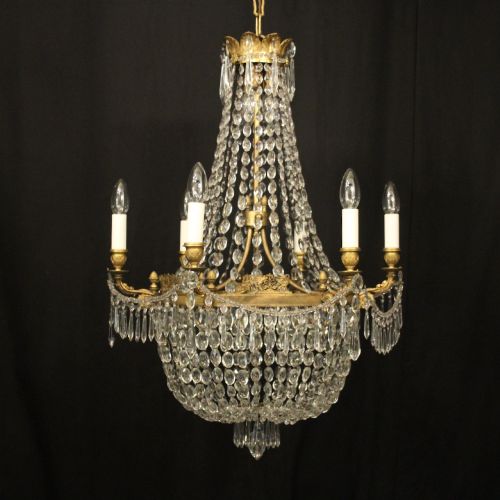
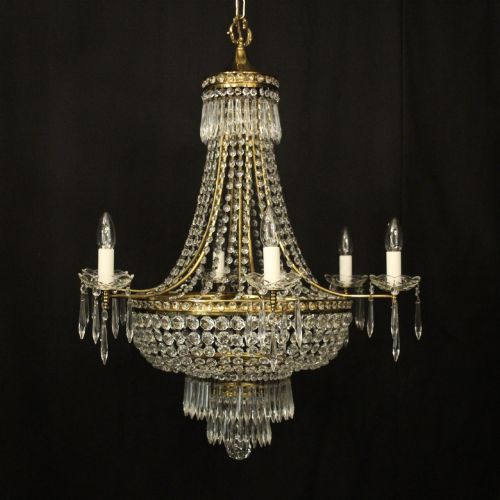


Gilded Waterfall Chandelier
A gilded waterfall chandelier brings cascading crystal and warm metallic frames to a room, offering grand illumination from French Chateau, Empire, and Edwardian design traditions.
Gilded Waterfall Chandelier
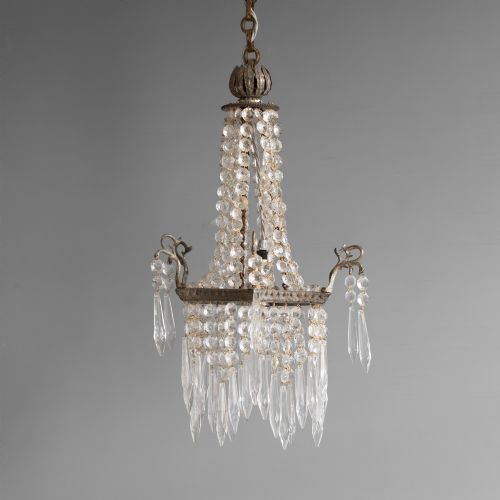
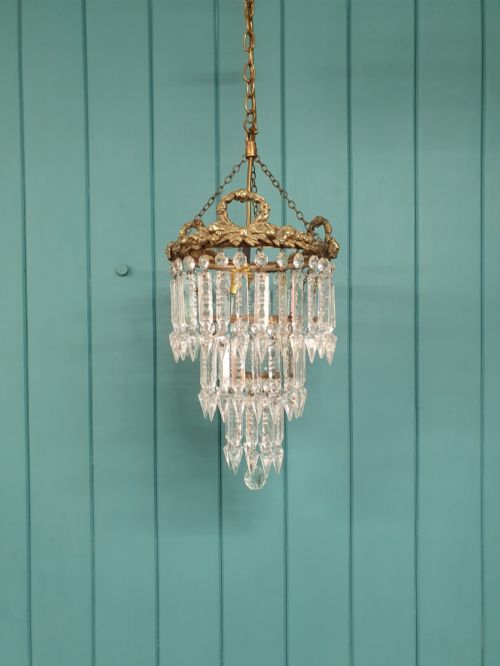
A gilded waterfall chandelier is a hanging ceiling light defined by a cascading arrangement of glass or crystal drops suspended from a metal frame. When you search for a gilded waterfall chandelier, you are looking at overhead lighting fixtures designed to catch and refract light through dense layers of crystal.
The pieces on this page span the nineteenth century, the Edwardian era, and the 1930s, alongside French provincial styles such as Chateau, Empire, Rococo, and Neoclassical. Most examples originate from French workshops or follow continental design traditions, ranging from compact nine-light fittings to larger fifteen- and sixteen-light chandeliers.
Beyond the standard tent and waterfall configuration, the selection includes related ceiling lights such as basket chandeliers, pendant lights, and lustre fixtures. These variations share a dependence on faceted glass elements mounted to gilt bronze, brass, or gilded metal frames.
Materials and Construction
The structural framework of these chandeliers relies on cast or forged metals, predominantly brass, bronze, and gilt metal, which receive a gold-toned finish or silver-gilded surface. These metal armatures support the weight of numerous glass components while providing the structural path for electrical wiring or historical candle arms.
Suspended from the metal frames are cut glass and crystal glass elements, including faceted drops, beads, and bag formations that create the characteristic cascading waterfall effect. Artisans wired these crystal strands individually to the metal rings, securing each pendant by hand to form dense veils of glass.
Gilded Waterfall Chandelier Retail Price Guide 2026
Typical asking prices for gilded waterfall chandelier among the pieces listed under this phrase on Sellingantiques today, from the lower quarter to the upper quarter. They describe what is for sale here now, not the wider market.
Listings feature pieces spanning the nineteenth century, the Edwardian era, and the 1930s, constructed from brass, bronze, gilt metal, and cut crystal glass.
Assessing Quality and Execution
Quality in these chandeliers rests on the depth of the metal gilding and the precision of the crystal cutting. Finer examples feature hand-chased bronze or robust brass mounts with heavy gold leaf application, whereas simpler pieces utilise lighter gilded metal frames.
The glass elements themselves determine much of the visual impact. Higher quality pieces incorporate hand-cut crystal with sharp facets that maximise light refraction, distinguished from simpler pressed glass drops that diffuse light more softly.
The Gilded Waterfall Chandelier Glossary
- Waterfall chandelier
- A lighting fixture featuring a cascading design where numerous crystal drops flow outward and downward from a central ring or crown.
- Tent and waterfall
- A specific configuration where an upper conical section of strung crystal beads sits above a looser, cascading lower tier of hanging drops.
- Gilt bronze
- Bronze metal treated with a thin layer of gold or gold leaf, providing a durable metallic finish that resists tarnishing over decades.
- Lustre
- A small ceiling light or candleholder adorned with hanging glass pendants designed to enhance the brightness of the flame or bulb.
- Cut glass
- Glass shaped and faceted by grinding against a wheel, producing sharp edges that catch and split light far more effectively than moulded glass.
Gilded Waterfall Chandelier: Frequently Asked Questions
How do I clean a crystal chandelier?
Cleaning requires a specialist glass cleaner applied gently by hand to each individual crystal drop while it remains suspended on the frame. Avoid harsh chemical sprays that might damage the underlying gilt metal finish.
For thorough maintenance, technicians often remove the crystal strands entirely for washing in warm soapy water before reattaching them to the brass or bronze armature.
Are these chandeliers suitable for low ceilings?
Most waterfall chandeliers possess a significant vertical drop, making them better suited to rooms with high proportions. Compact nine-light versions and smaller basket or lustre fixtures can occasionally accommodate standard ceiling heights.
Careful measurement of the suspension chain length helps determine whether a particular chandelier will clear household foot traffic.
How do I date an antique chandelier?
Dating relies on examining the construction methods of the metal frame, the style of the brass mountings, and the cut of the crystal drops. Edwardian and 1930s pieces often show specific wiring channels and casting techniques distinct from nineteenth-century examples.
Stylistic markers such as French Empire or Rococo revival details also help place a fixture within its correct period of manufacture.
Can antique chandeliers be wired for modern electricity?
Almost all historical chandeliers found on the market have been adapted for modern electrical supplies, replacing original candle sockets with wired fittings. Professional electricians can easily update internal wiring to meet current safety standards without altering the external appearance.
Inspecting the bulb holders and internal channels ensures the fixture integrates safely into a modern domestic electrical circuit.