
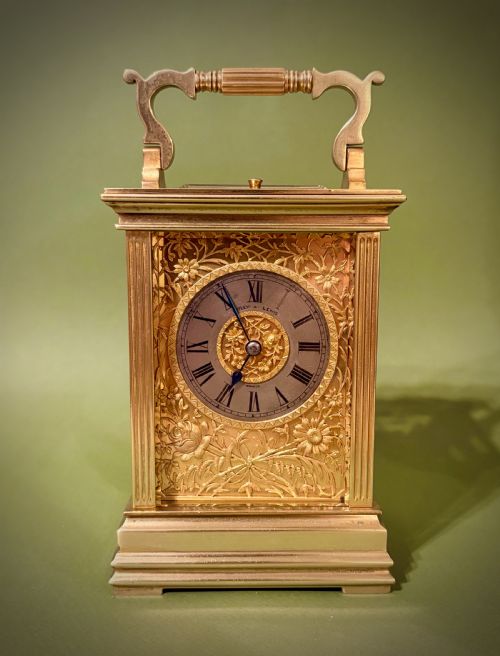
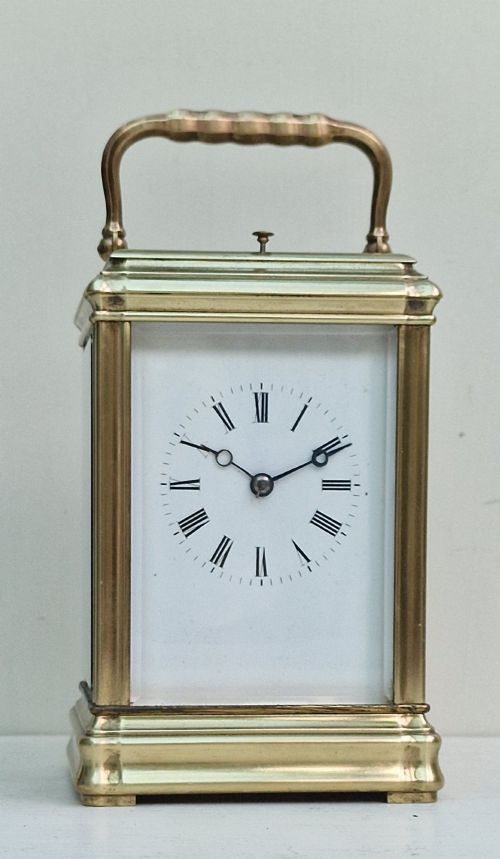


Gilded Repeating Carriage Clock
A gilded repeating carriage clock is a portable mechanical timepiece enclosed in glass and gilded metal, desired for its complex striking mechanism and gleaming presence.
Gilded Repeating Carriage Clock
When you search for a gilded repeating carriage clock, you enter a field dominated by nineteenth-century French horology. These portable timepieces combine mechanical complexity with striking architectural brass and glass cases.
The pieces you meet on this page hail from periods spanning the Victorian era through the late nineteenth century, including specific decades such as the eighteen sixties, eighteen seventies, eighteen eighties, and nineteen hundreds. Most examples display French origins, reflecting the dominant manufacturing centres of the epoch.
Forms vary from standard gorge cases to elaborate designs featuring enamel bandings, mask dials, and panels. Buyers encounter both simple repeating movements and more advanced petite sonnerie or grande sonnerie complications.
How they were made
Maker workshops constructed these clocks using robust brass frameworks, often applying heavy gilding to the exterior metal surfaces. Bevelled glass panels fitted snugly into the case frames to protect the delicate internal steel gear trains while allowing full visibility of the movement.
Enamel dials and panel bandings provided contrasting white and coloured surfaces beneath the glass. Artisans painted numerals and intricate details onto these enamel grounds before firing them to a durable finish.
Early travellers kept these heavy metal clocks in leather outer cases to survive bumpy carriage rides without smashing the glass.
What varies in quality
Quality in a gilded repeating carriage clock rests in the ambition of its movement and the crispness of its metalwork. Complex striking trains like grande sonnerie require superior engineering compared to standard time-and-strike configurations.
The preservation of original gilding and the sharpness of cast or engraved case decorations separate standard examples from exceptional ones. Intact enamel panels without hairline cracks and fully restored, original movements elevate the standing of a piece considerably.
Alfred Drocourt·J.W.Benson
The Gilded Repeating Carriage Clock Glossary
- Gorge case
- A distinct rectangular brass carriage clock case style characterised by stepped mouldings at the top and base. This architectural framing houses glass panels on all four sides and the top.
- Repeating mechanism
- A mechanical complication activated by pressing a button or cord on the case, causing the clock to restrike the last hour and quarters on demand. This function allowed time checks in unlit rooms during the night.
- Petite sonnerie
- A striking train that sounds the hours on the exact hour and chimes the quarters at each quarter-hour without repeating the hours. It represents a higher grade of horological complexity.
- Grande sonnerie
- A sophisticated movement that chimes both the hours and the preceding quarters automatically at every quarter-hour interval, alongside repeating capabilities. Such mechanisms require intricate gear trains and expert adjustment.
- Mask dial
- The decorative plate surrounding the central time ring on the face, frequently embellished with engraved patterns or gilt ornamentation. It frames the enamel chapter ring where the numerals sit.
Gilded Repeating Carriage Clock: Frequently Asked Questions
What is a repeating carriage clock?
A repeating carriage clock is a portable timepiece equipped with a mechanism that chimes the hours and quarters when a lever or button is pressed. This allowed travellers and homeowners to hear the time in the dark.
These clocks were originally designed for officers and travellers on the move during the nineteenth century. Their robust brass and glass cases protected the intricate gear trains during transit.
How do I wind a carriage clock?
Winding requires a dedicated key inserted into the arbours located on the underside or backplate of the movement. Care must be taken not to overwind the mainsprings.
Most nineteenth-century French movements run for approximately eight days on a full wind. Regular maintenance by a qualified clockmaker ensures the delicate steel pivots and brass gears remain lubricated.
What is the difference between petite and grande sonnerie?
Petite sonnerie strikes the hours on the hour and the quarters at each quarter-hour without repeating the hour. Grande sonnerie chimes both the hours and the quarters at every quarter-hour automatically.
Grande sonnerie movements require significantly more power and complex gear trains to execute the dual striking sequence. Consequently, clocks with this complication are scarcer and demand greater horological skill.
How do I date a nineteenth century carriage clock?
Dating relies on stylistic clues, case architecture, escapement types, and maker signatures inscribed on the backplate. Victorian and late nineteenth-century French pieces often exhibit specific case evolutions from simple gorge frames to elaborate engraved designs.
Makers such as Alfred Drocourt left registration marks or signatures that help pinpoint the decade of manufacture. Examining the escapement, from early cylinder platforms to later lever platforms, provides further chronological markers.