
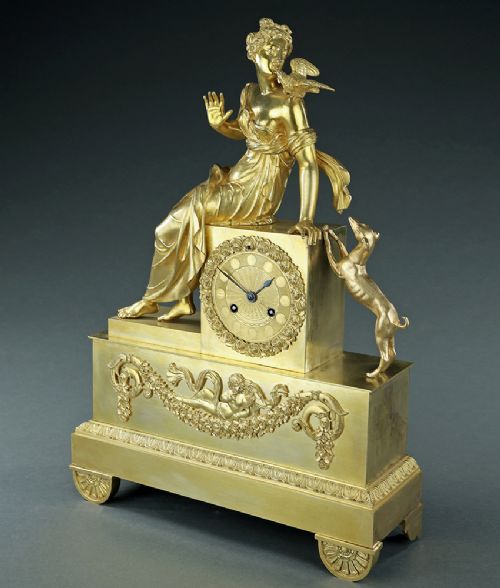

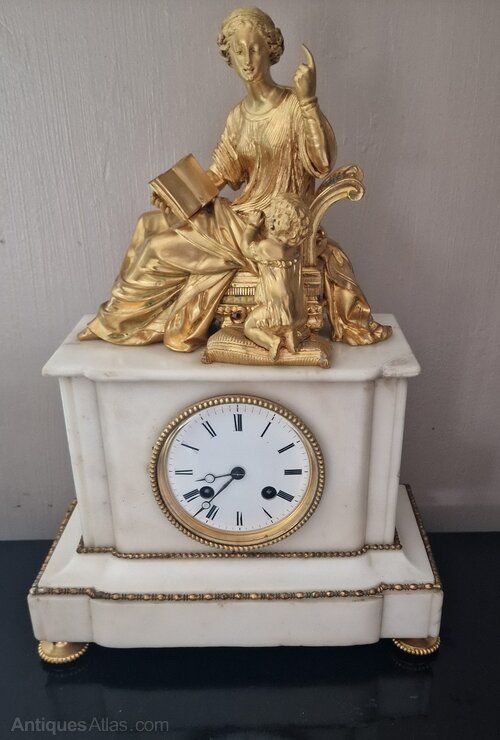


Gilded Figure Clock
A gilded figure clock combines ornamental metalwork with sculptural presence, serving both to measure time and anchor a room's decor.
Gilded Figure Clock
A gilded figure clock unites timekeeping with sculptural metalwork, frequently depicting classical deities, allegorical subjects or putti alongside the dial. These pieces span the nineteenth century, with Victorian examples and French workshop productions forming the core of what appears here.
Most entries belong to the mantel clock format, though wall clocks, longcase clocks and multi-piece garniture sets also occur. Styles draw heavily on French Empire, Louis XVI, Neoclassical and Rococo revivals, pairing gilded surfaces with contrasting materials.
Makers and retailers such as Berger, Deniere et Fils, Japy Freres and Phillipe H. Mourey contribute to the range. Figures such as Diana the hunter, personifications of chastity or romantic pairs frequently surmount or flank the clock case.
Materials and construction
Ormolu and gilt bronze provide the characteristic golden surface of these pieces, often combined with cast bronze details for figures and ornamentation. Fire gilding or electrogilding creates the rich metallic sheen over the base metal.
Marble and enamel frequently support and accent the metalwork, forming the clock bases and white enamel dial faces. Glass elements protect the dial, while brass components operate the internal movement of the clock.
Diana the hunter keeps permanent watch over time from the top of her gilt bronze perch.
Assessing quality and execution
The integration of the sculptural figure with the clock case and the choice of supplementary materials like fine marble influence the overall success of the piece. Signed movements and cases by known bronze-founders indicate higher workshop standards.
Berger, Paris·Deniere Et Fils·Japy Freres·Phillipe H. Mourey
The Gilded Figure Clock Glossary
- Ormolu
- Gilt bronze produced by applying a mercury and gold amalgam to a bronze object and heating it until the mercury vaporised. This historic technique yields a deep, durable golden finish.
- Garniture set
- A clock accompanied by matching decorative side pieces, such as urns or candelabra, designed to display together on a mantelpiece.
- Cartel clock
- A wall-mounted clock housed in an ornate, scrollwork frame typically made of metal or carved wood. These pieces sit directly against the wall surface.
- Enamel
- A glassy substance fused to metal under high heat to create smooth, glossy surfaces. It is most frequently found on clock dials bearing Roman or Arabic numerals.
- Putto
- A plump, naked male child figure, often depicted with wings. These motifs appear frequently in classical and revival decorative arts.
Gilded Figure Clock: Frequently Asked Questions
How do I wind a gilded figure clock?
Most of these clocks use a key-wound mechanical movement that requires a gentle turn of the winding key in the appropriate arbour on the dial face. Care must be taken not to overwind the mainspring.
Regulating the pendulum may also be necessary to maintain accurate timekeeping after moving the clock to a new surface.
Where should I place a mantel clock?
A sturdy, level surface such as a mantelpiece, sideboard or heavy console table provides the ideal foundation for a heavy bronze and marble clock. Ensuring the surface is completely flat helps the pendulum swing evenly.
Keeping the clock away from direct sunlight and damp environments protects the delicate ormolu finish and enamel dial from deterioration.
How do I clean ormolu surfaces?
Dusting gently with a soft, dry microfibre cloth removes everyday particles without harming the gilded metal. Avoid using liquid polishes, abrasive cloths or chemical cleaners, which can strip the thin layer of gold.
Professional conservation is recommended if deeper cleaning or restoration of the bronze is required.
How do I tell French Empire from Rococo styles?
French Empire pieces display strict symmetry, martial motifs and Neoclassical figures inspired by ancient Greece and Rome. They favour clean architectural lines and dark patinated bronze contrasts.
In contrast, Rococo revival clocks embrace asymmetrical scrollwork, naturalistic foliage, curves and playful putti or romantic themes.