
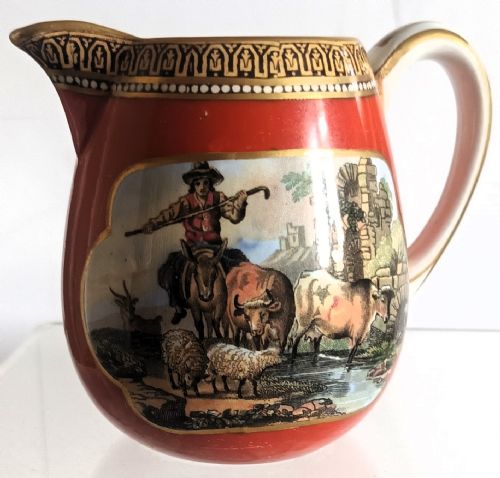


Gilded Ceramic Milk Jug
A gilded ceramic milk jug brings gilt-edged Regency elegance and Victorian refinement straight to the breakfast table.
Gilded Ceramic Milk Jug
A gilded ceramic milk jug is a pouring vessel designed for service at the tea or breakfast table, appearing in forms such as cream jugs, creamers, and larger pitchers. When you search for this phrase, you encounter pieces spanning the Georgian, Regency, and Victorian eras alongside later twentieth-century examples.
The most common versions on this page are porcelain and earthenware pieces decorated with gold leaf, gilding, or gold gilt. These items often form part of tea sets or stand alone as decorative jugs and ewers.
Origins range across English fine porcelain factories and continental works, encompassing traditional English designs as well as rococo revival styles. Makers such as Royal Worcester, H & R Daniel, Derby, Chamberlain Worcester, Royal Davenport, Meissen, and Rockingham dominate the heritage of these forms.
Materials and Construction
Potters shaped these vessels using porcelain and earthenware bodies, applying glaze to seal the ceramic base before decoration. Enamel colours and handpainted scenes of birds, insects, flowers, and armorial crests were then added alongside the ceramic body.
Gold leaf, gilding, and gold gilt were applied by hand to rims, handles, and panels, requiring careful firing to bond the metal to the glazed surface. Techniques such as rope edge moulding, ribbing, and second gadroon shaping further defined the profiles of these jugs.
Object types include standard milk jugs, cream jugs, creamers, cow creamers, decorative ewers, and complete three piece tea sets.
Judging Quality and Execution
Quality in a gilded ceramic milk jug rests on the crispness of the moulding and the finesse of the handpainting, such as detailed floral panels or signed fruit scenes. The precision of the gilding and the weight of the porcelain body distinguish finer factory production from standard wares.
The integration of form and ornament determines the merit of each piece, from the restrained elegance of Georgian armorial pieces to the elaborate decoration of Victorian and Rococo revival examples.
H & R Daniel·Royal Worcester·Derby Porcelain·Chamberlain Worcester·Royal Davenport·Meissen·Rockingham·Crown Derby
The Gilded Ceramic Milk Jug Glossary
- Gilding
- The application of gold leaf or gold gilt to the surface of porcelain or earthenware. This decorative technique highlights handles, rims, and painted panels.
- Porcelain
- A fine, vitrified ceramic material fired at high temperatures. It provides a smooth, white body ideal for detailed handpainting and gilding.
- Earthenware
- A porous ceramic body fired at lower temperatures than porcelain. It forms the base for traditional pottery items such as creamers and cow jugs.
- Gadroon
- A decorative carved or moulded ornamental band of radiating curves or fluting. Second gadroon moulding often appears around the lower body or rim of Regency pieces.
- Armorial
- A design featuring a heraldic coat of arms. These crests were handpainted onto porcelain jugs for wealthy patrons.
Gilded Ceramic Milk Jug: Frequently Asked Questions
How do I date an antique milk jug?
Dating relies on factory marks, the composition of the porcelain or earthenware body, and stylistic markers such as Regency gadrooning or Victorian forms. Comparing the handpainting style to known period examples helps narrow the decade of manufacture.
Changes in glaze formulas and gilding techniques across the Georgian, Victorian, and later periods also provide reliable clues for attribution.
Were these jugs used for daily dining?
Most of these vessels were created for formal tea and breakfast service in middle and upper-class households. They served to hold milk or cream alongside teapots and sugar bowls.
While robust enough for occasional modern use, many collectors display them to preserve delicate handpainted scenes and gold leaf.
What is a cow creamer?
A cow creamer is a novelty ceramic jug shaped in the form of a cow, designed to dispense milk or cream from its mouth. Makers like Pratt-ware and Jackfield produced these whimsical pieces during the nineteenth century.
They combine practical function with sculptural folk art appeal, often featuring slip-cast earthenware bodies and glossy glazes.