


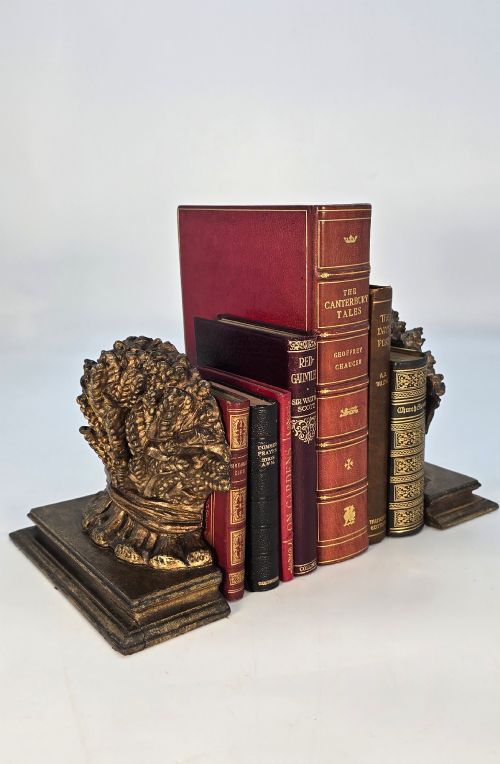


Gilded Bronze Desk Accessories
Gilded bronze desk accessories bring weight and polished lustre to a writing surface, combining cast metal with marble, glass and onyx.
Gilded Bronze Desk Accessories
When you search for gilded bronze desk accessories, you encounter functional items built to organise and equip a traditional writing table. The selection spans utilitarian desk sets, inkstands, heavy bookends, candlesticks, clocks, letter openers and figural inkwells.
The versions most frequently met on this page include French and English pieces created across the nineteenth and twentieth centuries. These range from Regency period wheat sheaf bookends to detailed animal figures and architectural inkstands incorporating glass and marble.
Makers and foundries utilised durable base metals to cast intricate botanical motifs, portrait busts and animal studies. Such objects served a practical purpose in studies and offices while doubling as decorative works of art.
How they were made
Foundries cast molten bronze into detailed moulds, employing techniques that allowed for sharp relief work in floral patterns, animal forms and classical figures. Artisans then applied a layer of gold through fire gilding or electrogilding to achieve a bright metallic finish.
Combinations of materials define many of these items, integrating cut crystal, onyx, marble and patinated bronze into the primary gilded structure. Fitted glass inserts served practical containment roles inside inkwells while contrasting with the heavy cast metal housings.
Gilded Bronze Desk Accessories Retail Price Guide 2026
Typical asking prices for gilded bronze desk accessories among the pieces listed under this phrase on Sellingantiques today, from the lower quarter to the upper quarter. They describe what is for sale here now, not the wider market.
Listings feature periods spanning from the Regency era through the nineteenth century and into the nineteen-fifties.
What varies in quality
The crispness of the chasing and the depth of the casting separate simpler utilitarian objects from superior works. Foundries employing skilled artisans achieved finer surface details in fur, feathers and foliate scrolls.
The preservation of the original surface finish and the integrity of supplementary materials such as marble bases and cut crystal inserts influence the overall standard. Heavier metal gauges and signed pieces indicate higher production standards.
Albert Marionnet·Asprey Of London·Bergmann
The Gilded Bronze Desk Accessories Glossary
- Ormolu
- A method of applying finely ground high-carat gold to a bronze base using a mercury amalgamation process. This technique produces a warm, durable metallic yellow sheen.
- Patinated bronze
- Bronze that has been treated with chemical solutions to alter its surface colour, often ranging from deep brown to dark green. It provides visual contrast against bright gilded highlights.
- Inkstand
- A tray or stand designed to hold one or more inkwells, pen rests and sometimes a matching sander or bell. These assemblies formed the centrepiece of a nineteenth-century desk.
- Chasing
- The manual finishing of a cast metal object using hammers and small steel punches to sharpen details and remove surface flaws. Superior chasing distinguishes high-end foundry work from mass production.
Gilded Bronze Desk Accessories: Frequently Asked Questions
What is an inkstand?
An inkstand is a desk accessory comprising a tray fitted with one or more inkwells and spaces for pens. These pieces formed the functional centre of a writing desk.
They often incorporated candlesticks or sanders within the same cast bronze or marble base.
How do I clean gilded bronze?
Gilded bronze requires gentle dusting with a soft brush to prevent accumulation in recessed crevices. Avoid abrasive polishes that can wear away the thin gold layer.
Moisture should be kept away from organic base materials like marble and wood during maintenance.
Are inkwell inserts original?
Many inkwells retain their original cut crystal or glass inserts, which slide into the cast metal collars. Replacements are sometimes found due to the fragile nature of glass.
Matching glass liners should fit snugly within the bronze housing without excessive movement.
What periods do these pieces span?
The items range from the early nineteenth century through the Regency and Victorian eras into the twentieth century. Art Nouveau and Art Deco styles appear alongside earlier neoclassical designs.
Dates are determined by stylistic markers, foundry signatures and construction methods.