
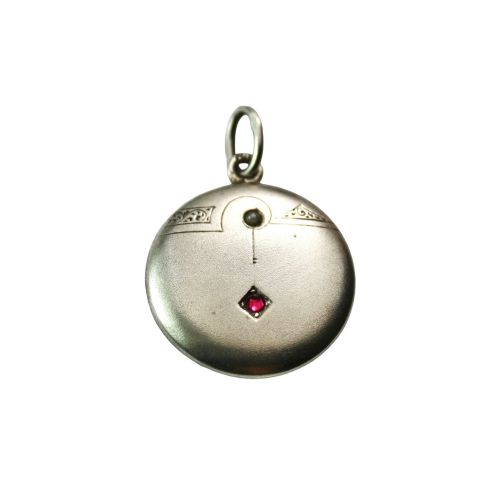


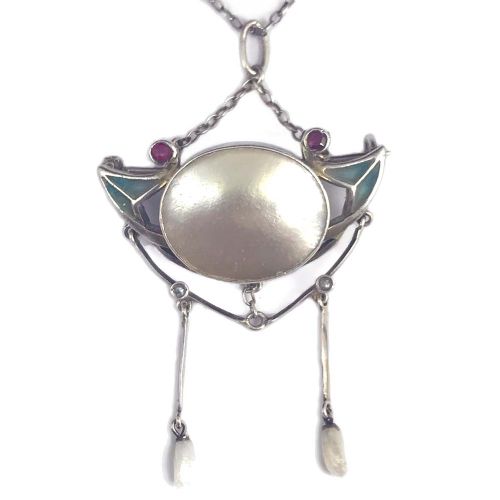

German Silver Necklace
A german silver necklace brings together striking modernist designs and intricate turn-of-the-century craftsmanship.
German Silver Necklace
The selections you meet here display prominent Art Nouveau, Art Deco, and Mid-Century Modernist styles. Makers utilise these aesthetic frameworks to produce varied forms incorporating intricate metallic structures and suspended decorative elements.
You will notice that many examples integrate multiple artistic traditions, bridging delicate floral motifs with geometric modernist geometry. This variety ensures that each piece offers a distinct visual character rooted in its specific decade of production.
How they were made
Artisans constructed these pieces using silver and silver gilt as the primary metallic foundations, often incorporating specialised alloy compositions. The fabrication techniques rely heavily on detailed metalwork to shape the distinct pendants and chain links.
Master craftsmen applied plique-à-jour enamel and landscape enamel to create translucent, stained-glass effects within the metallic frames. Others integrated natural gemstones, paste, pearls, citrine, chrysoprase, hematite, amazonite, and mother-of-pearl to enhance the visual depth.
What varies in quality
The finesse of the enamelwork dictates much of the visual standard, particularly in pieces featuring plique-à-jour where light passes through the translucent cells. Superior examples maintain precise control over colour gradients and secure structural boundaries within the metal.
The selection of set materials also differentiates the standard, with natural pearls, matched stones, and fire-gilt finishes elevating the overall execution. Greater attention to the articulation of snake heads, butterfly wings, or modernist geometric planes separates ordinary production from exceptional work.
Wilhelm Fuhner·Levinger & Bissinger·Otto Prutscher·Heinrich Levinger·Martin Mayer·Ludwig Knupfer·Theodor Fahrner·Jakob Bengel·Meyle & Meyer
The German Silver Necklace Glossary
- German silver
- A copper-nickel-zinc alloy that mimics the appearance of sterling silver without containing the precious metal. It provides a durable, lustrous base for mid-century and vintage jewellery designs.
- Plique-à-jour
- An enamelling technique where enamel is applied in cells without a backing, allowing light to shine through the transparent material. It resembles a miniature stained-glass window.
- Silver gilt
- Sterling silver that has been coated with a thin layer of gold over its surface. This treatment imparts a warm, golden hue while retaining the underlying white metal structure.
- Paste
- Hand-cut and polished lead glass used historically to imitate precious gemstones. High-quality historical paste displays remarkable brilliance and precise faceting.
- Chrysoprase
- A gemstone variety of chalcedony that contains small quantities of nickel, yielding an apple-green colour. It frequently appears as a cabochon set within Art Nouveau metalwork.
German Silver Necklace: Frequently Asked Questions
How do I identify Art Nouveau examples?
Art Nouveau pieces typically feature flowing organic lines, natural motifs like insects and serpents, and translucent plique-à-jour enamel. These designs emphasise asymmetry and graceful movement.
Makers from this movement often integrated pearls and cabochon stones to complement the sinuous metallic framework.
What is the difference between silver and silver gilt?
Silver refers to the base white metal used for structural and decorative jewellery components. Silver gilt is that same metal treated with a superficial coating of gold.
This application combines the structural properties of silver with the warm aesthetic appeal of a gold finish.
How should I care for enamel jewellery?
Enamel requires careful handling to prevent scratching or chipping of the glass-like surface. Store pieces individually away from harder metals and avoid harsh chemical cleaners.
Gentle wiping with a soft cloth preserves the lustre of both the metal settings and the delicate enamel cells.