


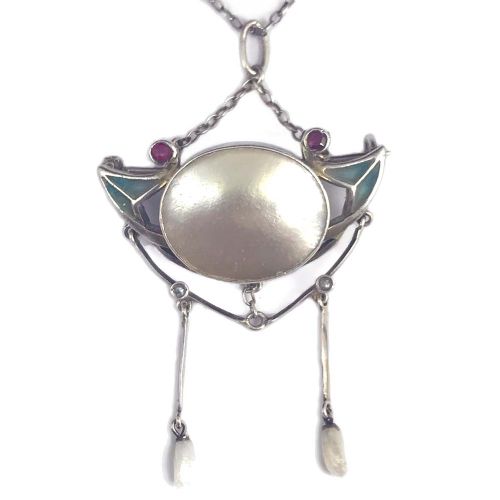


German Jugendstil Pendant
A german jugendstil pendant brings the flowing lines and natural motifs of the turn of the twentieth century directly to the neckline.
German Jugendstil Pendant
When you search for a german jugendstil pendant, you are looking at continental expressions of the Art Nouveau movement spanning the nineteenth century into the nineteen-tens. These pieces translate organic forms, botanical subjects, and insect life into wearable ornaments of silver and silver gilt.
You are most likely to meet silver pendants featuring delicate enamelling techniques alongside pearls, paste stones, and colourful gems like citrine, chrysoprase, and amazonite. The designs range from romantic mirrored lockets to striking butterfly and snake motifs created during the height of the modernist period.
Materials and Craftsmanship
Maker workshops utilised silver and silver gilt as the primary structural metals, often shaping them into flowing, asymmetrical frames characteristic of the style. Gilding applied a warm gold finish to the silver surface, enhancing the rich tones of the stones.
Enamelling sits at the heart of these jewels, with intricate plique-à-jour work creating translucent, stained-glass effects that catch the light without a solid backing. Artisans combined these vitreous enamels with pearls, seed pearls, and cabochon stones such as hematite and amazonite to complete the compositions.
German Jugendstil Pendant Retail Price Guide 2026
Typical asking prices for german jugendstil pendant among the pieces listed under this phrase on Sellingantiques today, from the lower quarter to the upper quarter. They describe what is for sale here now, not the wider market.
Pendants on this page feature both landscape enamels and intricate plique-à-jour techniques alongside stones like citrine and chrysoprase.
Assessing Quality and Design
The distinction between standard commercial output and superior work rests on the ambition of the design and the execution of complex enamelling. Pendants featuring meticulous plique-à-jour panels require exceptional technical skill to prevent cracking and to achieve even translucency across the metal cells.
Superior examples also demonstrate a harmonious integration of materials, where stones like chrysoprase, citrine, or pearls complement the organic curves of the silver rather than simply filling space. The presence of documented designer attributions further separates notable workshop pieces from anonymous production.
Wilhelm Fuhner·Levinger & Bissinger·Otto Prutscher·Meyle & Mayer·Heinrich Levinger·Martin Mayer·Ludwig Knupfer·Theodor Fahrner
The German Jugendstil Pendant Glossary
- Jugendstil
- The German counterpart to the Art Nouveau movement, named after the Munich art magazine Die Jugend. It is characterised by sinuous, plant-inspired lines and a rejection of historic revival styles.
- Plique-à-jour
- An enamelling technique where the enamel is applied without a backing, similar to miniature stained glass. This allows light to shine directly through the coloured vitreous material.
- Silver Gilt
- Silver that has been coated with a thin layer of gold. This treatment provides the warm appearance of solid gold while maintaining a silver base.
- Paste
- Hand-cut and polished glass used as a gemstone substitute in antique jewellery. High-quality paste exhibits strong refraction and vibrant colour.
- Cabochon
- A gemstone shaped and polished with a smooth, rounded surface rather than faceted edges. This style is frequently used for opaque stones like chrysoprase and amazonite.
German Jugendstil Pendant: Frequently Asked Questions
What is a german jugendstil pendant?
A german jugendstil pendant is an ornamental jewel created during the Art Nouveau period, typically featuring silver, enamel, and natural motifs.
These pieces reflect the continental design philosophy of the early twentieth century, focusing on flowing organic lines.
How do I identify a jugendstil piece?
Look for characteristic design elements such as whiplash curves, stylised flowers, insects, and naturalistic female forms.
The use of plique-à-jour enamel and cabochon stones is also typical of this continental aesthetic.
Were these pendants made of solid gold?
Most examples from this period utilise silver or silver gilt rather than solid gold. Silver provided a bright, accessible canvas for intricate metalwork and colourful enamels.
The gold wash on silver gilt items offered a richer contrast against translucent enamel panels.
How should I care for antique enamel jewellery?
Antique enamel requires gentle handling because the glass material can be sensitive to sharp impacts and harsh cleaning chemicals. Store your pendant separately to prevent scratches from other items in your collection.
Clean the metal and stones lightly with a soft cloth, avoiding prolonged immersion in water or liquid dips.