
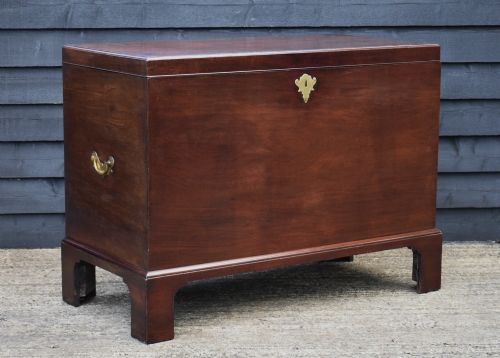

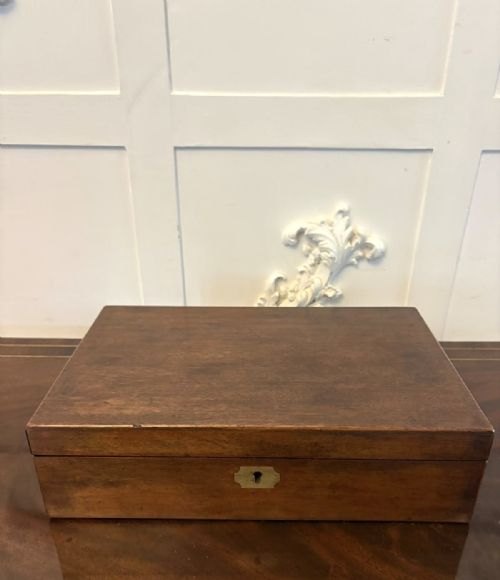


Georgian Wooden Travelling Box
A georgian wooden travelling box brings portable order to the road, built from sturdy timbers to survive carriage and ship.
Georgian Wooden Travelling Box
A georgian wooden travelling box encompasses sturdy trunks, military chests, fitted writing slopes, vanity cases, and specialised apothecary containers designed for mobility. These utilitarian vessels emerge from periods spanning the Georgian era into the Regency and Victorian years, reflecting a time when possessions travelled securely.
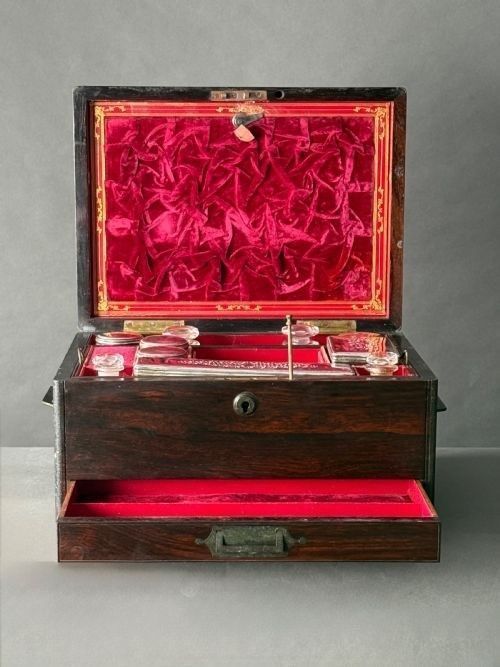
Mahogany and oak dominate the visible inventory, alongside rosewood and elm, often reinforced with iron or brass mounts and hinges. Interiors frequently reveal fitted compartments, secret drawers, and original glass bottles tailored for specific daily or scientific needs.
The versions most commonly met on this page include mahogany writing slopes with fitted interiors, rosewood vanity boxes, and larger oak or hide-bound travelling trunks. Each piece demonstrates how personal gear, documents, and medicines were organised for transit during the late eighteenth and early nineteenth centuries.
How these pieces were made
Cabinetmakers constructed these boxes using dense hardwoods such as mahogany, oak, rosewood, and elm, selecting timber capable of withstanding the rigours of coaching and shipping. Surfaces were polished to highlight the natural grain, while structural corners received heavy brass or iron reinforcement to absorb impacts.
Internal spaces required precise joinery to accommodate fitted compartments, folding writing surfaces, and secret drawers without compromising the outer shell. Delicate items like apothecary bottles and scientific instruments rested securely within custom wooden dividers lined with velvet.
Listings feature oak, mahogany, rosewood, and elm, frequently strengthened with brass and iron mounts.
What varies in quality
The distinction between standard utility items and superior examples lies in the complexity of the interior architecture and the grade of timber selected. Finer pieces integrate secret compartments, flush brass carrying handles, and secondary woods like mahogany throughout the internal carcass rather than common deal.
Survival of original fittings such as glass bottles, velvet linings, and working locks significantly elevates an object's integrity. The precision of the brass binding and the tightness of the dovetail joints further distinguish ordinary road trunks from bespoke gentleman's or lady's travelling chests.
Samuel Porter·Seabrook of St.Pauls London
The Georgian Wooden Travelling Box Glossary
- Writing slope
- A portable box with a hinged, slanted lid that folds down to form a writing surface, typically housing inkwells, pen trays, and hidden compartments underneath.
- Campaign apothecary box
- A compact wooden chest fitted to transport medical bottles, scales, and remedies safely during military campaigns or long journeys.
- Vanity box
- A portable dressing table case equipped with compartments for cosmetics, brushes, and mirrors, designed for use while travelling.
- Secret compartment
- A hidden drawer or concealed space built into the woodwork of a box to secure valuables, letters, or currency.
Georgian Wooden Travelling Box: Frequently Asked Questions
What were georgian wooden travelling boxes used for?
These boxes served as portable storage for personal correspondence, grooming items, medical supplies, and valuables during long journeys by coach or ship. Owners relied on them to keep essential tools and documents organised and secure away from home.
Different formats catered to specific needs, from large hide-bound trunks for clothing to compact mahogany slopes for writing letters on the move.
How do I identify a Regency box?
Regency boxes often feature cleaner geometric lines, dark rosewood or polished mahogany veneers, and restrained brass inlay or corner mounts. They frequently date from the early nineteenth century and reflect the neoclassical tastes of the period.
Examining the secondary woods inside and the style of the brass hardware helps confirm this specific era of manufacture.
Are fitted interiors common?
Many writing slopes and vanity cases retain their original internal partitions, small drawers, and compartments designed for specific accessories. These layouts often include velvet surfaces and dedicated slots for inkwells or glass bottles.
Complete internal fittings greatly enhance the character and historical context of the piece.
What woods were used in construction?
Cabinetmakers primarily utilised durable hardwoods including mahogany, oak, rosewood, and elm to withstand the demands of travel. These timbers were chosen for both their structural strength and their rich grain patterns.
Iron and brass were frequently added to reinforce corners and edges against heavy handling.