
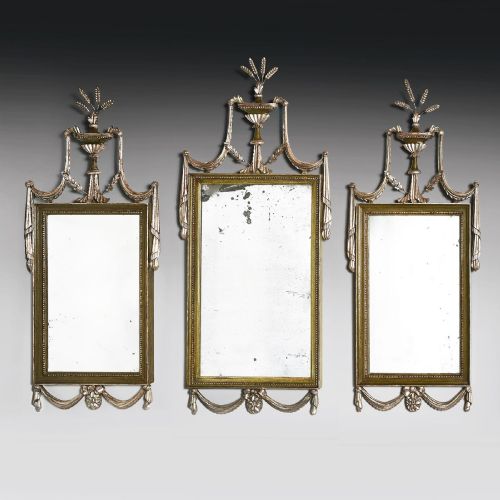
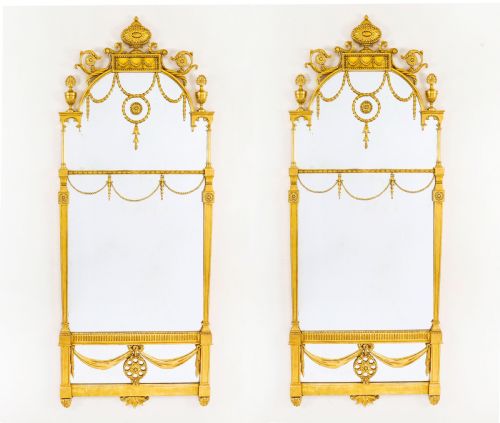


Georgian Urn Cresting Mirror
A georgian urn cresting mirror brings neoclassical balance and height to a room through crisp architectural framing.
Georgian Urn Cresting Mirror
A georgian urn cresting mirror provides a striking wall hanging defined by symmetrical neoclassical lines and classical ornament. These pieces typically take the form of vertical wall mirrors featuring distinct carved crests at the top.
Buyers encountering this group will mostly find pieces from the eighteenth century alongside later nineteenth and early twentieth century revivals. The selection spans Adam style pieces, Regency revivals, and French neoclassical interpretations.
Wall mirrors in this category function as principal focal points in formal rooms. Their proportions draw the eye upward, making them particularly effective above mantelpieces and console tables.
How they were made
Maker workshops built these frames using timber foundations enriched with gesso to hold sharp decorative relief. Craftsmen then applied gold leaf or silver leaf to the prepared surfaces.
Mirrored glass plates are set within these ornate wooden frames, often accompanied by hand-carved urn motifs at the crest. The construction methods combine structural joinery with delicate surface ornamentation.
Listings feature wall mirrors spanning from the eighteenth century through to the Edwardian period in Giltwood and Gesso.
What varies in quality
The sophistication of the carved detail sets the finest examples apart from standard workshop production. Crispness in the gesso ornamentation and the depth of the gilding indicate superior craftsmanship.
Proportion and balance dictate the visual success of the piece. The relationship between the central glass plate and the decorative urn crest determines the overall harmony of the design.
Gillows Of Lancaster
The Georgian Urn Cresting Mirror Glossary
- Giltwood
- Wood carved and coated with gold leaf. This finish creates a luminous reflective surface that catches natural light in a room.
- Gesso
- A plaster mixture applied to wood frames as a base for gilding. It allows carvers to achieve fine decorative details.
- Neoclassical
- A style drawing inspiration from classical antiquity. It emphasises symmetry, straight lines, and motifs such as urns and husks.
- Urn
- A classical vessel shape frequently used as a decorative finial. In mirror design, it anchors the central cresting.
Georgian Urn Cresting Mirror: Frequently Asked Questions
Where should I hang a georgian urn cresting mirror?
These mirrors suit principal reception rooms where their height can be fully appreciated. Placing them above a fireplace or sideboard creates a balanced focal point.
Ensure the wall construction can support the weight of a giltwood frame. Hanging them at eye level maximises their decorative impact.
How do I identify a revival piece from an 18th century original?
Examining the construction methods and the backing boards helps reveal the age of the piece. Revival pieces often date from the Victorian or Edwardian eras while imitating earlier neoclassical designs.
Material patination and the wear on the mirror glass provide further clues to dating. Consulting the specific period attribution in the listing clarifies the origin.
What styles are associated with these mirrors?
Adam style and Regency revival are frequently seen among these pieces. They draw heavily on French neoclassical vocabulary.
Characteristics include symmetrical frames, architectural mouldings, and the signature urn crest. These elements reflect changing tastes across the eighteenth and nineteenth centuries.
How do I care for giltwood and gesso frames?
Dust the frame gently with a soft, dry brush to prevent accumulation. Avoid commercial cleaning sprays and moisture which can damage the delicate leaf finish.
Keep the mirror away from direct sunlight and fluctuating humidity. Stable indoor conditions preserve both the timber and the gilded surface.