




Georgian Telescope
A georgian telescope is a precision optical instrument crafted for navigation and astronomy, prized for its combination of brass, mahogany, and fine glass optics.
Georgian Telescope
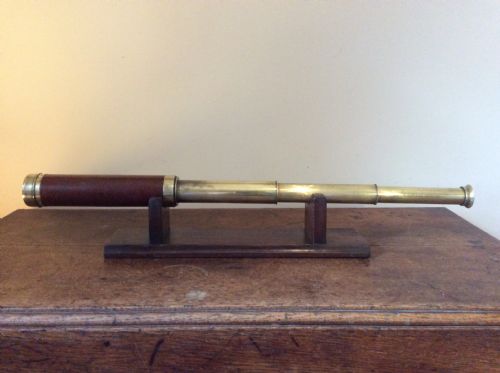
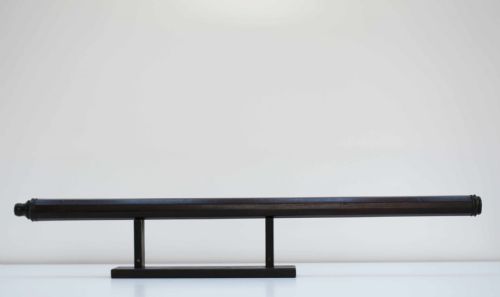
A georgian telescope represents an era of scientific discovery and maritime expansion, combining brass and mahogany in portable and library formats. These instruments range from small pocket versions to larger library models mounted on stands, reflecting the period's demand for accuracy.
Most examples found on this page date from the eighteenth and nineteenth centuries, including items from the Georgian, Regency, and Victorian periods. Makers in London and Edinburgh produced these instruments using materials such as leather, wood, and silvered metal alongside brass.
Forms vary from standard three-draw designs to more unusual configurations like decagonal and nine-sided barrels. Scientific instruments of this type served both terrestrial navigation and celestial observation, making them practical tools of their time as well as decorative objects.
Materials and construction
Makers constructed the body tubes of a georgian telescope primarily from turned mahogany or wrapped leather, often reinforced with brass draw tubes. Cardboard and walnut also appear in the construction of barrels and cases.
Optics relied on glass lenses fitted within brass housings, sometimes finished with silvered metal details for gradations. Precision machining allowed the draw sections to slide smoothly while maintaining optical alignment.
Georgian Telescope Retail Price Guide 2026
Typical asking prices for georgian telescope among the pieces listed under this phrase on Sellingantiques today, from the lower quarter to the upper quarter. They describe what is for sale here now, not the wider market.
At least one maker broke away from tradition to build a nine-sided telescope, proving that even eighteenth-century opticians enjoyed a geometric challenge.
Assessing quality and execution
Quality in a georgian telescope lies in the precision of its optical performance and the crispness of the maker's signature engraved on the brass draw tube. Finer examples retain their original fitted wooden cases and auxiliary lenses.
The execution of the woodwork, particularly the joinery of the mahogany barrels and the fit of the leather coverings, distinguishes workshop output. Simpler utilitarian instruments differ notably from elaborate library telescopes equipped with dedicated stands.
Nairne and Blunt·W and S Jones·W and T Gilbert·Cary London·Alexander Adie·Matthew Berge·G Adams·John Gilbert
The Georgian Telescope Glossary
- Draw tube
- A sliding section of a telescope barrel that extends to adjust the focus. Multiple draws allow a long focal length to collapse into a portable size.
- Library telescope
- A larger stationary instrument mounted on a tabletop stand for study rather than field use. These typically feature greater magnification and heavier brass mountings.
- Achromatic
- An optical design that corrects colour fringing by combining different types of glass. Non-achromatic versions show distinct colour bands around bright objects.
- Altazimuth mount
- A two-axis mounting system that allows movement in both altitude and azimuth directions. This permitted precise tracking of objects across the sky.
Georgian Telescope: Frequently Asked Questions
What is a georgian telescope used for?
These instruments were designed for navigation, terrestrial viewing, and astronomical observation during the eighteenth and nineteenth centuries.
Captains used them at sea, while scientists and gentlemen employed library versions for surveying and studying the stars.
How do I identify a georgian telescope?
Look for materials characteristic of the period, such as turned mahogany, brass draw tubes, and sometimes leather-wrapped bodies. Signatures and locations engraved near the eyepiece often name London or Edinburgh makers.
Barrel shapes can also vary, with traditional round forms appearing alongside unusual decagonal or nine-sided examples.
Are these telescopes still functional?
Many retain their original glass lenses and can still be focused to view distant objects. The quality of the optics depends on whether the instrument is an achromatic design.
Proper care is necessary when extending the brass draw tubes to prevent strain on the historical materials.
What is the difference between pocket and library models?
Pocket telescopes are compact, multi-draw instruments designed to be carried easily for travel or field use. Library models are substantially larger and typically require a desk stand for stable viewing.
Library versions usually offer higher magnification and finer mechanical adjustments for detailed observation.