
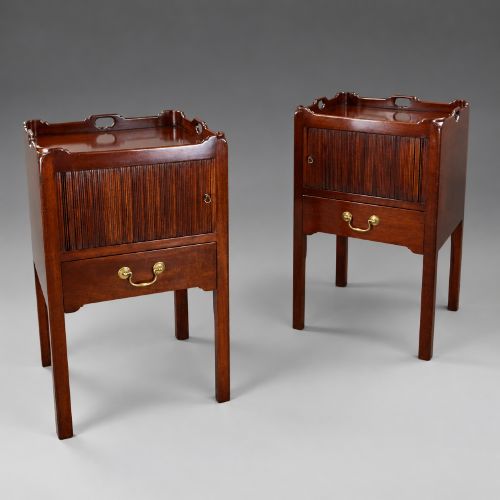
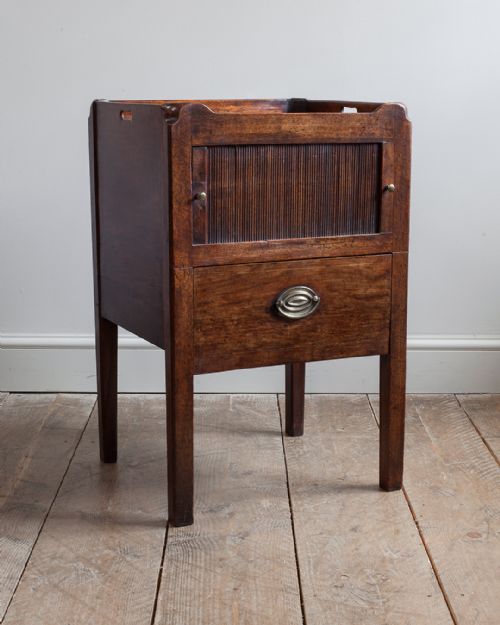


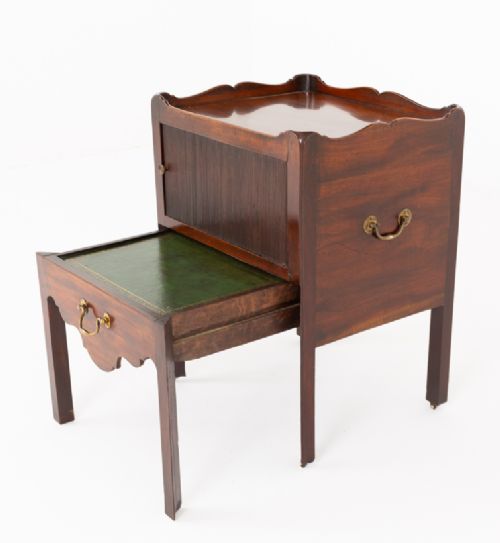

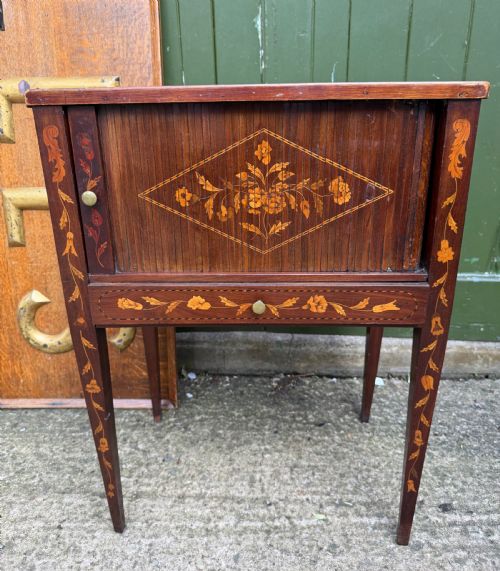


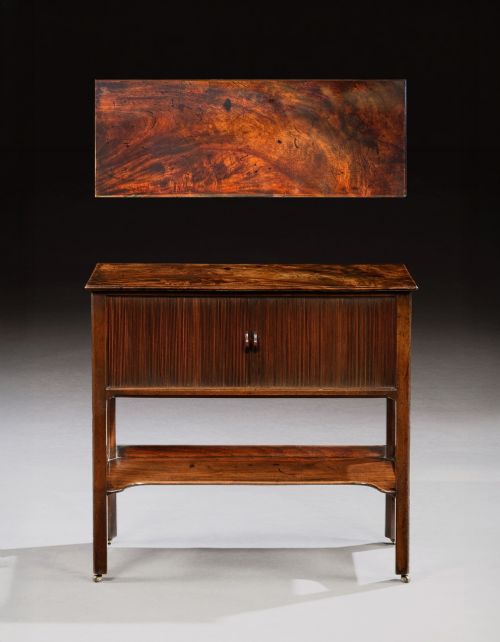
Georgian Tambour Cupboard
A georgian tambour cupboard is a small storage piece offering concealed slatted doors, prized for its clever sliding mechanism and fine timber construction.
Materials and construction
Cabinet makers relied primarily on solid and veneered mahogany, frequently accented with contrasting boxwood inlay, satinwood, or walnut details. Brass hardware such as pulls or hinges appears selectively, while leather occasionally lines writing surfaces or pull-out trays.
The defining tambour mechanism consists of narrow vertical strips of wood glued to a fabric or leather backing, allowing the door to slide smoothly around a curved track. This demanding joinery requires precise alignment so the flexible curtain operates without binding within its housing.
Judging quality and execution
Superior execution shows in the smooth, silent glide of the tambour tracks and the tight alignment of individual slats when closed. Lesser examples suffer from warped slats or stiff runners that resist movement.
Selected timber grain and the crispness of inlay work dictate visual standing. Well-chosen mahogany with rich figuring elevates a standard bedside table into a distinguished collector piece.
Gillows
The Georgian Tambour Cupboard Glossary
- Tambour
- A flexible door formed of narrow wooden strips glued to a fabric backing. This allows the door to slide around curved corners in restricted spaces.
- Commode
- A decorative low cabinet or chest of drawers dating from the eighteenth century or later. The term frequently applies to bedside tables fitted with enclosed storage.
- Tray top
- A raised rim surrounding the upper surface of a small table or cabinet to prevent items from rolling off. These tops often incorporate shaped cut-out handles for lifting.
- Marquetry
- Decorative patterns formed by fitting contrasting veneer pieces onto a carcase. Floral and geometric motifs appear frequently in Dutch and English cabinet work.
Georgian Tambour Cupboard: Frequently Asked Questions
What is a tambour door?
A tambour door consists of thin vertical wooden slats joined together on a flexible backing fabric. This construction lets the door slide smoothly around a curved track to open or close.
Cabinet makers used this method to enclose small compartments in bedside tables and desks where swinging doors would take up too much room.
How do I date a georgian tambour cupboard?
Dating relies on timber choice, secondary woods, and construction methods. Pieces from the eighteenth century typically feature hand-cut dovetails and solid mahogany framing.
Later nineteenth or twentieth-century revivals often display machine-made elements and different internal secondary timbers beneath the exterior veneer.
Were these cupboards meant for bedrooms?
Most of these pieces served as bedside nightstands, commodes, or pot cupboards in period bedchambers. Their enclosed shelving kept chamber pots or personal items hidden from view.
Today, their compact footprint makes them versatile side tables in living rooms or studies as well as traditional bedside cabinets.
What woods were used?
Mahogany forms the primary structure for the vast majority of these cabinets, valued for its rich tone and durability. Cabinet makers enhanced the appearance using boxwood, satinwood, and walnut for decorative inlay.
Secondary woods like oak or pine often appear inside drawer linings and internal framing where the eye does not reach.