



Georgian Style Bowfront Table
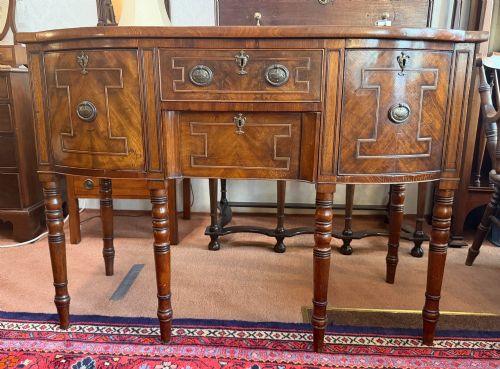
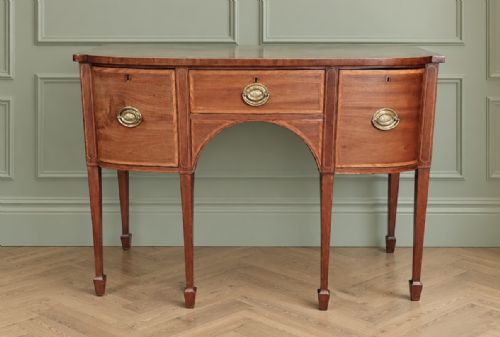
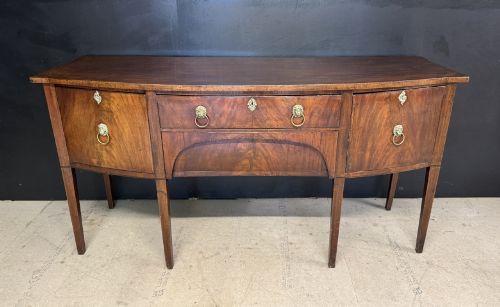
A georgian style bowfront table brings curved mahogany elegance to a room, offering practical surface space and period character.
Georgian Style Bowfront Table
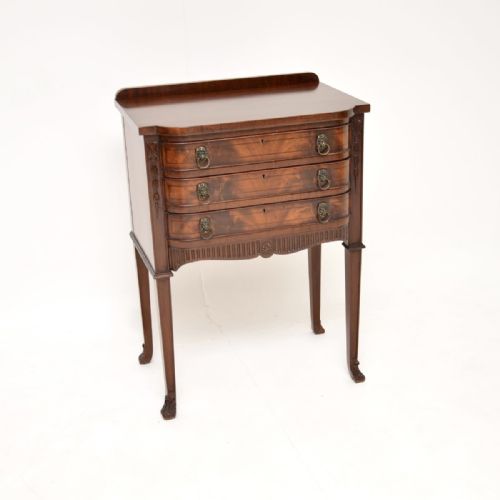
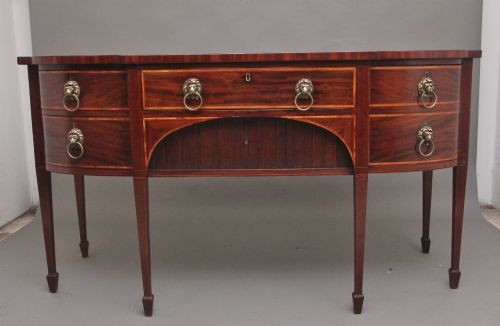
A georgian style bowfront table encompasses sideboards, side tables, and desks defined by their curved front profiles. These items emerge in original eighteenth and nineteenth century incarnations alongside later revival pieces from the Edwardian era and the early twentieth century.
Origins span genuine eighteenth century workshops, nineteenth century utilitarian pieces, and late nineteenth or early twentieth century revival items produced in the Georgian and Sheraton styles. This mix provides options suited to both traditional room schemes and period interior settings.
What varies in quality
Quality separates pieces through the selection of timber and the precision of the cabinetwork. Superior examples display highly figured mahogany veneers and finely executed boxwood or satinwood inlay work that remains intact and flush with the surrounding wood.
Construction methods also dictate grade, with better pieces showing tight joinery in the curved front framing and well-fitted drawer linings. Lesser items may exhibit simpler secondary woods and less refined decorative stringing without the crispness found in superior revival and period work.
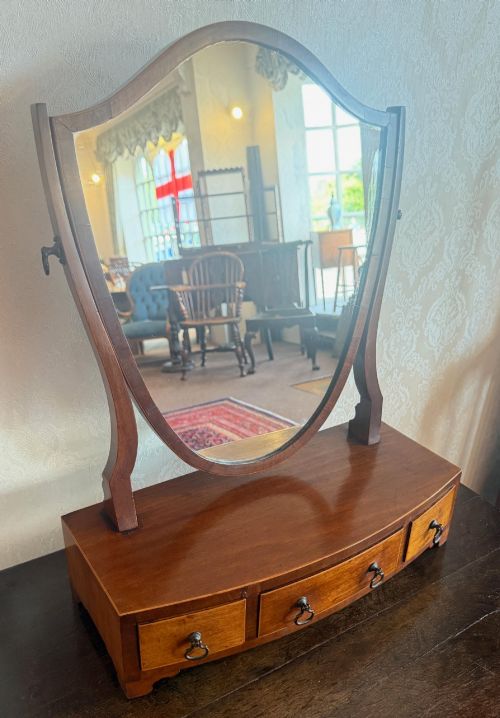
Some nineteenth century dressing table mirrors hide tiny secret compartments behind their swing glass frames for storing small keepsakes.
George Hepplewhite
The Georgian Style Bowfront Table Glossary
- Bowfront
- A convex curved cabinet front that swells outward in the centre. This profile became popular during the late eighteenth century to soften room angles.
- Inlay
- A decorative technique where pieces of contrasting timber like boxwood or satinwood are inserted into recesses in the primary wood. It creates geometric patterns and delicate borders.
- Sideboard
- A large dining room serving piece fitted with cupboards and drawers. Period versions frequently feature the curved bowfront shape.
- Sheraton Style
- A neoclassical furniture style characterised by refined proportions, straight tapered legs, and subtle wood inlay. It draws inspiration from the late eighteenth century designer Thomas Sheraton.
- Satinwood
- A pale, lustrous exotic timber used extensively for banding and inlay details on mahogany furniture. Its golden tone provides a strong visual contrast.
Georgian Style Bowfront Table: Frequently Asked Questions
How do I date a sideboard?
Dating relies on examining the construction methods, timber choice, and secondary woods used inside drawers and back panels. Eighteenth century pieces display hand-cut joinery and native secondary timbers.
Later Edwardian and twentieth century revival items often show machine-cut elements and standardised fittings beneath the traditional mahogany and inlaid surfaces.
Where should I place a side table?
A side table or console fits well in entrance halls, living rooms, or dining spaces where surface area is needed without excessive depth. The curved front allows easy movement in narrow hallways.
Pairing the table with a matching mirror or placing it beneath a picture frame creates a balanced focal point in a traditional interior.
What woods were used?
Mahogany serves as the primary wood for the vast majority of these pieces, providing a rich reddish-brown base colour. Figured variations offer dramatic grain patterns on drawer fronts and tabletops.
Boxwood and satinwood appear as contrasting inlay materials used for delicate stringing lines and decorative banding around the edges.