
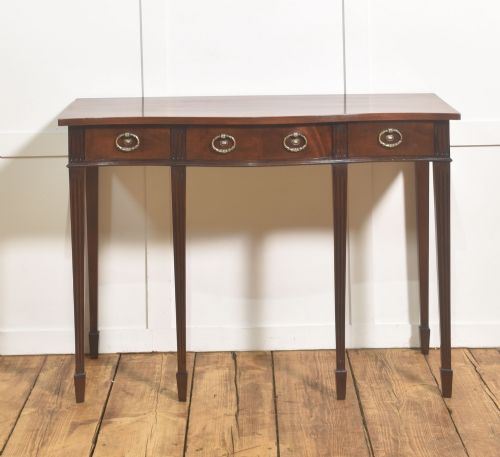
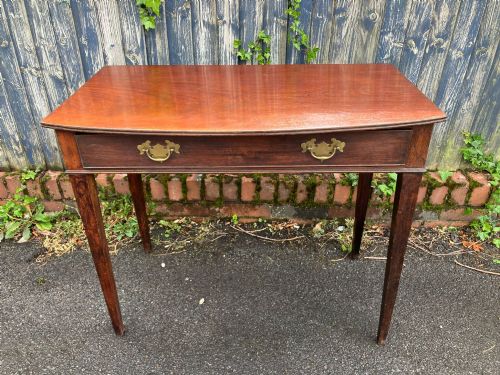


Bowfront Hallway Table
A bowfront hallway table brings a curved silhouette and rich mahogany timber to narrow circulation spaces.
Bowfront Hallway Table
A bowfront hallway table is a narrow surface designed for entryways and corridors, predominantly appearing in mahogany across this selection. These pieces frequently span the Georgian period, the Regency era, and later Victorian or Edwardian interpretations.
Makers shaped these forms as side tables, sideboards, console tables, and small side cabinets to fit tight spaces without losing storage or display area. The curve of the front softens the geometry of a narrow hall while keeping the profile slender.
Most examples rely on the Georgian style, Sheraton influence, or Hepplewhite design principles to govern their proportions and leg placement. Buyers will encounter both genuine 18th and 19th-century antiques alongside later 20th-century revival pieces.
How they were made
Cabinet makers built these tables primarily using solid and veneered mahogany, sometimes supported by secondary timbers like pine. The curved front required careful bending or shaping of the frame to maintain structural strength along the bowed perimeter.
Workshops embellished the mahogany surfaces with boxwood inlay, contrasting wood veneers, and boxwood stringing. Drawer construction often incorporated brass pulls, bone details, and fine joinery suited to daily use in a busy entrance.
Some tables hide tiny bone escutcheons around keyholes, offering a pale contrast to the dark mahogany grain.
What varies in quality
The refinement of the timber figure and the crispness of the boxwood inlay separate standard examples from finer works. Superior pieces display carefully matched grain patterns across the curved drawer fronts and top surface.
Proportion and leg taper dictate visual balance, with better proportions ensuring the table sits lightly in a hall. The integration of the curved drawer boxes within the main frame demonstrates the joiner's skill.
The Bowfront Hallway Table Glossary
- Bowfront
- A convex curved front facade that projects outward in a smooth arc. This shape softens the angles of furniture placed in narrow corridors.
- Inlay
- A technique where contrasting materials such as boxwood are set into recesses flush with the wood surface. It creates geometric borders and decorative motifs.
- Console table
- A wall-mounted or freestanding table with a narrow footprint designed for hallways. These surfaces hold small items or decorative objects near an entryway.
- Sheraton
- A neoclassical furniture style characterised by straight lines, satinwood highlights, and classical ornamentation. Pieces from this tradition value symmetry and refined geometry.
Bowfront Hallway Table: Frequently Asked Questions
Where should I place a bowfront hallway table?
Position the table flat against an entryway or corridor wall where the curved front helps people move past easily. The narrow depth leaves enough clearance for foot traffic while offering a surface for letters or keys.
Ensure the height matches your sightline and any wall mirror placed above it. These pieces anchor an entrance hall without blocking doorways.
How do I identify a Georgian piece?
Examine the timber grain, drawer construction, and secondary woods like pine used on the interior framing. Georgian pieces display hand-cut joinery and proportions rooted in eighteenth-century design.
Compare the leg style and inlay work against established Sheraton or Hepplewhite patterns. Older pieces show natural wear and patination across the mahogany surfaces.
What is the difference between a side table and a sideboard?
A side table offers a simpler open frame underneath with one or more shallow drawers. Sideboards include deeper storage cabinetry designed to hold dining or household items.
In narrow hallways, side tables provide a lighter visual footprint than bulkier sideboards. Both share the curved bowfront shape found across these listings.
How do I care for antique mahogany?
Keep the wood away from direct heat sources and strong sunlight to prevent the mahogany and inlay from drying out. Dust the surface regularly with a soft, dry cloth to protect the finish.
Apply a traditional wax polish occasionally to nourish the timber and maintain its natural lustre. Avoid chemical sprays that can damage antique polishes.