
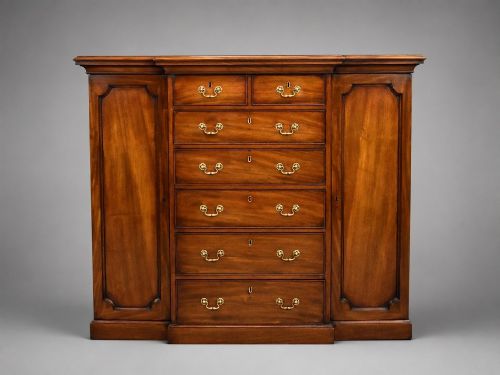


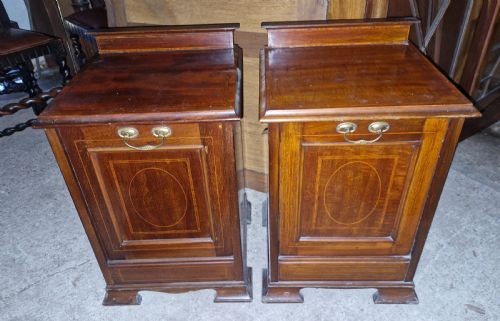


Georgian Storage Pedestals
Georgian storage pedestals encompass compact cabinets, side cupboards and teapoys designed to organise domestic spaces with architectural proportion.
Georgian Storage Pedestals
These georgian storage pedestals cover a functional group of case furniture intended for bedside storage, tea preparation and serving across several distinct periods.
Buyers will encounter bedside cabinets, sideboards, pedestal cupboards and teapoys spanning the Georgian, Regency, William IV and Victorian eras.
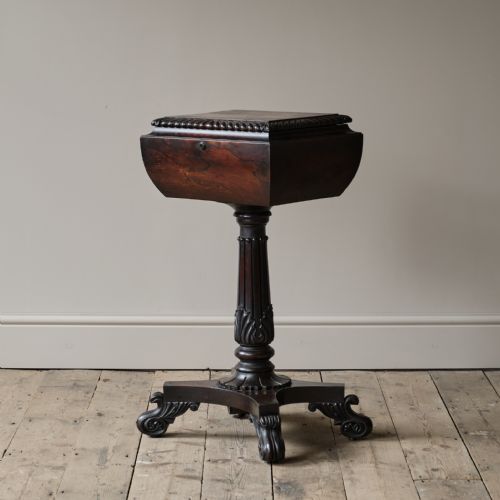
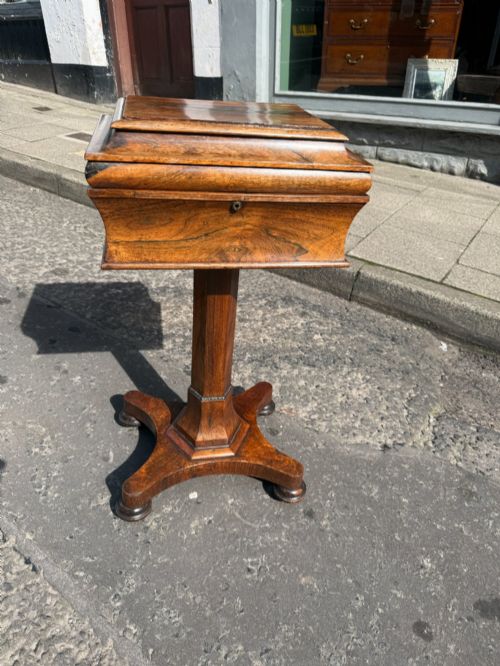
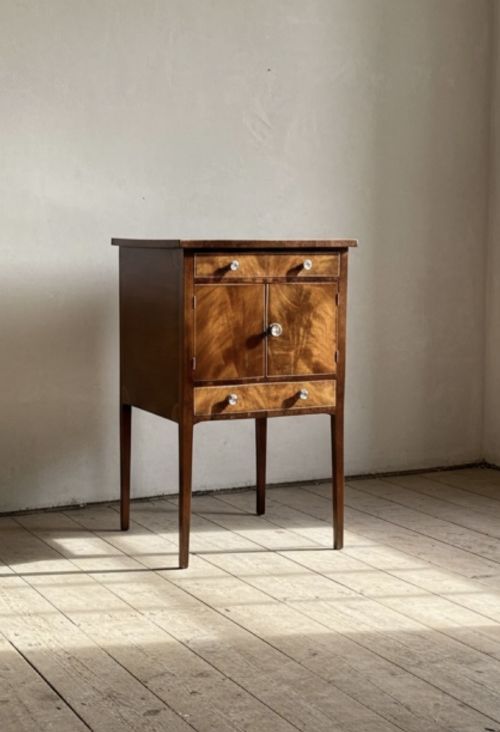
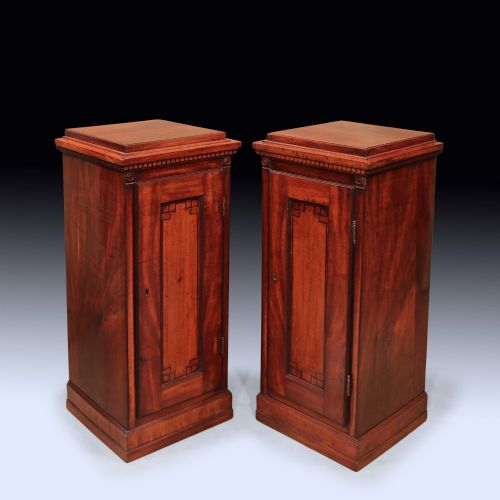
Forms range from sarcophagus-shaped tea caddies and hexagonal pedestal cupboards to bowfront side cupboards and night tables.
Materials and construction
Cabinetmakers utilised dense timbers such as mahogany, flame mahogany veneer, rosewood, gonçalo alvez, walnut and burr yew to construct robust carcases.
Decorative surface enrichment often involved boxwood stringing, ebony inlay and cast brass mounts or handles to accent the timber grain.
Listings incorporate items from the Georgian, Regency, William IV, Victorian and Edwardian periods, constructed primarily in mahogany and rosewood.
Standards of craftsmanship
The degree of refinement in timber selection, particularly the choice of figured mahogany or exotic veneers, dictates the visual weight of each piece.
Precision in joinery, the integrity of internal compartments in teapoys, and the crispness of carved details or inlay separate standard utility items from finer workshop output.
Gillows
The Georgian Storage Pedestals Glossary
- Teapoy
- A small box or chest mounted on a central pillar and feet, originally used to store loose tea leaves. They often feature internal lidded compartments and mixing bowls.
- Pedestal cupboard
- A single-door freestanding cabinet designed to fit beside a bed or in a corner for discreet storage. These often display panelled doors and plinth bases.
- Sarcophagus
- A monumental coffin-like shape with a convex lid and sloping sides, adapted during the Regency period for decorative tea caddies and wine coolers.
- Stringing
- A narrow inlay of contrasting timber used to outline drawers, tabletops and cabinet doors. This technique provides delicate linear definition to flat surfaces.
Georgian Storage Pedestals: Frequently Asked Questions
What is a teapoy used for?
A teapoy served as a portable or stationary container for storing expensive tea leaves securely under lock and key in the parlour.
Inside the box, small lidded canisters kept green and black teas separate, while a glass bowl permitted the blending of leaves before brewing.
How do I identify a Regency cabinet?
Regency cabinets often display architectural symmetry, bold rosewood or mahogany grains, and restrained use of brass inlay or ebony stringing.
They draw inspiration from classical antiquity, favouring clean geometric lines over the ornate carving typical of earlier periods.
Are bedside cabinets original to the Georgian era?
True Georgian bedside cabinets were built as night tables or pot cupboards to house chamber pots and nighttime necessities.
Many examples found today date from the early nineteenth century and the Victorian period, reflecting the evolution of bedroom furniture.
How should I care for polished mahogany?
Polished mahogany requires protection from direct sunlight and excessive moisture to prevent the timber and veneer from fading or lifting.
Regular dusting with a dry, soft cloth preserves the natural lustre of the wax finish without building up heavy residue.