
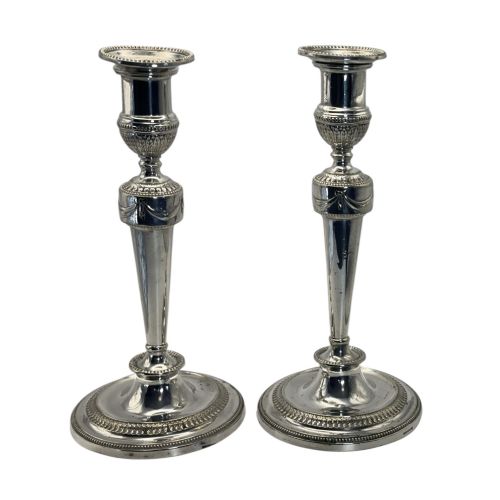
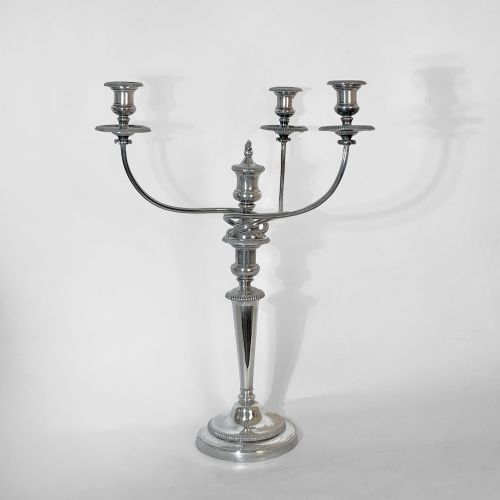
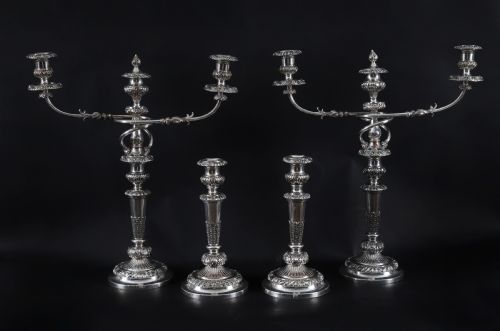
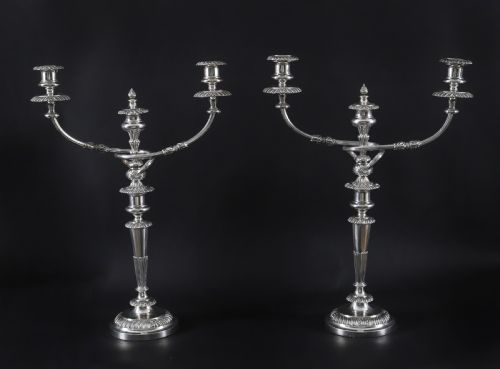
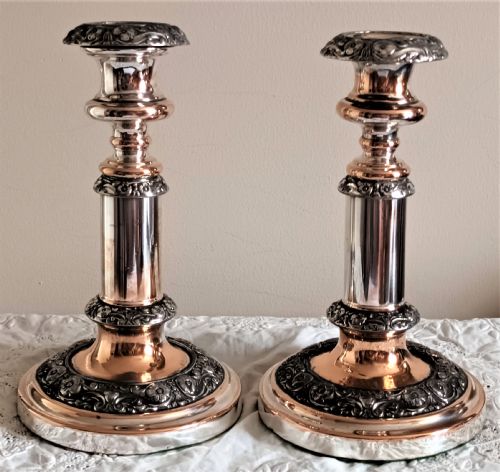
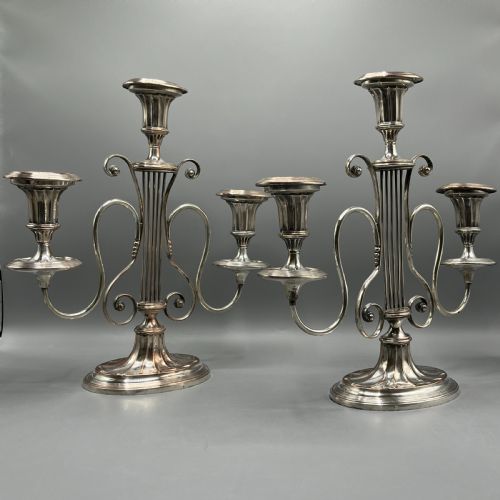


Georgian Silver Plate Candlesticks
Georgian silver plate candlesticks bring warmth to a dining table through the rich lustre of fused metals and traditional forms.
Georgian Silver Plate Candlesticks
When you search for georgian silver plate candlesticks, you encounter lighting designed to illuminate formal rooms during the eighteenth and nineteenth centuries. These items include standard single-light shafts, extending telescopic designs, and multi-light branching candelabra.
The pairs and sets originate from the Georgian era through to later revivals, utilising foundational metals shaped into classical columns, fluted stems, and circular bases. Many examples retain removable drip pans known as sconces, which catch melting wax during use.
On this page, the standard offering spans Old Sheffield plate produced by fusing silver and copper, alongside later electroplated nickel silver and standard silver plate. Pairs dominate the selection, often accompanied by matching chambersticks intended for bedroom illumination.
How they were made
Makers of Old Sheffield plate created these items by fusing a thin sheet of silver to a thicker copper ingot under heat, then rolling the combined metals into workable sheets. This technique allowed craftsmen to shape complex candleholders while keeping production costs lower than solid silver.
Later nineteenth and twentieth-century pieces rely on electroplating, depositing a layer of silver onto a base of nickel silver or copper using electrical current. Telescopic variants incorporate internal sliding tubes that allowed users to adjust the height of the flame.
Many structural components were cast separately, including decorative bases and capital details, then soldered together before finishing. Workers added weighted bases filled with resin, wood, or plaster to provide stability when holding tall tapers.
Listings feature items spanning from the eighteenth-century Georgian period through to the Edwardian era and the 1930s.
What varies in quality
The standard of a piece depends heavily on the preservation of the original fused silver layer over the underlying copper base. Where copper shows significantly through the high points of the plating, the visual harmony of the object diminishes.
Design complexity and weight separate basic utility lighting from high-status items made for formal entertaining. Superior examples display crisp chasing along the edges and retain their matching detachable sconces without wobble or replacement parts.
Matthew Boulton·Mappin & Webb·Elkinton & Co·Barker Ellis·Blagden, Hodgson & Co
The Georgian Silver Plate Candlesticks Glossary
- Old Sheffield plate
- A material formed by heat-fusing silver onto a copper core before rolling, developed in the eighteenth century. This method produced distinct edges where the copper layer occasionally shows.
- EPNS
- Electroplated nickel silver, a modern base metal combination introduced in the nineteenth century. This process replaced older fusion methods by using electricity to bond silver.
- Sconce
- The removable pan fitted at the top of a candlestick to catch dripping wax. These components are frequently lost or mismatched over centuries of use.
- Telescopic
- A shaft design featuring concentric sliding tubes that permit height adjustment. These mechanisms require precise engineering to function smoothly without jamming.
- Chamberstick
- A low-profile candleholder fitted with a loop handle and a saucer base. These were carried through corridors to light the way to bed.
Georgian Silver Plate Candlesticks: Frequently Asked Questions
Are these items made of solid silver?
These pieces consist of base metals such as copper or nickel silver covered with a layer of actual silver. Old Sheffield plate uses a fused sheet, whilst later items rely on electroplating.
Testing the underside or edges often reveals the reddish hue of the underlying copper core.
Why do some candlesticks extend in height?
Telescopic designs allowed users to adjust the height of the flame to suit different table settings and lighting requirements. The sliding mechanism relied on snug internal friction to hold position.
Finding a matching pair of working telescopic sticks indicates higher original manufacturing quality.
What is the difference between a candlestick and a chamberstick?
Candlesticks stand upright on dining tables or mantelpieces to illuminate a stationary space. They feature weighted pedestal bases designed for stability.
Chambersticks include a saucer base and a loop handle intended for carrying through dark hallways.